Unknown's avatar

About JoeDuck

Internet Travel Guy, Father of 2, small town Oregon life. BS Botany from UW Madison Wisconsin, MS Social Sciences from Southern Oregon. Top interests outside of my family's well being are: Internet Technology, Online Travel, Globalization, China, Table Tennis, Real Estate, The Singularity.

Hurricanes! Not.


I’ve been assuming that Global Warming was in fact contributing to an increase in the severity and number of hurricanes, but wondering if the alarmists had been exaggerating the effects for psychological effect. But here is the NOAA Hurricane data and this more recent NOAA analysis.  Neither suggest any catastrophes are looming. In fact we may have one of the *least* severe Hurricane seasons on record this year unless some big ones are brewing out there in the twinkling eyes of …. mother nature.

Excuse me but I’d like people to separate the politics from the science. Why is this so hard for *scientists* to do these days? I’m rapidly, and with great frustration, coming to the conclusion that it is because alarmism fuels research and focuses more attention on scientists.

Global warming is clear but catastrophic consequences from it appear to be so uncertain, so ill defined that it would be immoral and foolish to base hugely expensive public policy decisons on delaying warming for a few years.

Let’s try an experiment for a few years.

1) Take $80 billion – each year – from our bloated defense and homeland security budgets.

2) Ignore Global Warming

3) Solve *every major human problem* on earth. (The UN estimates that approximately 80 billion per year would solve virtually all major health, water, food problems).
Camp Latgawa


Just back from a fine weekend with other Unitarians up at Camp Latgawa, a Methodist owned camp about an hour into the mountains from Ashland, Oregon. Although I don’t attend “real” church much I really enjoy meeting some of the bright, enthusiastic, and usually fairly old folks who make up our fellowship in Ashland. Talks about astronomy and how the natural world may be seen as encompassing of all human thought and can underpin the notion of “spirituality” were good thoughtful Unitarian fare. Also, by stacking chairs and folding up tables I have redeemed myself and no longer possess the distinction of being the world’s only excommunicated unitarian.

Travel peeps – 1 generation = internet peeps


Asked about my CA trip I noted that my second Google party was not as fun as the first. Free (good) beer and mini burgers only go so far. I think the magic of Silicon Valley is wearing off – in fact this was my second trip down in 4 weeks with a Virginia reunion in between, a nice trip to the ol’ Virginia roots and relatives in the Shenandoah Valley.
There was a fun highlight of being in on a conversation between Google and Microsoft’s key search guys at the Google Party, though no spectacular SEO insights came out of it other than unmasking the main MSNdude poster at WMW (who was talking to GoogleGuy).

One thing I noted is how travel industry folks tend to be 1) friendlier than internet peeps, 2) older, often by a generation, and 3) lacking at internet events. This may serve me well as I push ahead with some travel ideas where I’ll be mashing up some databases with flickr, google video, and maps. I think the Travel industry is so mired in the mythologies surrounding print and TV advertising that it will literally take a new generation of travel professionals to realize the lost online opportunities. With the new sites I’ll be putting more of my money where my mouth is.

SES San Jose – exhibitors are followers, not leaders


Note to middle sized companies that have exhibit staff – you’d probably be surprised to see them in action. Although I’m usually impressed by the people from Google and Yahoo who are typically well informed, enthusiastic, and polite, many of the technology exhibit folks seem poorly informed about the marketplace and too focused on their own pitch and “sale”.

I’d guess that the return on investment is negative for all but a few exhibitors, though perhaps the leads they get at an event like SES San Jose – the world’s top Search related conference – are golden and therefore hugely valuable?

The good news for me is that I now understand *very* clearly that outsourcing any search optimization I want to do would probably be a waste. Some of these places don’t even keep up with the freshest SEO news from Matt , WMW , or even SES. There are some exceptions to this SEO ignorance by SEO companies. I’m always very impressed with Bruce Clay . His approaches reflect recent SEO information. Bruce is always very well informed and helpful even to non-clients. Another exception would be freelance guys like Aaron Wall of SEObook fame. However, I’d say there are only a few hundred people in the world who know enough about SEO to make their insight more valuable than, for example, a clever high schooler who spends a few days absorbing information from Matt Cutts, the Google Guidelines, and Danny Sullivan posts. I’m increasingly skeptical that time spent at WMW and SES forums does more than create noise and confusion. This idea was supported even at a conference party by comments from the real engineers at MSN and Google who post at WMW as “MSNdude” and “GoogleGuy”.

SES San Jose – it’s almost like I’m not … here.


I’m sitting in my San Jose hotel room a few blocks from the Search Engine Strategies conference thinking how much better the information about the conference is … right here on my pc … than at the conference itself.   I’m not knocking SES (yet), just noting that a broadband connection and good website coverage means that even up in my little Oregon town I can “see” the emerging online world as well – in some ways much better – than hanging out in the middle of things here in Silicon Valley.  Microsoft’s MIX06 had more PCs all over the place where SES, like last year, has a long line to check mail unless you want to lug your own pc all over the place.   Also an inconvenience if you want to check up on blogs or conference updates.   The key point?  The virtual 24/7 conference online is rocking, and will only get better over time.

I shouldn’t knock the conference because I’m just an “exhibits only” attendee and SES clearly has emerged as the key search conference.   Also, Danny Sullivan is arguably the sharpest SEO observer in the world and based on comments by some presenters I know he treats his peeps well …

YET …  it sure seems they have the same tired “Our SEO is the best ever” exhibitors and perhaps as many as 60+% of the same presenters show after show, most pretending they are better at or more helpful with PPC and organic optimization results than … a smart high school kid … which is not supported by much evidence I can see, especially on the organic side of SEO.   I do hate to miss Matt Cutts comments and the Eric Schmidt interview but maybe I’ll bump into them at the party at Google tonight.

After going to 3 full Webmasterworld conferences, two SES as exhibits only, and one AD-TECH (where they more-nicely-than-SES allow exhibits people to attend the keynotes which are the best part of that conference), I think Webmasterworld offers the best insights and networking.  One presenter who appeared at both told the WMW crowd he had to dumb down the presentation for SES. Perhaps he says the opposite here, but I think SES, at three times the price, is not even as valuable as a WMW conference for all but a handful of niches such as Vendors, who’ll do better at this venue because they are selling things rather than dispensing quality information.   (Man there are a lot of SEO clueless salespeeps in SEO!)

Of course personal contacts are important, but I know I’ll find some people I know over at the Google Party later this evening.

Steven says I’m insane. OK, but I’m still right.


Steven Berlin Johnson, the clever fellow who suggested that TV and video games often make kids smarter and we should stop fretting so much over screen time, is now defending the indefensible – mainstream journalism.

Here Steven suggests that all sane people would agree that Mainstream, top-down, professional journalism will continue to play a vital role in covering news events, and in shaping our interpretation of those events, as it should. [emphasis added ].

Well, it should NOT play that role because mainstream journalism’s commercial focus, though natural, is NOT healthy. In fact it’s tragic because the interpretations are so misguided and narrow. Blogs can help fix this, and they will.
I replied:

I think, therefore I’m insane?

Your first point – that professional journalism “should” play something like the powerful role it currently plays is as misguided as a Fox News analysis and simply absurd. Mainstream journalism stinks, and is getting worse. Blogs will help fix this deficiency, and hopefully will replace mainstream superficiality with in depth, smart coverage of complex events.

Although blogs are only beginning to challenge the absurd commercial sensibilities of mainstream journalism I have much higher hopes than you that blogger journalists will prevail over mainstream celebrity journalism which reaches new lows every year. (cf many great mainstream journalists who are impressive but stifled by forced brevity).

Mainstream journalism has fallen very far from reasoned analysis of current events. It no longer pays more than superficial attention to critical news events (e.g. “Oral rehydration therapy saves millions”, “Congo War”, “Global Child Welfare”, etc, etc.

Can the long tail wag the big internet dog?


Obviously niches of human interests will be a very powerful force in the shaping of the online world, and it would seem the best way to serve niches, especially a small one, is more along the lines of medium or  small business rather than big biz.  However the mega sites seem to be increasing their share of the action, and are shaping the new access and community tools.

I’m wondering which of the following models, if any, will be most prevalent in the future.  How much will the long tail wag the internet dog ?
Big Corporate Website model:  Yahoo, Myspace, Google, MSN as giant info, tools, purchasing portals, community centers.
Medium Website model:  I see this as content aggregator sites like technorati that serve large niche markets and use Web 2.0 sensibilities to help users slice and dice the overwhelming amounts of online content.

Mom and Pop model:  Local or niche specific info-rich sites where users will spend most of their time researching/buying/socializing.

Obviously there will be all of this and more, but I think the trends are important and it *makes intuitive sense* to me that onliners, especially the next generation, will seek niche specific social interaction that is not handled well by anybody right now.   Big sites mostly lack enough of a human element and sites like Myspace that do have a powerful human element fail to deliver a high quality or info rich experience.

With that in mind I’m off to Silicon Valley to hear 1) pitches from the Search Engine Strategies vendors about how they can get me to the top of the search heap (thanks, but I’ll just take the T shirt for now).  2) Google Party!   Always fun to talk to the search and labs teams there.  They be clever folk.

Opportunity Cost is Knocking


I like to think I’ve got a good intuitive sense of optimizing my investment dollars, but when people ask me how to apply sound investment principles to their potential investments I find it hard to give more than simple equations I do in my head or scratch out on paper. I also caution people to “review your opportunity cost”.

I think the notion of opportunity cost is critical to investment success. Namely, what opportunities from “plan B” investment are you foresaking to invest in plan A?
My favorite investment shortcut is to simply look at the cost of borrowing X dollars vs the expected return on the investment over a very short and a medium term (5-10 year) horizon. If the expected return is close to the cost of the money (or less than that cost which is now about 8% via equity lines) I generally see it as a bad deal.  However, if the expected return is immediate with long term prospects even brighter, such as a rental property with positive cash flow in an appreciating market, then I’m inclined to sign myself up.

Vastly complicating matters are taxes, which vary so much by person, state and circumstance that a great investment for me may be a terrible one for you, and it can even be true that a great investment on December 31 is a poor one on January 1. Due to progressive taxes you need to accurately predict future income (hard) and future tax rates (impossible) to know how all the money will shake out even after a few years.If you are reasonably solvent and can borrow reasonably large sums of money the number of potential investments is enormous, though I generally operate on the assumption that “great investments” are few and far between and bad investments are as common as junk emails. I’m amazed by how many people are sucked into the type of investments (e.g. real estate timeshares) that involve high priced sales staff and expensive pitches, because these generally offer some of the *worst* returns on your money, often even negative returns. Those salespeople need to eat, and in many cases they just ate your lunch. The silly charts that show these as good investments usually avoid the concept of the “present value” of your money (money today is worth FAR more than future money due to interest compounding) and inflate the appreciation rates.

In Hawaii we dragged the kids to a Maui timeshare presentation so I could save $175 on some tickets and I was floored by the intensity of the presentation, which would have included a flight over to Maui had we let it continue (a “free” flight if you bought the timeshare, otherwise we’d have been charged).

We did the same thing in Tennessee timeshares in the Gatlinburg area to save a large amount on Dollywood tix and they were not quite as intense but still had the funny charts which, by ignoring present value and opportunity cost fundamentally distort the investment analysis.

wow, this post got too … long…

Google Party at SES 2006


Tuesday is the 5th annual Google Party in Mountain View at the GooglePlex, one of the biggest social events of the internet year. It’s held in conjunction with the Search Engine Strategies conference at the San Jose Convention Center. I was just down in Silicon Valley about 3 weeks ago for Mashup Camp 2, but I can’t miss the Google Party!

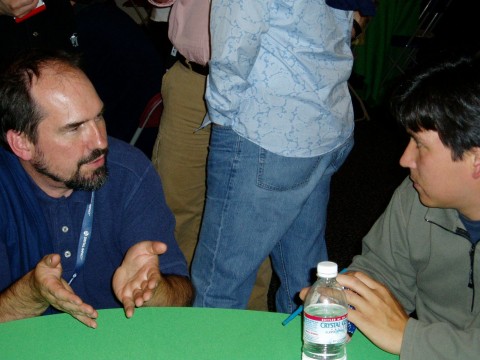
One of the highlights last year was a chance to talk to several of the Google Search Engineers. Here I am pestering Kekoa – I think about 302 vs 301 redirection and ranking items:

Kekoa at Google Party

Matt Cutts is generally in *high demand* at conferences as well as here at the 2005 Google Party webmaster talks, which are held away from the really big crowd outside. In fact in Boston at Webmasterworld he told me he hardly got anything to eat at this 2005 Google bash because he was constantly mobbed.  Thanks to my good friend John for shooting these pix.   He’ll be joining me again this year at the Party.

Matt Cutts at Google Dance 2005