Searches, Searches, get ya 1% of all searches for a billion dollars!


Don Dodge is always doing great, straightforward biz math over at his blog and today is no exception. He looks at Search biz and search revenues and concludes that one percent of the search market is worth about a billion bucks.

I think that the key concept in play right now is “advertising”. This is contrary to many silly protestations of the big players who claim that “user centric computing” is the key to success. I do think that many on the development teams actually believe their own hype, but it’s clear from the behaviors and allocations of resources that ads are the online king and will remain the key development driver for some time.

Can you have ads and good user stuff? Of course you can. Google has done the best job with this though I think they are now on a slippery slope with more ads, more ambiguous ads, and considerable collateral damage in the spam wars, but can you blame them when, as Don points out, there are billions on the table and a lot of potential players waiting for a piece of the search action.

Jimmy Wales on Charlie Rose


Jimmy Wales, founder of Wikipedia, discusses his Wikia search projectand the internet. He’s the chairman of Wikia, Inc. He thinks it’ll be 2-3 years before they have a robust product.

“Democratic, participatory” search project.
“Google, Yahoo, Ask” have similar, proprietary and closed search. He wants to break up the idea that a few companies should be so dominant.

Making search ubiquitous. He thinks Google may not have problems with WIKIA because they can keep matching up ads, advertisers, and buyers as they have been.

Wales thinks Facebook made the right decision to turn down Yahoo’s billion+ offer for Facebook, calling it an “interesting gamble”. “He’s a pretty sharp guy” (Zuckerman), and Wales thinks that unlike Myspace, Facebook is doing right by the customers. Notes increase of spam and advertising intensity of Myspace.

Wikia major initiatives: Search, Reference Works for humor, opinion, sports. 66 languages plus a “Klingon language” project. “Roll this revolution” into many other areas. What makes the internet great is that it’s a “global platform for people to share knowledge”. Keeping it “open” appears to be a key guiding principle for Wales, and his admirable efforts at Wikipedia support his sincerity in that mission.

Wales suggests that Firefox is the best browser, primarily due to features that he sees as the result of the open source development model that created Firefox.    He says that monopolistic activity by Microsoft has slowed innovation, but feels that Google is a friend of Open Source.     Wales recounted telling Bill Gates at Davos that Microsoft search is so bad people are switching away from it as the Vista default, and suggests that he’ll have fun trying to build a better search than Google with Wikia.

Vending machine payment for drink = watch an advertisement!


I love this idea of choosing to either pay for your soft drink or watch an ad and get it for free.    We’ll see a LOT more things like this over time as consumers start to demand that companies cut out the middleman and pay them *directly* for providing attention and the potential to be influenced by advertising.

To me it’s very natural for a consumer to be compensated directly for their attention, It’ll shake up the ad industry in new, fun, and interesting ways.

Google Downrank Penalty


One is torn between respect owed to Google for all they’ve done with search and frustration with their insufficient help/info for downranked sites. I know a small number of folks on the web spam team work to keep “collateral damage” low, but I think what bugs me is the ongoing strong implication that there is very little collateral damage when in fact there is a lot.

Ironically this opaque approach to downranking penalties is what spawns a lot of bad information at many forums and leads to the mistrust of Google that is increasingly common among many of the elite SEOs and webmasters.

The big part of my frustration comes from what I think is a lie, or at best a misleading thing that Google tells sites in the standard emails from Google support, which says that because your site is found in the Google index you have no penalty.

I now believe that by any reasonable definition of “penalty” this is a false and unreasonable statement.

What they really mean by this emails is that your site has no “manual penalty”. A manual penalty is invoked in extreme cases where sites are removed from the index. This is generally for things like hidden text, sneaky redirection, or other SEO tricks banned by the Google Webmaster Guidelines. However, if your site has a big downrank it probably has been penalized by the algorithm in a direct way, probably by a subtraction of points that leads to a much lower score for many/all of the pages in your site.

Here’s a good example of the downranking penalty at our Online Highways Travel site:

Searching Google for “Province of Djizak” it would be reasonable for a user to find this page somewhat high among the results: http://www.ohwy.com/uz/z/zdjizak.htm

Why would a user want this page? It’s highly relevant for the search, leads to more info about Uzbekistan, and our Uzbekistan section was created mostly by a leading travel expert from Uzbekistan who publishes the leading travel magazine for the Silk Road region of Asia.

So, why is this page relegated to obscurity, at position of approximately 190 of 193 results listed? Here it is on the last page of the Google results.

I wish I knew, though I’ve been assured by Google in several emails that we have no penalty when clearly … we do.

Google probably has a right to penalize and re-rank however they see fit, but along with this power and responsibility goes an obligation to tell an unvarnished truth about the status of sites. I used to believe that large sites with high advertising spends were not more likely to get special help than small sites, and to Google’s credit they have historically been good listeners/talkers at events like WebmasterWorld and Search Engine Strategies, but I now wonder if the lines are getting blurred between the advertising and ranking realms at Google. Google probably has the right to do things as they see fit, but please don’t tell me that thousands of small and medium-sized sites with relevant pages aren’t getting penalized and downranked when they … clearly are.

Update: Blogging about this has affected the results – on May 11 this blog post is number one for the term “Province of Djizak”! Our subject page remains very low – about 201 in rankings even though it is *referenced* by the number ONE page for the term (and of course is much more relevant to the search).

This, combined with the Chico the Wonder Dog experiments and a lot of reading and talking with SEO people, leads me to think that the downrank penalty really is site wide and that Google really is sacrificing a lot of good pages like our UZ section to punish us for what they see as undesirable cross linking / thin pages / failure in some cases to use nofollow on links / ?

Update 2: Maybe I shouldn’t complain about the rank? Our Djizzak Province page appears, after all, two places above this, um, highly relevant page for that query: Application of defecation lime from sugar industry in Uzbekistan

Update 3: OK, I have now created what I would argue is the world’s best “Province of Djizak” web page, located at the Online Highways blog. Unfortunately I had a problem changing the title but that page should *at least* rise higher than 200 for a query. Why? Because it is quite a bit more relevant than any others for that term and it now has TWO LINKS from this, the top page for the query “Province of Djizak“. If my hypothesis is correct it will not rise up because it will fall under OHWY’s site downranking penalty.

Update 4: Province of Djizak original OHWY page is now number one at Google for “Province of Djizak”. This is NOT at all consistent with my site penalty hypothesis above. It is consistent with the idea that we need to beef up incoming, new links to get pages re-ranked.

Update 5 (June 1). The original OHWY page is again heavily penalized – number 216 from number 1 yesterday. This, alas, is totally consistent with the sitewide penalty hypothesis I describe above.

Yahoo, Right Media, and the right idea about advertising


Terry Semel, Yahoo CEO, is optimistic about Yahoo’s purchase of Right Media, an advertising network. This, with Google’s recent aquisition of DoubleClick, may be the beginning of the end for agencies specializing in online (and eventually even offline) advertising as it will make it easier for companies large and small to manage their own advertising and relationships. The recent death of Zunch supports this idea although there may have been many other factors in that corporate meltdown.

Semel brings in the concept of *democracy* to advertising and this is a really interesting idea. Historically advertising industry has been driven by aggressive, emotional sales pitches to clients. Even major account activity may be driven less by careful analysis of ROI on campaigns and more by clever cocktail parties and perceptions of brand coolness.

I’d suggest that in most contexts the concept of “branding” is bogus. Sure, there are many global brands have major influence on consumer behavior, but it’s not clear to me that advertising campaigns do a lot to enhance sales based on these brands. There are surprisingly few high quality studies of this, partly because the power of branding is (foolishly) accepted as a maxim in and out of advertising circles. Google, now considered the world’s top brand, hardly spent a dime on branding advertising early on as it was rising to prominence. Google as brand matters a lot, but it’s not clear there is much benefit to *advertising* the brand.

Much of the truth about ads will shake out as these new advertising networks take hold of the marketplace, and it’s going to be a fascinating thing to watch. Using great free tools like Google Analytics, advertisers are already better able to measure campaign success than ever before, and are starting to hold publishers more accountable for results than for throwing good cocktail parties and making hip and cool presentations.

So I’m with Terry Semel – bring on the advertising democracy dudes!

Another victim of Google’s cleverness? Zunch Marketing goes belly up.


I don’t know Zunch, but I’d argue that it’s generally good riddance when overpriced fancy SEM firms go belly up. As Google creates easier, better, and cheaper ways to do great in-house SEM (e.g. Analytics and PPC management) it’s not surprising places are opting for this approach. For the most part the big SEM firms are dramatically overselling types of SEO that cannot be done at all or are best done in-house or with the greater expertise found in small SEM shops and freelancers. My $9600 bad experience with a fancy SEM firm last year led to a refund, but that was thanks to threatening to blog about it and the written guarantee of increased traffic. I think very few get refunds despite generally poor performance.

After a clever and intense process of selling me on the service it was frustrating to watch them apply generally good but obvious principles of SEO. Also frustrating to note that I knew more about SEO than they did from attending a few Webmaster World Conferences.

So, is Zunch the beginning of a new trend? Perhaps a good trend.

Advertising as Snake Oil. Wanna buy a bottle?


Via Aaron Wall an excellent article post by John Andrews suggesting how difficult it is to find legitimate SEO people among the ocean of pretenders and deceivers. There is some irony here though. This point is not lost on many advertisers who now (correctly) view most SEO people like used car salesmen. However a far more important point has been lost in the SEO quality scandals, and that is the fact that in advertising almost all salespeople and agencies are *absolutely* not to be trusted and generally are misinterpreting flimsy research to their own ends. They are not lying to you, they are simply interpreting results to favor their needs rather than yours. You think not? How many times has your agency recommended they be fired in favor of better teams they know about, or made recommendations that cost your agency big money in favor of your success?

Here’s a good advertiser mantra, and it should be repeated with each campaign:

Trust no one.
Independently verify results.
Change spending according to results.

Incredibly, I think 90% of all advertisers don’t use this approach, preferring to treat advertising salespeople and agencies or magazine and TV research reporters as “marketing” experts which of course they are not. Salespeople make money selling their own stuff, not selling success. As long as advertisers fail to follow up with metrics and/or trust the salesperson/ Agency’s claims it’s impossible for them to appropriately adjust the spend and define failure vs success. I used to think this was a problem only in small business, but it’s clear that even the largest corporations often fail to properly test, preferring (I think bureaucratically) to go with comfortable approaches that can be justified to spending committees.

The extreme failures of print and TV advertising (and other forms) to deliver has fueled the PPC revolution, though even PPC often has a negative ROI and testing is needed. Fortunately for those fortunate advertisers who realize how much better PPC will likely be than other forms of advertising it’s easier and cheaper to measure online advertising successes.

I commented over at John’s:
A simply excellent post John, getting to the heart of the challenge facing SEO customers and providers as well as a possible solution – forms of success metrics that are fairly standardized and/or easy to digest.

But good metrics are a gaping void in advertising and have been for decades. I’m often floored by the ignorance of advertisers who think they can count on salespeople to advise them on the effectiveness of the campaigns, which in my sector of travel are often horrible.

I’d suggest that TV and print salespeople are the most conspicuous deceivers, even more than many SEO pretenders. Although I agree that the overwhelming majority of SEO claims are bogus or deceptive, it’s important for advertisers to realize that even a modest PPC campaign, run themselves, will often outperform *their best print or TV efforts*.

Advertising in all forms, for the most part, is a lie. It often fails and people are too mathematically ignorant to discover the problems and realign the spend.

Google barely (corrected from “not”) shading search advertising links!


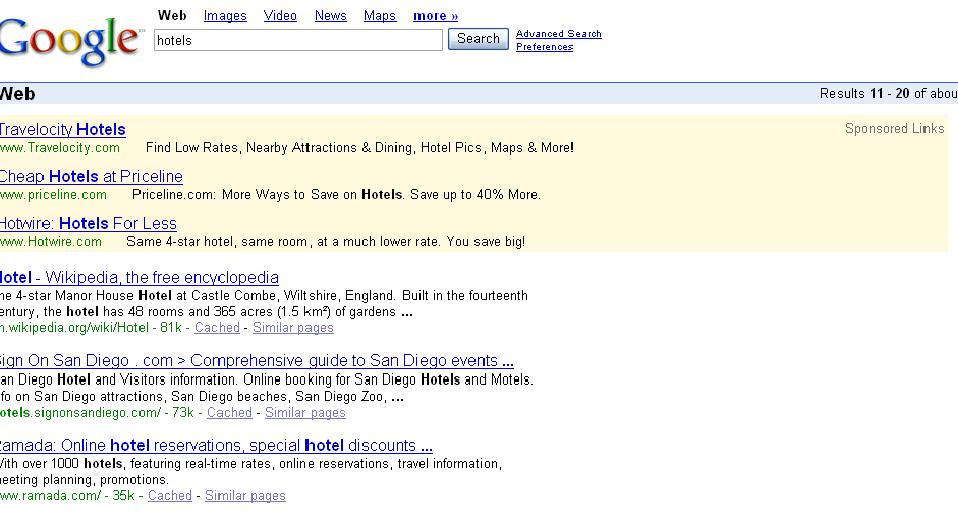
Google is no longer narily, barely shading the advertisements that appear at the top of the organic listings on the left of the search web page. This may be a regional thing or experimental (I’m in Oregon on Charter ISP), but it’s very conspicuous and frankly it makes it very difficult to distinguish between ads and real content.

Although I’ve always held that Google has a right to do this type of thing, I’ve always been frustrated with the pretense that they always take the high road and “don’t do opportunistic things”. This is a huge departure from Google’s previous approach and claims, which suggested how critical it is to separate organic and commercial listings. As this screen shows it is now *impossible* for the user to make that determination. Good for advertisers but bad for users and somewhat misleading.

The FCC actually claims to object to this approach, telling search engines some time ago that they need to make a clear distinction between commercial content and non-commercial.

I’m assuming they are testing the affect on clicks and revenue, and clearly it will be enormously profitable to do things this way as smart users typically look first to organic listings and last to advertising. However, in the long run it challenges the idea that Google’s primary interest is providing “unblemished” results. At the very least Google owes people an explanation here, and if it does not include the fact they’ll make a lot more money this way, and that that was a prime motivation, clear thinkers are going to call foul on this new practice.

googlenoshade.jpg

Google buys DoubleClick for 3.1 Billion


Google as advertising juggernaut continues the aggressive “advertising baron” expansion with today’s purchase of DoubleClick. I doubt it was DoubleClick’s technology that made this attractive to Google, rather the stable of existing advertisers and – perhaps most importantly – keeping DoubleClick away from Google rivals. It seems to me a key part of the Google strategy is to buy technologies and sites like YouTube and DoubleClick to effectively dry up the lake of opportunity for advertising rivals, especially Yahoo and MSN.

Yahoo’s also got good news today with a big newspaper deal, coming on the heels of Yahoo’s Viacom deal. I was surprised Yahoo stock didn’t reflect these positive developments but Yahoo’s stock fate seems to be tied more to the perception of Yahoo as a second fiddle to big and brilliant Google than to developments in the marketplace.

More from NYT 

Google Advertising Rumor


I really appreciate Robert Scoble‘s great insights but I’m skeptical of the party rumor he cited today that suggests this about Google Advertising:

… fewer ads mean less revenue SHORT TERM. But long term the advertising revenue actually goes up. Why? They found their users started trusting the advertising more and were more likely to click on ads.

This is possible but seems unlikely. Heavy users are generally going to want a bunch of ads to quickly scan because Google context matching and user queries are usually not specific enough to come up with the “right” ads.

Revenue per click goes down as you add more ads at lower per click rates so it complicates things as well, but I don’t get the ‘trust’ factor cited by Robert – it just does not make sense to me that Google is effectively training people to click on ads more often by offering fewer ads.

Maybe I’m missing something in this case, but these trends are huge because online advertising is arguably the most significant change in the landscape in decades, and thanks to having accurate conversion measures we are going to see a huge shakeup in the ad world.   That’s a very good thing in an industry that is, to a large extent, based on either misleading people or, at the very least, changing their behavior opportunistically.