
AOL lawsuit over data release and, more importantly, storage of search database of intentions


Over at TechCrunch there’s a discussion about the lawsuit against AOL for releasing search data and also challenging their right to store the search histories of AOL users. I’m surprised this took so long because Google, Yahoo, MSN, etc have been storing all of our searches for some time and probably are using that data to adjust the search experience including refinement to advertising and organic results.

It frustrates me (or I should really say it pisses the heck out of me) that 1) Search engines think they should have rights to my search info with no obligation to tell me what they do with my info and 2) there is a lack of concern in the online community about this. John Battelle has been one of the few voices pointing out that this issue is big and getting much bigger, that these privacy issues need a lot more clarification, and that search companies are sneakily dodging many key issues with search and privacy.

Contrary to many comments I read from other onliners, the Government viewing my data is low on my list of privacy concerns because I doubt they’ll choose to or be able to effectively process the information in sinister ways. However it bothers me a LOT that my search “fingerprint” is getting used without my consent, understanding, or permission in an effort by Google, Yahoo, et al to sell me things and adjust my search and internet experiences.

If they want to do that they need to let me know the process they use to do it. If they think sharing that process violates their need for commercial secrecy then…do NOT use my stuff. I never gave you permission, and you should not assume you have my permission. In fact few people even know that Google and Yahoo and MSN store every single one of their searches – Google, Yahoo, MSN cannot reasonably claim they have implied permission for the search storage identified to individual computer level when very few people are even aware they are doing it!
Relevancy + Targeting = $123,490,000,000


Although this article suggests “infinite” reasons for Google’s success, I’d say there are only two that have made Google worth about 123 billion dollar bills.
The article supports that there have only been two truly notable reasons: A superb PPC model of advertising combined with the most relevant= best search engine to date.

Both the engine and the ad model were largely built by the time of huge expansion.   The story is nicely chronicles in John Battelle’s “The Search”, which also notes how Google’s ad model came about somewhat serindipitously, and basically as a copy of the Goto.com model developed by Bill Gross.  This serendipitous refinement of good ideas  lies at the heart of many great innovations and challenges the idea that greatness comes from stable, consistent, well organized forces of change.

Sure Google has the best technologists, leadership, and corporate culture, but it was the PPC model that was necessary for the success and that is largely ignored in most external analyses (Google knows this all too well).

Good points that without relevancy you’ll lose the audience and the PPC revenues. *Together* these two factors lie at the heart of Google’s success and both are unstable territory, so all are in for more fun in the search sun.

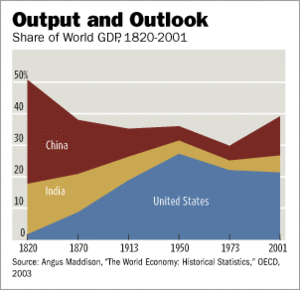
China and India accounted for half the global economy in 1820!


Venture Capitalists make good bloggers because they often have a broad view of the world. I just found this fascinating graph over at Ed Sim’s blog that compares GDP for US, India, and China from 1820 to 2001.

The amazing thing is that back in 1820 India and China together accounted for fully half of the global economy!

What we typically describe now as “the rise of China and India” in the modern economy is actually a *resurgence* of two economic superpowers from their previous dominance. With a little help from … Wal -Mart.
Share of GDP

If you are in it only for the money you won’t get as much … money.


When he’s not coming up with self serving pseudo communities like Squidoo, (am I too harsh? maybe…) , Seth Godin has lots of excellent marketing insights such as this one that suggests the big innovations come from passion about the topic and not from the quest for the holy big buck, which Seth suggests forces people to *stop innovating* too early.  He cites Apple Computer, Google, and others that really do support the hypothesis.

I don’t think this is the *main* story of success however.  I still prefer to view success as an evolution of ideas where 99.9% become “extinct” and .01%  survive due to forces outside of the control of the company – forces like global economics, weather, personalities, lucky timing, zeitgeists, etc, etc.

We tend to look only at “survivors” and forget that an analysis of corporate success would take a large number of company starts and follow them to their demise or success and then look at the factors that led to their fate.

Flickr  even suggests an evolutionary model both as idea and within the company.   Flickr started as a game maker rather than a photography sharing community.   Flickr’s evolution seemed to be a combination of luck, serendipity, brilliance, and (Caterina Fake might say most importantly) her realization of the potential of the “little idea” that became a huge online community.   Also important is that from Yahoo’s perspective Flickr probably needs to generate a LOT more cash before it’ll be considered worth the $20-30 million they paid for it.      Hmmm – I wonder if founders Caterina and Stewart are eyeing Yahoo’s possible 1 billion dollar offer for Facebook with any envy?

“Dear, we should have held out for a hundred million more!”

But as Seth suggested these innovators are not in it for the money so no worries there I’m sure…. hmmmmmm……

Spinach economy losing $1 million per day. A microcosm of global concern overreaction and stupidity.


Who’d have thunk that spinach was a pretty big biz. This article suggests that the spinach scare is losing a million per day for California farmers, some of whom are plowing it all under and laying off workers.

Of course if people are spending this million on *other* healthful veggies than the positive affects may wash out the negative, but it seems more likely they are buying something less healthful. If true the scare may have a (small) but net negative affect on health.

I think the overreaction to such small things offers great insight into how defectively we process the big stuff like global health and welfare, and lesser but still significant things like automobile and gun dangers and heart risks. Part of this is simple mental accessibility – “news” outlets report things that people can latch on to easily and we like “easy to digest” news sound bytes. But that’s no excuse. The news attention deficit syndrome is a perilous approach in these troubled times.

As with the ridiculous overreaction to Mad Cow non-disease, the spinach “cure” – basically nobody eating spinach for weeks or even months – combined with economic problems from the loss of milions of pounds of the crop, layoffs, and hardships in the agriculture sector, is likely going to have a more negative health impact than the problem itself.

When you expand this defective type of analysis to the overreaction to Global Warming and the underreaction to AIDs, Malaria, and Rotaviral diseases in underdeveloped world that kill millions per year the future looks … ummm….. green and leafy?

Clinton Global Initiative


The Clinton Global Initiative is tackling the world’s major problems. It’s a great effort with the backing of one of the world’s most effective superpower schmoozers, Bill Clinton. Although I’d suggest that the Copenhagen Consensus is a more rational way to prioritize spending, Clinton’s group is far more likely to bring big money and big corporations and Government interests to the table.

Today’s announcement is that Richard Branson will donate 3 billion towards reduction of Global Warming via the Clinton Global Initiative. Although I’d much rather see the group put more towards current catastrophes at least this donation is consistent with the notion that big providers of greenhouse gasses like Branson’s many transportation interests should do the most to alleviate the effects of those gasses on the environment.

Perhaps my friend Linda was right to suggest that some people will support Global Warming initiatives in ways they won’t get behind those confronting global poverty. If we can do it all that’s great and for the first time in my life I do think there is a great, driving force on the part of most people, policy makers, and even Governments to initiate “Global Improvements”. Let’s do it!

Maple Syrup Memories. Sappy, but very sweet.


TourPro got me thinking about New York’s Adirondack Mountain country where I grew up. His site is an excellent guide to that region. Then my old pal Tom, who really should write more often in his blog because he’s a great wordsmith, reminds me that Maple collection is in the spring, not fall. Funny because I’d blended the memories together, maybe simply under the category of “maple tree stuff”?

I actually remember (at least I *think* I remember) picture perfect scenes like this from the woods a short drive out of Plattsburgh, NY. Image is from Dale’s Ponies Gallery:Sap horse

The more newfangled approach lacks the romance, but probably pulls a lot more sap out of the trees.Maple trees with the bucket system seem to use the difference between the pressure in and out of the tree via the tree’s transpiration system.  Hey, DOW makes the filters for this gadget. Why don’t the put THAT fact in their ad campaign with a few horses and maple sap buckets and sugar shacks and I wouldn’t be reminding people of their sordid chemical past.

Sap Extractor

Dow’s Advertising … creepy or cool?


The DOW Chemical TV and internet ad campaign about “The Human Element” always strikes me as odd, though I think in some ways fits with my Dad’s excellent notion that advertising often talks about a company’s weaknesses as if they were strengths. Using people and faces in an attempt to get across the point that DOW is about people, not chemicals and technology, backfires for me and gets me wondering “what are they trying to hide here?”.

Maybe it’s a generational thing as I always make the Vietnam era “Dow = napalm” reference which in turn leads to the world famous photo of a Vietnamese girl burned by napalm.

DOW can hardly lay much claim to moral, people focused “high ground” but I also don’t buy into the narrow vision of corporations as heartless. Somewhat like people, a corporation is a curious blend of innovation, competition, selfishness, profiteering, good will and more. I believe corporations are as much a reflection of the forces that built that particular company (the “corporate culture”) than subject to standard rule sets. This suggests that DOW may be a bit off with their version of the old Coca Cola campaign about the world singing together.   In fact it kinds of creeps me out like the people in invasion of the body snatchers – is anybody even SMILING in those commercials?

The death, and rebirth, of user generated content is coming to a home theater near you


I think it’ll take a few years for regular folks to figure out ways to measure the value of their content and for many to even understand the value of what they give away to many sites for free.

User content contributions to  Facebook,  travel sites, myspace, Google, Yahoo, and many many more make up what I think is an increasing share of the total value of all web info.   When people understand this it may – it certainly should – change the internet landscape and hopefully shift more control from big companies to regular users.    It also may increasingly commercialize the landscape, which is probably not a good thing though the world has never seen a very democratic and global commercialized landscape controlled by any old mom or pop who sticks up a site.   It’ll be interesting to say the least.

To one extent this has already begun with Google adsense allowing publishers to share in revenues, but note that Google itself is built on the backbone of billions of web pages they didn’t have to create.
Most of their money comes from people using Google to search *other peoples stuff*.    When will Yahoo or Microsoft wake up to the fact that people will abandon Google search quickly for a variety of reasons including inferior quality, change in habit, inconvenience (Vista Search!?), or payment to use alternatives (cha-ching!).   Seems to me that Ask is doing a better job of changing habits than Yahoo or MSN though I haven’t checked the market share numbers to see if ASK’s massive ad campaign is working.

The current thinking by most Web 2.0 sites is that if you create a high traffic community site you’ve got it made, and that has certainly been true with Myspace, Facebook, Flickr, and many more.   However users may soon start to realize that the content is more valuable than the  consolidation of that content.

You might suggest that Adsense recognizes this since it a pays publishers about 70% of the ad click revenue from their sites.   However this does not factor in that the collective site content around the world, indexed by Google et al, is the big money ticket.   Google shares none of the revenue they get when somebody clicks on ads presented after a search at Google even though they’d have nothing to show if, say, the collective internet world did what the news agencies are starting to do – challenge Google’s right to present their content.

John Battelle’s Federated Media understands this and is providing mechanisms to better monetize high value content.

However it’s the low brow stuff that brings the big money and I wonder how long before banners above sites will read “Webbers of the World Unite!”

Survival of the pro-fit-test


Biological evolution is a complex process with simple underyling truths. Perhaps the most profound of those evolutionary truths is that evolution works AWAY from failure rather than towards success.

Thus you don’t have ‘pinnacles’ of evolutionary success represented by super great creatures , rather you have change branching out in many directions, with success best defined in terms of how well a creature manages to adapt to an environmental niche. For every successful creature there are many who died, failing to adapt successfully to the conditions of a niche, or failing to adapt *as well* as a competing creature who then scarfed up the niche’s available resources leaving the less well adapted ones out to dry, and often to die.

What if we apply this notion of succcess and adaptation to the rapidly evolving Web 2.0 business community? In that realm of business innovation millions of ideas become thousands of “good” ideas and then hundreds of ‘great ideas’ that do a great job of exploiting circumstances.

In this business evolution “survival of fittest” becomes survival of the the profit-est, though it may still be too early to define “success” in terms of profits since many highly innovative companies have not shown anybody the money, rather it’s assumed that their huge traffic and community support will eventually yield high profits. (A risky but reasonable assumption).

More importantly if evolutionary principles are applicable to business processes it means that we’ll see a LOT more failures than successes, and we may have trouble predicting the winners until the game is over and they’ve already won.

Rather than a product of elaborate, complex planning and innovative think tank thinking we may see that success crops up in unusual and unpredictable spaces where it is not careful plans and execution that work, rather trial and error and failure and adaptation that rule the day and lead to the survival of the profit-est companies.