Fun with Google Adwords


The Adwords routines are fun to play with to see the funniest combinations you can find as auto-generated Google Ads for various Queries. This comes from a Google search for “Terrible People”

Terrible People
Products and information about
Terrible People. Aff.
eBay.com

Update:  Hey, there is an old book with “Terrible People” in the title.   Maybe Adwords deserves more credit for being clever and accurate?

Does Web 2.0 success flow from the seven deadly sins?


Yahoo reports a neat quote by Reid Hoffman who founded LinkedIn.com the business networking site and has invested in many other 2.0 companies. He was asked for investment criteria and replied: “Which of the seven deadly sins does it appeal to?”

Let’s review the seven deadly sins to see if internet success stems from addressing them.
Thanks to deadlysins.com for this summary of the seven deadly sins:
Pride is excessive belief in one’s own abilities, that interferes with the individual’s recognition of the grace of God. It has been called the sin from which all others arise. Pride is also known as Vanity.

Envy is the desire for others’ traits, status, abilities, or situation.

Gluttony is an inordinate desire to consume more than that which one requires.

Lust is an inordinate craving for the pleasures of the body.

Anger is manifested in the individual who spurns love and opts instead for fury. It is also known as Wrath.

Greed is the desire for material wealth or gain, ignoring the realm of the spiritual. It is also called Avarice or Covetousness.

Sloth is the avoidance of physical or spiritual work.

OK, we’ve got a problem. I suppose you could argue that Google and Yahoo are not “2.0” companies, but clearly the big online money is not coming from the sins as much as from *search* which may be indirectly related to the sins as in people searching for sins, but I think the seven sins criteria falls short in favor of simple curiosity, socializing, and habituation (~aka branding) criteria which drive the top sites like Myspace, Google, and Yahoo and can be expected to drive future 2.0 successes.

Yahoo! too much 2.0 can be a … confusing…. thing.


Awhile back I failed to make my point about Yahoo doing “too good” a job at 2.0 for their own good, but now I see they are back at it again.    Yahoo Photos looks like some really good stuff, and if I remember correctly they have a huge library of pix and a user base  that is something like 10x greater than Flickr.    But I’m already confused.   Yahoo owns Flickr, which is a great application.   Are they expecting Flickr users – and more importantly developers of picture applications – to switch to Yahoo Photos?  Why? Are they rebranding here?   Sure I could spend a little time trying to answer these questions but this is not high on the list.  I know Flickr and love it and I’ll use it until further notice.

My earlier point was that offering people too many choices, or unclear choices, gets in the way of people *accessing* those quality innovations.   One of Google’s virtues has been to offer simple, targeted  solutions.   MSNs vice has been to offer cumbersome, bloated and confusing applications which change names every 6 months.

Yahoo, please follow the Google “instructions for use should be obvious and intuitive” plan.

Google v. Kinderstart ing over again in September


The Google vs Kinderstart Lawsuit was dismissed though judge Fogel suggested that if Kinderstart can show  a case of “manual intervention” by Google the outcome might be different and it’s now clear they’ll refile in September, probably as a class action.   If the judge means they only need to show that Google’s done manual intervention *in any case* then this is going to get interesting, because everybody in SEO knows that Matt’s spam team routinely zaps sites that violate guidelines from the index.   I doubt this was Kinderstart’s problem though – rather a severe algorithmic downranking that many sites have suffered over the past few years.     However the Google lawyers may have failed to understand the nuances of the algorithm vs violations and how humans interface with this at Google (I think no single person knows everything over there).  Thus if the judge felt Google claimed “no manual intervention whatsoever” then I think he might get pissed to know how often violating sites get killed off.

If this is any indication of the thinking that could guide the decisions I have no idea what’s going to happen here.

Reason Rules! Not.


Over at the House of J there’s some discussion about the irrationality of some security measures and about the AOL search results privacy scandal (which I also think is a questionably rational concern).

I’ll put up my comments from over there:

IMHO people are missing the key point about privacy — that cat is out of the bag. We need rules about how to penalize for abuses of information, not the pretense that AOL/Yahoo/Google/MSN will do a great job of keeping information away from Govt or commercialization. People worry about abstract Government abuses even as their search stream is processed to invoke better manipulation of their behavior.

RE screening pilots … sounds logical, but the FAA’s record of identifying flight school terrorists is not … impressive. I think the “answer” is for us all to realize that we can’t lower the risk threshold to zero so we should optimize the costs and benefits, allocating resources to the “low hanging fruit” problems in all sectors that are cheap to solve. Solving terror problems in the current fashion is so expensive it’s breaking the bank which will lead to more vulnerability.

Travel peeps – 1 generation = internet peeps


Asked about my CA trip I noted that my second Google party was not as fun as the first. Free (good) beer and mini burgers only go so far. I think the magic of Silicon Valley is wearing off – in fact this was my second trip down in 4 weeks with a Virginia reunion in between, a nice trip to the ol’ Virginia roots and relatives in the Shenandoah Valley.
There was a fun highlight of being in on a conversation between Google and Microsoft’s key search guys at the Google Party, though no spectacular SEO insights came out of it other than unmasking the main MSNdude poster at WMW (who was talking to GoogleGuy).

One thing I noted is how travel industry folks tend to be 1) friendlier than internet peeps, 2) older, often by a generation, and 3) lacking at internet events. This may serve me well as I push ahead with some travel ideas where I’ll be mashing up some databases with flickr, google video, and maps. I think the Travel industry is so mired in the mythologies surrounding print and TV advertising that it will literally take a new generation of travel professionals to realize the lost online opportunities. With the new sites I’ll be putting more of my money where my mouth is.

SES San Jose – exhibitors are followers, not leaders


Note to middle sized companies that have exhibit staff – you’d probably be surprised to see them in action. Although I’m usually impressed by the people from Google and Yahoo who are typically well informed, enthusiastic, and polite, many of the technology exhibit folks seem poorly informed about the marketplace and too focused on their own pitch and “sale”.

I’d guess that the return on investment is negative for all but a few exhibitors, though perhaps the leads they get at an event like SES San Jose – the world’s top Search related conference – are golden and therefore hugely valuable?

The good news for me is that I now understand *very* clearly that outsourcing any search optimization I want to do would probably be a waste. Some of these places don’t even keep up with the freshest SEO news from Matt , WMW , or even SES. There are some exceptions to this SEO ignorance by SEO companies. I’m always very impressed with Bruce Clay . His approaches reflect recent SEO information. Bruce is always very well informed and helpful even to non-clients. Another exception would be freelance guys like Aaron Wall of SEObook fame. However, I’d say there are only a few hundred people in the world who know enough about SEO to make their insight more valuable than, for example, a clever high schooler who spends a few days absorbing information from Matt Cutts, the Google Guidelines, and Danny Sullivan posts. I’m increasingly skeptical that time spent at WMW and SES forums does more than create noise and confusion. This idea was supported even at a conference party by comments from the real engineers at MSN and Google who post at WMW as “MSNdude” and “GoogleGuy”.

SES San Jose – it’s almost like I’m not … here.


I’m sitting in my San Jose hotel room a few blocks from the Search Engine Strategies conference thinking how much better the information about the conference is … right here on my pc … than at the conference itself.   I’m not knocking SES (yet), just noting that a broadband connection and good website coverage means that even up in my little Oregon town I can “see” the emerging online world as well – in some ways much better – than hanging out in the middle of things here in Silicon Valley.  Microsoft’s MIX06 had more PCs all over the place where SES, like last year, has a long line to check mail unless you want to lug your own pc all over the place.   Also an inconvenience if you want to check up on blogs or conference updates.   The key point?  The virtual 24/7 conference online is rocking, and will only get better over time.

I shouldn’t knock the conference because I’m just an “exhibits only” attendee and SES clearly has emerged as the key search conference.   Also, Danny Sullivan is arguably the sharpest SEO observer in the world and based on comments by some presenters I know he treats his peeps well …

YET …  it sure seems they have the same tired “Our SEO is the best ever” exhibitors and perhaps as many as 60+% of the same presenters show after show, most pretending they are better at or more helpful with PPC and organic optimization results than … a smart high school kid … which is not supported by much evidence I can see, especially on the organic side of SEO.   I do hate to miss Matt Cutts comments and the Eric Schmidt interview but maybe I’ll bump into them at the party at Google tonight.

After going to 3 full Webmasterworld conferences, two SES as exhibits only, and one AD-TECH (where they more-nicely-than-SES allow exhibits people to attend the keynotes which are the best part of that conference), I think Webmasterworld offers the best insights and networking.  One presenter who appeared at both told the WMW crowd he had to dumb down the presentation for SES. Perhaps he says the opposite here, but I think SES, at three times the price, is not even as valuable as a WMW conference for all but a handful of niches such as Vendors, who’ll do better at this venue because they are selling things rather than dispensing quality information.   (Man there are a lot of SEO clueless salespeeps in SEO!)

Of course personal contacts are important, but I know I’ll find some people I know over at the Google Party later this evening.

Can the long tail wag the big internet dog?


Obviously niches of human interests will be a very powerful force in the shaping of the online world, and it would seem the best way to serve niches, especially a small one, is more along the lines of medium or  small business rather than big biz.  However the mega sites seem to be increasing their share of the action, and are shaping the new access and community tools.

I’m wondering which of the following models, if any, will be most prevalent in the future.  How much will the long tail wag the internet dog ?
Big Corporate Website model:  Yahoo, Myspace, Google, MSN as giant info, tools, purchasing portals, community centers.
Medium Website model:  I see this as content aggregator sites like technorati that serve large niche markets and use Web 2.0 sensibilities to help users slice and dice the overwhelming amounts of online content.

Mom and Pop model:  Local or niche specific info-rich sites where users will spend most of their time researching/buying/socializing.

Obviously there will be all of this and more, but I think the trends are important and it *makes intuitive sense* to me that onliners, especially the next generation, will seek niche specific social interaction that is not handled well by anybody right now.   Big sites mostly lack enough of a human element and sites like Myspace that do have a powerful human element fail to deliver a high quality or info rich experience.

With that in mind I’m off to Silicon Valley to hear 1) pitches from the Search Engine Strategies vendors about how they can get me to the top of the search heap (thanks, but I’ll just take the T shirt for now).  2) Google Party!   Always fun to talk to the search and labs teams there.  They be clever folk.

Google Party at SES 2006


Tuesday is the 5th annual Google Party in Mountain View at the GooglePlex, one of the biggest social events of the internet year. It’s held in conjunction with the Search Engine Strategies conference at the San Jose Convention Center. I was just down in Silicon Valley about 3 weeks ago for Mashup Camp 2, but I can’t miss the Google Party!

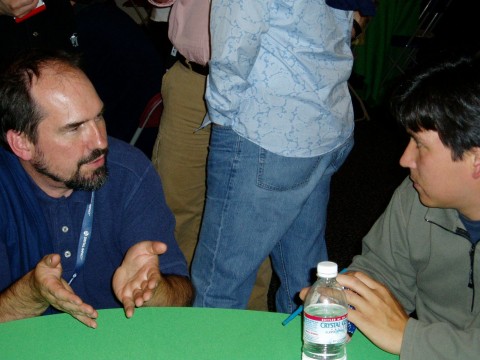
One of the highlights last year was a chance to talk to several of the Google Search Engineers. Here I am pestering Kekoa – I think about 302 vs 301 redirection and ranking items:

Kekoa at Google Party

Matt Cutts is generally in *high demand* at conferences as well as here at the 2005 Google Party webmaster talks, which are held away from the really big crowd outside. In fact in Boston at Webmasterworld he told me he hardly got anything to eat at this 2005 Google bash because he was constantly mobbed.  Thanks to my good friend John for shooting these pix.   He’ll be joining me again this year at the Party.

Matt Cutts at Google Dance 2005