Tipping point of choices leading to actions.


Malcolm Gladwell, the clever author of "Blink" and "The Tipping Point", spoke to Webmasterworld Boston. One observation was that having too many choices can inhibit our actions, as in the case where a company that offered FEWER retirement plans found this INCREASED participation.

Noting how many super applications Yahoo has been spinning out over the past few years I'm wondering if other users, like me, are simply overwhelmed with the choices and therefore NOT taking advantage of what appears to be the best suite of options in the online universe.

I stopped using Yahoo 360 not because of problems – it's excellent – but because there are only so many routines to absorb when they are not part of your core set of work tools or interests.  Also, unlike Myspace, 360 did not seem to be creating an "exploding community" and thus time spent setting it up might have been wasted if it fell off the map as a community place.

I think I'm like many users who are not yet ready to tie into highly personalized programs though I'm getting ready for that now that I want to tap more effectively into RSS and the power of online communities.

Yahoo 360 (and my Yahoo) are such good tools that I'm planning to go back and figure out how to use each more effectively, but the trick as a user is to pick the best combination of quality and community.   Good applications that have small or shrinking communities are problematic for social reasons.  Bad applications with big communities have problems as well, though for different reasons.

Yahoo! It’s time to buy YHOO.


I've been waiting for a "sign" to buy Yahoo (well, some SHARES of Yahoo ) which seems due for a huge surge when their publisher network revenues kick in later this year. Yahoo has more traffic than Google but you sure wouldn't know it from the buzz, even among industry insiders. Capitalization lags Google big time for what appear to be no really good reasons.

My sign that Yahoo will do very well came last week as I signed up and used Flickr, which ranks among the most intuitive and brilliant applications I've ever used. Checking their Alexa stats Flickr is 85th most visited site and rising fast – proving that Yahoo can take a good idea, make it better, and expand a giant community almost overnight. A giant community that posts, for example, pictures from an Antarctica Science Voyage. Is Web 2.0 cool or what?

It's not that Flickr alone will increase YHOO profits.  What strikes me clearly is that Yahoo – far more than Google – is positioning itself as the front runner with big plans to grow and maintain the flexibility to fill many niche spaces created by the rapidly expanding Web 2.0 economy.

Yahoo's profit boost will come from online publisher revenues which now comprise about 43% of Google's revenue and will flow to Yahoo if they offer publishers a higher revenue share. Yahoo will be able to legally adjust profits upward very strategically using this technique and I'm guessing that they are now drooling at the thought of doing that.

Flickr is only one of many aquisitions of Web 2.0 companies by Yahoo, which is clearly the 2.0 leader.

Google's equivalent in the photo space? Hello? Hello? What the HECKo? It may be a good application, but I'll probably never know and almost everybody's using Flickr now, pulling others in every day.

People are very, very unlikely to switch away from a great application like Flickr once they start using it. This EBAY effect is powerful in some niches like online auctions or photos where the main barrier to participation is signing up and learning to use the service.

Contrast this with NO barrier but the admittedly powerful "habituation" to search engine use where it's likely people will flow to the 'best search' over time rather than the one they started with.   Now that Yahoo is equal to Google in relevancy this will tend to work in their favor as well.

Time to buy Yahoo! 

WebmasterWorld Boston Site Reviews, part Deux


More site reviews from WMW Boston, continued from HERE

6. eomega.com 

27 years teaching Tai Chi and other personal enrichment technniques. Want to rank better for terms like Tai Chi since they are a key resource.

Tim: Not clear from site what you actually do at the institute. Write more about your key focus which helps both people and SEs figure out the site. Put "Yoga" and "Tai chi" keywords on home pages!

Bruce: Look at competitors Static pages with more decriptions would be better. Send more NON volatile content to home page. [By Non Volatile he means less flash, dynamic, changing material which can confuse the indexing process]

Matt: A good site map is important. If you use java mouseover navigation FIND ANOTHER WAY.

"Treat Search Engines as dumb little kids with short attention spans"
(do a separate post on this concept which is important)

Change your huge URLs to more intuitive reading like /carol-anderson/. Weird or long URLs can fool the search engine and you have a lot of them.

Thomas: List of workshops is WAY too long – cut it up into sections with better categories which will spider better. (Matt nodded that this was a good idea).

Jake: All Title tags in the site appear to be the same! Bad.

7. Shopping.com [this is one of the largest shopping portals]. They appear to be having big ranking problems though they have a huge number of indexed pages. He said 80% of their server load is from SE crawling(!).

Matt: Mouseover problems? Always use DASHES as separators rather than underscores. Underscores will be treated as connecting the two words.

Jake: Load balancing at the servers can lead to duplicate content filtering.

[Shopping.com said they had som latency (slow loading page) issues. Matt indicated this is UNlikely to cause problems with Google but might with MSN.

Users have complained about empty epinions.com pages – get rid of them.
Use more user friendly URLs – more for users than for Search engines.

8. CorporateCasuals.com. Now in top 60 for most terms but can't rank for "embroidery".

Tim: More descriptive anchor text needed.

Matt: 3 parameter URLs are not good. DO NOT use ID=. Best to use NO parameters but keep to 1-2 if you must do it. Stop using nofollows on (internal?) links. These prevent the SE from following internal navigation and beefing up the site.
Think about attracting attention to the site to get more inbound links.

Bruce: Descriptions are NOT unique and that is bad.

9. Arcamax.com "We syndicate content. Site Tips wanted. Comics are top read at the site. They send out joke of the day. 30-40 subscribers per week from home page and position of subscription box on home page does NOT appear to affect this. 40-50% leave home page without going in to site.

Matt: I see irrelevant ads and a toolbar download that might scare people. Focus on other things like jokes and cartoons.

Tim: Leverage RSS power. Need content surfacing [more readily available?] Make more specific calls to action.

Matt’s mom’s blog


When Matt Cutts mentioned that his Mom had been blogging longer than he has it set off a flurry of "Find Matt's Mom's blog" activity. She actually has three blogs! Betty is a great lady who is using the blogs to bring together people and ideas and help spread the wealth we enjoy here in the USA to those less fortunate in China. No wonder Matt's such a smart and clever fellow!

Matt's mom's blog

Blessing Hands Charity   Betty's great charity effort – send them some money!   In fact it looks like there is a matching grant in place now through another educational charity so this will double the effect of your contribution.   Especially for those at Webmasterworld Boston who enjoyed Matt's helpful sessions I recommend you pony up for his Mom's worthy efforts in China.

Google and Yahoo review websites at WebmasterWorld Boston


The best session at WebmasterWorld Boston had site reviews of nine websites by Matt Cutts of Google, Tim Mayer of Yahoo, and SEOs Thomas Bindl and Bruce Clay. Jake Baille did a fine job moderating, keeping the reviews fast. Here's a summary which I'll add to during the day as I recover from the conference here in Concord, MA.

1) Britannica.com Problem: Brittanica's subscription content is behind the pay firewall and therefore not crawlable. They don't want to change this model too much. They rank poorly for many terms for which they think they are authoritative. What should they do?

Matt Cutts: Wikipedia gives people all the information they are looking for and therefore ranks above Brittanica. Paid firewall snips are NOT enough information to attract inbound links. Consider picking a few articles in highly searched areas and making 100% of that content crawlable. It's tough to rank a page with just a paragraph of text and even tougher to get links to that content.

Bruce Clay: Check your "Expertness" by analyzing inbound links, outbound links. Check technical factors related to weighting and content rankings. Check server issues including accidental replication of content which can lead to duplicate content filters.

Tim Mayer: Consider a more colloquial writing style (I understood this to mean that that SE's are looking for natural conversational styles over formal or automated content though I don't think Tim said that specifically). Talk to the Search Engines about an information feed program.

ResumeRabbit.com He wanted optimization comments on a new home page here: edirectpublishing.com/newlandingpage/ BUT in a fun moment at the start of this review Matt said he'd gotten a LOT of unsolicited emails from ResumeRabbit and felt that may have "tainted" the brand. "how about ResumeAardvark?" suggested Matt in perhaps his *worst* piece of advice during the conference.

Matt: Links look good, you've made the site crawlable.
Thomas: Links, links, links (I think he meant one always needs more quality inbound links)
Tim: Use keyword tags! They matter in some SEs
Bruce: Drop id= which is in the source code for some/all pages.

InternationalLiving.com Problem: We are one of the best sites in the niche, but don't rank high.
Tim: Lose the flash download at home page. You are losing people immediately by forcing them to download stuff to see the whole site.

Bruce: Put the postcard thing in an IFRAME, consider more consistent home page text rather than regular changes.

Thomas: Consider CSS style sheets for better look. Use of H tag is good.

Matt: The site feels "thinner" than it really is. Emphasize the detailed content and the fact the project predates the web and has been online for a LONG time. Try to buy Internationaliving.com, a similar URL that could be taking some traffic away due to spelling confusion. If you do this use 301 redirect to send them to the real [canonical] site. People make weird queries you can't predict so cast a wider net [using emphasis on more keywords] to pull in long tailed searches.

Cherokee-NC.com

As the big flash home page …. slowly ….loaded …. the crowd erupted into laughter. [Note to all my friends in Travel and tourism STOP HIRING PRINT AGENCIES TO BUILD YOUR WEBSITES and STOP USING FLASH as a key component of any part of the site – it does NOT index well and often confuses the search engines!]

Problem – they get 80% of the traffic from terms "Cherokee" and "Cherokee NC"? and want more long tail searches to deliver traffic. How to optimize.

Tim: Build another site that is static and optimized for search. Flash is a BIG disadvantage.

Matt: Do not build a separate website but do a text version of this one. Note that if you select a text blurb on your site and can find it elsewhere you may be under a duplicate content penalty/filter. [he mentioned tripod.com because I think he found some duplicatation of this site there?]. Flash: You are not getting link credit in the index for [the flash based links?] but duplicate content is probably more important.

Separate navigation links from Flash. Matt: I turn off Flash. You may be losing 5% of traffic just by using Flash.

BigMouthMedia.com

I don't think Big Mouth asked for this, rather somebody wanted Matt to explain why and how they got dropped and then back in the index so fast.

Matt: Turn off CSS to see if hidden text is a problem. Look at internet Archive (or Alexa Wayback Machine) for page history [?] They had 13,000 characters stuffed into a small box, this was considered hidden text and they were banned. They cleaned it up and filed for reinclusion and are now back. Matt indicated they are not "out to get you" and this was a simple case where he did not go back in to fine every possible violation, rather when they removed the offending hidden text he felt they deserved back in. PR7 indicates a "robust" site.

Continued HERE 

Webmaster World Day 2 – Jeremy, Matt, Robert on blogging


DSCF0082.jpgDSCF0080.jpgDSCF0079.jpg
The blogger session at PubCon Boston was a crowd favorite. Jeremy Zawodny, Matt Cutts, and Robert Scoble talked about their experiences as the key "unofficial" spokespeople for Yahoo, Google, and Microsoft. The big item here was "Where is Matt's Mom's blog?"   

Jeremy also gave an interesting summary of his experiences blogging about the troubled history at Yahoo Finance.   He compared it unfavorably to Google's new product suggesting Google was doing things Yahoo should and could have done long ago.  His gutsy post got him a meeting with the new Finance program manager who was new and wanted to brief him on what appear to be excellent upcoming features.  The moral of the story seemed somewhat in line with Scoble's insistence that companies need to "blog or die" and that allowing this type of open examination is healthy, leading to faster action and enlightenment.

I'm not so sure that on balance negative blogging episodes have a positive impact on the company, but I do think that the long term, honest blogging by Zawodny and Scoble and Matt's new efforts send a very powerful credibility signal to the community and indicate their companies "get the new web" in an important way.   

I hope that YPN and other "official" blogs work to retain an honest, creative voice.   I'm skeptical and waiting to see if that is even possible when the blog is under corporate management.   Better to just cut your people loose, treat them well, and involve the whole world in the conversation.

v7ndotcom elursrebmem rears it’s ugly alien head at the house of Cutts


Over at Matt's blog we be talking about the V7ndotcom elursrebmem contest. I'm reproducing here because I think it's an interesting dialog about what constitutes spam and about the vagueness of the Google guidelines, AND it's an opportunity to link to my Alien Astronaut evidence for the existence of V7ndotcom elursrebmem

  1. Michael Martinez Said,

    April 5, 2006 @ 8:45 am

    I think Matt is manually reviewing every listing for v7ndotcom elursrebmem to make sure he knows who all the spammers are.

    After all, v7ndotcom elursrebmem is a “Come and get it!” call to spammers. Why not take advantage of their audacity and track them down, one by one.

    Maybe John Scott is on Google’s payroll, serving as an industrial spy, enticing the black hats to come out with the v7ndotcom elursrebmem contest so that Google can finally track them all down and nuke them.

    Frankly, I’m not entirely sure we can trust Matt to be our advocate at Google any longer. He may actually be putting their interests first, since he is a stockholder.

  2. Joseph Hunkins Said,

    April 5, 2006 @ 9:08 am

    Michael the V7Ndotcom elursrebmem contest is NOT a call only to spammers – it’s a reasonable and fascinating experimental approach to figuring out how ranking works. I’m restraining myself from saying how PISSED OFF I get when people suggest that simply trying to figure out Google’s definition of “relevancy” is the province of cheats and liars which it’s NOT. I have huge respect for Matt and his spam team, and for the fact they must deal with a lot of crap, but I’m not going to ignore information about ranking or not run any experiments. I’m think Matt would agree that ranking experiments that stay within the Google webmaster guidelines are a reasonable use of electrons. V7N as a *concept* is within the guidelines though I’m sure some people are using spammy methods to rank.

  3. Ryan Said,

    April 5, 2006 @ 10:23 am

    within the guidelines?
    what about guideline number 3:

    Create a useful, information-rich site, and write pages that clearly and accurately describe your content.

    how is a page that ranks for a nonsense term useful or information rich?

    Doesn’t information have to involve real words?

  4. Michael Martinez Said,

    April 5, 2006 @ 8:13 pm

    ” I’m restraining myself from saying how PISSED OFF I get when people suggest that simply trying to figure out Google’s definition of “relevancy” is the province of cheats and liars which it’s NOT.”

    Then you have no reason to be pissed off at me. I wonder how you feel about people putting words into other people’s mouths, though, and deliberately misrepresenting and misconstruing what those other people say.

    Nonetheless, the v7ndotcom contest reveals nothing about relevancy, and is little more than a call to spammers to have some fun and earn some money. Legitimate people may have gotten involved in it, but that doesn’t change the fact that the results have been spammed to death (with 6 milllion+ raw hits).

    A much more reliable SEO contest would not use the cattle call approach. It would require independent judging by panels and evaluation of live projects (with full non-disclosure agreements to ensure contestants’ contracts were not violated or compromised).

  5. Joseph Hunkins Said,

    April 11, 2006 @ 12:49 pm

    Michael –

    1. I apologize. I didn’t mean YOU piss me off, rather the idea in general, but it did look attack-like from my response and that was bad by me.

    2. I also agree with you that V7dotcom is probably inferior to the type of study you suggest. Interesting though that the V7 listings do appear to be propagating much like “normal” ones. Google prefers to avoid manual intervention and I’m guessing they’ll avoid it here as well.

    Ryan – Maybe I’m splitting hairs a bit but you are doing what people should NOT do and that’s starting to accept Google’s most restrictive interpretation of their rules as the “correct” one. In the traditions of early Google I say they/we should use less restrictive interpretations of the guidelines. But even with restrictive use I’d say that the V7 contest does meet the criteria you cite above as follows:

    Useful – V7 sites are useful to many both as experiments and as a big SEO news item.

    Info rich – look at all the listings! Most have LOTS of relevant, real information about the contest. Those that do not don’t rank well. hmmmmmm

    Accurately describe your content: Again, most do this while those like the “hotel” site (hi DaveN) create a fiction and make it clear it’s a fiction.

    The more I watch the contest the more convinced I am it’s fun, educational, and legitimate. I wish Matt would weigh in but I think he can’t cuz it’s an “Algorithmic item”.

Oh yes – here is the V7ndotcom elursrebmem Alien Astronaut evidence

Web 2.0 as the “generous” internet


Over at O'Reilly's blog there is an excellent discussion about the nature of biz in a Web 2.0 world (why does the term Web 2.0 BOTHER so many people?  Get over it!)

Doc Searls seems to suggest that old style biz is selfish where new style is generous, sharing resources in a virtually unrestricted way.   One poster suggests, I think wrongly, that generosity comes after affluence.   Based on my experiences I'm often surprised that when I share ideas openly and honestly I build trust with people and that trust leads to opportunity *for everybody in the equation*.   Sure there is a *chance* that somebody will nab your idea, implement it better than you can, and do great thing.   But that is:

1) OK because ideas, even great ideas, are not a key component of change.  The key is a fully implemented great idea and is a much taller order. 

2) unlikely, because they are probably working on a new angle or different idea or implementation anyway.  At MashupCamp I was pleased and surprised how few people were even interested in doing some of the things I thought would make "great mashups" in the travel space.  Why?  Because they were busy with THEIR vision of the next big thing.  Cool, and the best part is that the collective intelligence in such a group, or in the internt community at large, leads to a sort of *collective* expanion of horizons and creation *even better* stuff than without the open exchanges.    I'd note that MSN's traditional failure to understand and harness this power may be their biggest impediment to moving ahead successfully in the new Web world.

What one should seek in the new "generous" internet are relationships and mechanisms (e.g. blogs, websites, wikis, wifi, free computers, etc, etc) that foster bigger and better ideas which in turn will foster bigger and better improvements to the global web, still a very immature system.

Search, Lies, and Googleyness


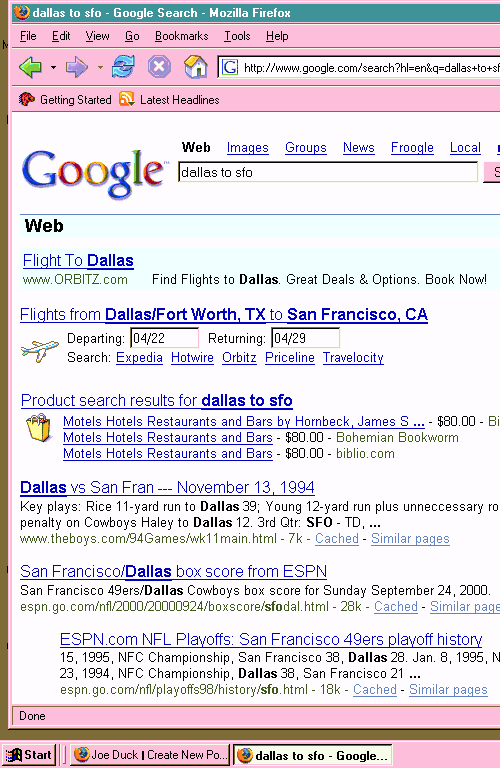
Here's the screen shot of the Google sponsored links that are placed OUTSIDE of the "sponsored links" areas! Call me a naive and stupid S.O.B. but I really thought that Google was the kind of company that stuck to the high road on such matters.   IMPORTANT NOTE – the "flights" link goes to EXPEDIA flights rather than an objective, non commercial site.

Again I should say I don't mind the ads, but why have they shouted so loudly and so often that they would NOT compromise organic listings with ads? Well? Huh?

The moral of the story is that Google's in it for the money more than the user experience.

That's OK, just stop telling me that you are NOT.
googadz1.gifshame on Google!