
Drats, Foiled again! Humbled by math and technology, which I’m convinced are EVIL forces of the DEVIL!


There was me, priding myself on applying the elusive Monty Hall conditional probability math to "Deal or No Deal" TV show and thinking how clever I was to integrate DVD, touchscreen, and LCD Television for a snazzy new tourism presentation.     WRONG and WRONG was I, since it appears the math on Deal no Deal is NOT Montyfied, and the DVD touchscreen solution remains elusive.

Circuit City was very helpful figuring out the challenges and I learned that running DVD through a computer using the normal VGA outputs will give crappy picture.   The video is very high quality and keeping it that way is a priority.  Surprisingly to me, even with a hyped up graphics card and DVI output I may not get great quality on a 42" LCD TV.    The TV dude said that this is from incompatibilities in digital standards and helps explain why media center technology (much hyped by Microsoft at MIX06) is NOT taking off very well.

The problem is I need to interface with a touchscreen so the users control the presentation on the touchscreen but can also view it on the 42" LCD TV above.    The solution appears to be to get a touchscreen capable DVD player (which I did not know until today existed) and then hopefully be able to output from it to touchscreen AND the LCD TV.     If this fails it's back to the DVI PC solution.
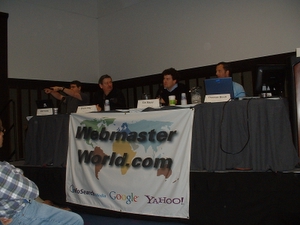
Let’s have more OPEN conferences – a LOT more.


I've been to all or portions of about 7 internet conferences in the past year, and without a doubt Mashup Camp was my favorite in terms of the quality of the information and the way it was delivered.

Unlike the highly structured MIX06, WebmasterWorld, AD TECH, and Search Engine Strategies, MashupCamp lets attendees decide the topics, interact via wiki and other features, and in my favorite session had developers present their stuff to small roving groups in 5 minute "speed geeking" sessions.

Rather than take a nap because the topics were rehashes of what I knew, I had to take a walk outside to cool my brain from the firehose of Web 2.0 information overloading me in Mountain View during the 2 day conference.

I think and hope that events like Foo Camp, Bar Camps, and Mashup Camps are the future of power networking, because this type of conference builds a much stronger type of relationship between attendees and powers more effective idea building than the traditional "lecture/session/track" model. It's a wild west out there and the conferences should reflect that.
Conspicuous is the fact that this conference charged nothing to attend, cleverly getting corporates to sponsor the meals and other needed items. I did chip in a few hundred because that was helpful but I don't think it'll be needed at the upcoming conferences, which now have even more active support of Yahoo, Google, MSN, ASK, and many more key industry players.

Huge KUDOS to David Berlind, Doug Gold, Mary Hodder and Doc Searles who not only put on a great event but are doing it again in July and expaning the camp to include "Mashup University".

Internet Report Card Gives Google A, Yahoo B+, MSN C-


I think CNN's grades are realistic. However grades are a *trailing* measure of performance and the real question is what's in the future for these companies. This much is clear: All have really sharp folks working for them. All face challenges from their growth which can inhibit innovation and flexibility.

I think Google's done the best overcoming that challenge but I also think it's because the initial crowd is still pretty much in place and still excited about work. When kids start coming into the Google families, and mundane concerns start piling up, and the early GooglePeeps are sitting on millions in stock, the 9am to midnight work routine is going to get old…fast. I think Google's ability to keep their best and brightest may be the biggest challenge they face.  Working in their favor though is that Brin and Page are both young and brilliant.   They won't burn out anytime soon and certainly have an edge on the MSN folks who have made their mark already.  MSN's older leaders simply *cannot* understand the internet the way younger people do, and even bringing brilliant but "first generation" internet  people like Ray Ozzie on board is unlikely to solve this.     What would solve this?  Buying all/part of Yahoo as appears to be in the works right now.

Yahoo and MSN have already been through the "losing some of your best people" problems and I think have a more mature and somewhat stable workforce. This is good for maintaining status quo but also is clearly a factor in Yahoo and MSN's ability to overtake Google in most online endeavors.

The search market share numbers can be misleading in my opinion. People no longer move to Google due to superior search, they do it because as the average user becomes less sophisticated they are simply responding to the collective habit of most users which is to use Google. I predict this effect will wear off as search quality converges, people move more to vertical and user-generated search routines, and Microsoft exploits it's browser and OS advantages.

These grades are from the second quarter of a course that's lasting a lifetime. Anything can happen as this all heats up. The only certainty is …. change.

Home Again Pet ID System? You call this appropriate technology?


Is it just me or is this due for the idiot invention of the year award?

HomeAgain® is an advanced pet identification and retrieval system. A microchip the size of a grain of rice with a unique identification code that is implanted between the shoulder blades of your pet. Then your pet needs to be enrolled with the HomeAgain® Pet Recovery Service. HomeAgain® maintains a national database that is available 24-hours daily, 365 days a year. If your pet is ever lost, they can be scanned at animal shelters or veterinary clinics. Your pet’s identification number is called in to HomeAgain® (1-866-PET-ID24), and you are notified immediately.

… For those interested I have a simpler solution. 1) Get your OWN phone number etched onto a $2-5 dog tag 2) Hang it on your pet 3) Send me $10 for saving you from the HomeAgain database fees for life.

OK, so if the pet loses his collar my system doesn’t work but how many people finding a lost pet with no collar are going to SCAN them?

UPDATE: Based on the rather overwhelming support for chips I’m admitting I must be wrong about this.

People and/or/for/non Profit?


Time Magazine:

Last month Gates-funded scientists announced that they had created the technology to manufacture artemisinic acid synthetically. Within five years, the cost of a lifesaving supply is expected to drop from $2.40 to 25 cents. Lead researcher Jay Keasling says it would not have been possible without a $43 million Gates grant. "I had companies call me and say, 'This is great, but we can't give you any money. We can't make a profit on this,'" he says.

I tend to be in the crowd that says profit is a great motivator to get companies to do bigger and better things, in turn raising the standards for most people and societies that intersect with those businesses.    At first glance the quote above indicates that in this case profit was getting in the way of optimizing development of new drugs where it will do the most good – in the developing world fighting easy-to-cure diseases or conditions like dehydration that kill millions every year.   But why didn't the Govts of those nations pony up for this effort?    Since the pharmaceutical industry was NOT the beneficiary of this was it reasonable to expect them to bear the entire financial burden?

Since the $43 million from the Gates foundation basically started out as profits distributed from Microsoft to Bill Gates, who in turn funded this life saving effort, we need to be cautious about saying profits are the problem here since they were the solution here as well.   Thus one could argue, and I think I would, that without a capitalistic infrastructure to create this wealth it's unlikely we'd see this development at all.

But most important is this question – how do we find the MOST effective mechanisms to create innovations on this scale?   I think the new breed of corporate foundations are part of the answer because they apply many of the successful principles of business to development projects.  Combine this growing force with tax and other incentives for companies that use their brainpower and expertise innovating for the broad social good.

And as for us everyday folks?  What can we do?  We can stop looking so narrowly at our own little niches, and instead look to the low hanging fruit solutions such as increased support for global health care.  We can broaden our perspective to a global one and recognize that we have to make small sacrifices in an effort to save entire generations who are threatened with disease and starvation but for the lack of simple remedies.   Even the most selfish person should realize that the satisfaction that comes from helping those in need is generally a much more profound experience than almost any other.

Tipping point of choices leading to actions.


Malcolm Gladwell, the clever author of "Blink" and "The Tipping Point", spoke to Webmasterworld Boston. One observation was that having too many choices can inhibit our actions, as in the case where a company that offered FEWER retirement plans found this INCREASED participation.

Noting how many super applications Yahoo has been spinning out over the past few years I'm wondering if other users, like me, are simply overwhelmed with the choices and therefore NOT taking advantage of what appears to be the best suite of options in the online universe.

I stopped using Yahoo 360 not because of problems – it's excellent – but because there are only so many routines to absorb when they are not part of your core set of work tools or interests.  Also, unlike Myspace, 360 did not seem to be creating an "exploding community" and thus time spent setting it up might have been wasted if it fell off the map as a community place.

I think I'm like many users who are not yet ready to tie into highly personalized programs though I'm getting ready for that now that I want to tap more effectively into RSS and the power of online communities.

Yahoo 360 (and my Yahoo) are such good tools that I'm planning to go back and figure out how to use each more effectively, but the trick as a user is to pick the best combination of quality and community.   Good applications that have small or shrinking communities are problematic for social reasons.  Bad applications with big communities have problems as well, though for different reasons.

Nuclear Power – More Needed ASAP


Even Senator Kennedy of Mass was on the radio a few days ago saying how we needed to take a new look at expanding the USA's nuclear power framework. 

Wow – when Kennedy starts talking nuclear power I think it should be the long needed wakeup call for the "head in the sand" crowd that continues to insist the dangers outweigh the benefits.  

They don't.  It's not even close.  Europe's electricity is mostly from nuclear plants, and they – tightly packed into small areas –  have a LOT more to worry about in terms of a meltdown than we well-dispersed Americans.   

Of course there is risk as there is with all power technologies, but it's been exaggerated by irrationality and "fear of the unknown".    China's consumption is rising and exploding.   This demand is unlikely to be met with even the most innovative alternative energy programs.

Ironically I think some of the same folks who are lobbying for greenhouse gas reductions are lobbying against more nuclear power.    They are letting politics and (largely faulty) ideas about the economy of capitalism prejudice good science and analysis of risk and reward.

Yahoo! It’s time to buy YHOO.


I've been waiting for a "sign" to buy Yahoo (well, some SHARES of Yahoo ) which seems due for a huge surge when their publisher network revenues kick in later this year. Yahoo has more traffic than Google but you sure wouldn't know it from the buzz, even among industry insiders. Capitalization lags Google big time for what appear to be no really good reasons.

My sign that Yahoo will do very well came last week as I signed up and used Flickr, which ranks among the most intuitive and brilliant applications I've ever used. Checking their Alexa stats Flickr is 85th most visited site and rising fast – proving that Yahoo can take a good idea, make it better, and expand a giant community almost overnight. A giant community that posts, for example, pictures from an Antarctica Science Voyage. Is Web 2.0 cool or what?

It's not that Flickr alone will increase YHOO profits.  What strikes me clearly is that Yahoo – far more than Google – is positioning itself as the front runner with big plans to grow and maintain the flexibility to fill many niche spaces created by the rapidly expanding Web 2.0 economy.

Yahoo's profit boost will come from online publisher revenues which now comprise about 43% of Google's revenue and will flow to Yahoo if they offer publishers a higher revenue share. Yahoo will be able to legally adjust profits upward very strategically using this technique and I'm guessing that they are now drooling at the thought of doing that.

Flickr is only one of many aquisitions of Web 2.0 companies by Yahoo, which is clearly the 2.0 leader.

Google's equivalent in the photo space? Hello? Hello? What the HECKo? It may be a good application, but I'll probably never know and almost everybody's using Flickr now, pulling others in every day.

People are very, very unlikely to switch away from a great application like Flickr once they start using it. This EBAY effect is powerful in some niches like online auctions or photos where the main barrier to participation is signing up and learning to use the service.

Contrast this with NO barrier but the admittedly powerful "habituation" to search engine use where it's likely people will flow to the 'best search' over time rather than the one they started with.   Now that Yahoo is equal to Google in relevancy this will tend to work in their favor as well.

Time to buy Yahoo! 

Jeremy’s paying attention to our lack of concentration


Jeremy Zawodny is having trouble concentrating.   I think he's speaking for a large and increasing number of people who suffer from the simply overwhelming and seemingly infinite amounts of information now available.

The barriers to massive amounts of information access approach zero in the online environment, a very different state of affairs than a mere 10 years ago when even simply answers required trips to stores or local libraries and good quality research on complicated or in-depth topics generally meant many trips to a university libary.

In the comments Tracy wondered if "Maybe technology is the downfall of humanity…

This is always a provocative notion. I hope the concentration problems mean we are not losing the tendency for good thinkers to spend long and reflective amounts of time solving complex problems when needed.
I'm still in the "pro technology" camp that says technology is far more likely to save us than bury us, but I'm not sure I'd want to debate that in light of the current state of global affairs and internet abuses and info overload.

If it wasn't a dispicably bad pun I'd suggest we have one of those open format conferences and call it "Concentration Camp" 

WebmasterWorld Boston moves to the Elephant & Castle


DSCF0053.jpg

WMW Boston ended at a nice Pub on Devonshire in Downtown Boston. This conference seemed to get better each day and although I felt some of the sessions covered "much of the same" things I'd been hearing at the last two Pubcons the special sessions and networking were great as always.

I'm kind of burned out right now from hundreds of new people, conversations, and ideas but I'll have some time tomorrow to pull together my notes on the site reviews session which was very good.

I think the highlight of this conference was a very enjoyable dinner with Aaron Wall, one of those very few who is *so good* at search optimization that Matt Cutts was asking *him* questions.

Aaron is an excellent guy. Buy his book!