Death on Everest. Would YOU have stopped climbing to save the guy?


News Item:
David Sharp, 34, died apparently of oxygen deficiency while descending from the summit during a solo climb last week.
More than 40 climbers are thought to have seen him as he lay dying, and almost all continued to the summit without offering assistance.

Our first reaction is to be appalled at the lack of concern and I'm anxious to hear from those who passed him by to hear their rationalizations. A Semper Fi sensibility hardly seems to apply to the new Everest hiking crowd. Sir Edmund Hillary observed this in his harsh criticism of the decision to put the summit above saving a life.

YET don't we ALL do this every day when we choose to distance ourselves from far more pressing global concerns where saving lives requires nothing like the efforts needed in this case? The key difference is proximity rather than ability to help. A modest Unicef contribution is more likely to save a life than attending to an oxygen deprived climber at 27000 feet in 80 below zero weather. Yet we don't have to look the malnourished kid in the face and thus we condemn and abhor the feelings of those who passed by the climber but absolve ourselves of what are probably more justified feelings of guilt for doing little in the face of great need.

It's a cruel world, right?

Update 

Flight Health tips


This just in from that bastion of journalistic objectivity, FOX news –
Health tips for frequent (or infrequent) flyers –

Swelling of intestines means avoid overeating? Avoid junky food? [C'mon, flying's a new great excuse to nab some fast food between flights!]

Drink lots of water, but NOT from the unregulated bathroom source.

Earache? Put a warm towel on ear.

Keep babies alert during takeoff and landing to clear sinuses.*

Afrin and Claritin for adult sinus problems.
DO NOT drink the bathroom water, it's cleanliness is not regulated.

Last seat in Coach in aisle is safest statistically.

Gone Scuba? Wait 12-24 hours before flying

New Orleans Tourism stats


New Orleans Tourism Economy

Note the 16 to 1 return on tourism investment.  This "huge ROI" theme is always interesting and mathematically provocative, since without qualification it means you can balance/expand any state budget by simply investing a few billion in tourism which will in turn yield huge economic gains and spin off lots of extra income tax revenues.    Oregon recently decided to hugely increase state funding for tourism promotion while cutting other sectors.   Based on what little I've seen it really does seem to be working in returning far more to even the TAX base than the cost of the marketing.

Let’s have more OPEN conferences – a LOT more.


I've been to all or portions of about 7 internet conferences in the past year, and without a doubt Mashup Camp was my favorite in terms of the quality of the information and the way it was delivered.

Unlike the highly structured MIX06, WebmasterWorld, AD TECH, and Search Engine Strategies, MashupCamp lets attendees decide the topics, interact via wiki and other features, and in my favorite session had developers present their stuff to small roving groups in 5 minute "speed geeking" sessions.

Rather than take a nap because the topics were rehashes of what I knew, I had to take a walk outside to cool my brain from the firehose of Web 2.0 information overloading me in Mountain View during the 2 day conference.

I think and hope that events like Foo Camp, Bar Camps, and Mashup Camps are the future of power networking, because this type of conference builds a much stronger type of relationship between attendees and powers more effective idea building than the traditional "lecture/session/track" model. It's a wild west out there and the conferences should reflect that.
Conspicuous is the fact that this conference charged nothing to attend, cleverly getting corporates to sponsor the meals and other needed items. I did chip in a few hundred because that was helpful but I don't think it'll be needed at the upcoming conferences, which now have even more active support of Yahoo, Google, MSN, ASK, and many more key industry players.

Huge KUDOS to David Berlind, Doug Gold, Mary Hodder and Doc Searles who not only put on a great event but are doing it again in July and expaning the camp to include "Mashup University".

Another one bites the dust.com?


It’s spring and people in the travel sector are all buzzing about revamping their websites. In many cases this will happen with little regard to quality information or navigation and will wind up with the site losing traffic thanks to deep sixing pages that have been indexed for years. Even with 301 redirection it’s not clear you can recapture old page ranks easily after revamping sites. The best advice for travel sites? CHANGE little with your old indexed pages unless you are having problems within search indexes. Add NEW PAGES to the existing site with information in mind rather than “improving the look”.

For reasons I simply can’t understand people in travel cannot get beyond “image” and therefore almost completely misperceive the value of designing websites not for “looks”, but for info richness. Although nice looks are not totally incompatible with nice info, one sees few sites that blend them in ways that will optimize the intended result (more travel related business in the area).

Errors like flash introductions and splash pages are simply too dang common in the travel sector which ironically still has simply staggering potential for sites that are built to help users find usable information.

PPC campaigns are far more common at the mom and pop business level than at the higher level destination management level where they’d have ROIs of ten to ONE HUNDRED times that of TV and print campaigns where the travel ad spend is largely wasted. There is still a very common notion that you can drive people to a URL using print advertising as effectively as with online ads. In fact the cost to drive people online with print is about 10-100x the online cost (I know this from extensive experiments I did in my past life as webmaster for Southern Oregon Visitors Association).

I’m finally coming to understand that as human primates we have a tendency to be stubborn and hold old ideas dear until the consequences become so severe and negataive or the evidence so overwhelming we simply MUST change course. Combine this with most people’s mathematical illiteracy and you’ve got what we’ve got – a LOT of wasted advertising buys in the travel sector, not to mention waste, waste, and more waste in all areas where human stubborness prevails over reason.

WebmasterWorld Boston Site Reviews, part Deux


More site reviews from WMW Boston, continued from HERE

6. eomega.com 

27 years teaching Tai Chi and other personal enrichment technniques. Want to rank better for terms like Tai Chi since they are a key resource.

Tim: Not clear from site what you actually do at the institute. Write more about your key focus which helps both people and SEs figure out the site. Put "Yoga" and "Tai chi" keywords on home pages!

Bruce: Look at competitors Static pages with more decriptions would be better. Send more NON volatile content to home page. [By Non Volatile he means less flash, dynamic, changing material which can confuse the indexing process]

Matt: A good site map is important. If you use java mouseover navigation FIND ANOTHER WAY.

"Treat Search Engines as dumb little kids with short attention spans"
(do a separate post on this concept which is important)

Change your huge URLs to more intuitive reading like /carol-anderson/. Weird or long URLs can fool the search engine and you have a lot of them.

Thomas: List of workshops is WAY too long – cut it up into sections with better categories which will spider better. (Matt nodded that this was a good idea).

Jake: All Title tags in the site appear to be the same! Bad.

7. Shopping.com [this is one of the largest shopping portals]. They appear to be having big ranking problems though they have a huge number of indexed pages. He said 80% of their server load is from SE crawling(!).

Matt: Mouseover problems? Always use DASHES as separators rather than underscores. Underscores will be treated as connecting the two words.

Jake: Load balancing at the servers can lead to duplicate content filtering.

[Shopping.com said they had som latency (slow loading page) issues. Matt indicated this is UNlikely to cause problems with Google but might with MSN.

Users have complained about empty epinions.com pages – get rid of them.
Use more user friendly URLs – more for users than for Search engines.

8. CorporateCasuals.com. Now in top 60 for most terms but can't rank for "embroidery".

Tim: More descriptive anchor text needed.

Matt: 3 parameter URLs are not good. DO NOT use ID=. Best to use NO parameters but keep to 1-2 if you must do it. Stop using nofollows on (internal?) links. These prevent the SE from following internal navigation and beefing up the site.
Think about attracting attention to the site to get more inbound links.

Bruce: Descriptions are NOT unique and that is bad.

9. Arcamax.com "We syndicate content. Site Tips wanted. Comics are top read at the site. They send out joke of the day. 30-40 subscribers per week from home page and position of subscription box on home page does NOT appear to affect this. 40-50% leave home page without going in to site.

Matt: I see irrelevant ads and a toolbar download that might scare people. Focus on other things like jokes and cartoons.

Tim: Leverage RSS power. Need content surfacing [more readily available?] Make more specific calls to action.

Matt’s mom’s blog


When Matt Cutts mentioned that his Mom had been blogging longer than he has it set off a flurry of "Find Matt's Mom's blog" activity. She actually has three blogs! Betty is a great lady who is using the blogs to bring together people and ideas and help spread the wealth we enjoy here in the USA to those less fortunate in China. No wonder Matt's such a smart and clever fellow!

Matt's mom's blog

Blessing Hands Charity   Betty's great charity effort – send them some money!   In fact it looks like there is a matching grant in place now through another educational charity so this will double the effect of your contribution.   Especially for those at Webmasterworld Boston who enjoyed Matt's helpful sessions I recommend you pony up for his Mom's worthy efforts in China.

Google and Yahoo review websites at WebmasterWorld Boston


The best session at WebmasterWorld Boston had site reviews of nine websites by Matt Cutts of Google, Tim Mayer of Yahoo, and SEOs Thomas Bindl and Bruce Clay. Jake Baille did a fine job moderating, keeping the reviews fast. Here's a summary which I'll add to during the day as I recover from the conference here in Concord, MA.

1) Britannica.com Problem: Brittanica's subscription content is behind the pay firewall and therefore not crawlable. They don't want to change this model too much. They rank poorly for many terms for which they think they are authoritative. What should they do?

Matt Cutts: Wikipedia gives people all the information they are looking for and therefore ranks above Brittanica. Paid firewall snips are NOT enough information to attract inbound links. Consider picking a few articles in highly searched areas and making 100% of that content crawlable. It's tough to rank a page with just a paragraph of text and even tougher to get links to that content.

Bruce Clay: Check your "Expertness" by analyzing inbound links, outbound links. Check technical factors related to weighting and content rankings. Check server issues including accidental replication of content which can lead to duplicate content filters.

Tim Mayer: Consider a more colloquial writing style (I understood this to mean that that SE's are looking for natural conversational styles over formal or automated content though I don't think Tim said that specifically). Talk to the Search Engines about an information feed program.

ResumeRabbit.com He wanted optimization comments on a new home page here: edirectpublishing.com/newlandingpage/ BUT in a fun moment at the start of this review Matt said he'd gotten a LOT of unsolicited emails from ResumeRabbit and felt that may have "tainted" the brand. "how about ResumeAardvark?" suggested Matt in perhaps his *worst* piece of advice during the conference.

Matt: Links look good, you've made the site crawlable.
Thomas: Links, links, links (I think he meant one always needs more quality inbound links)
Tim: Use keyword tags! They matter in some SEs
Bruce: Drop id= which is in the source code for some/all pages.

InternationalLiving.com Problem: We are one of the best sites in the niche, but don't rank high.
Tim: Lose the flash download at home page. You are losing people immediately by forcing them to download stuff to see the whole site.

Bruce: Put the postcard thing in an IFRAME, consider more consistent home page text rather than regular changes.

Thomas: Consider CSS style sheets for better look. Use of H tag is good.

Matt: The site feels "thinner" than it really is. Emphasize the detailed content and the fact the project predates the web and has been online for a LONG time. Try to buy Internationaliving.com, a similar URL that could be taking some traffic away due to spelling confusion. If you do this use 301 redirect to send them to the real [canonical] site. People make weird queries you can't predict so cast a wider net [using emphasis on more keywords] to pull in long tailed searches.

Cherokee-NC.com

As the big flash home page …. slowly ….loaded …. the crowd erupted into laughter. [Note to all my friends in Travel and tourism STOP HIRING PRINT AGENCIES TO BUILD YOUR WEBSITES and STOP USING FLASH as a key component of any part of the site – it does NOT index well and often confuses the search engines!]

Problem – they get 80% of the traffic from terms "Cherokee" and "Cherokee NC"? and want more long tail searches to deliver traffic. How to optimize.

Tim: Build another site that is static and optimized for search. Flash is a BIG disadvantage.

Matt: Do not build a separate website but do a text version of this one. Note that if you select a text blurb on your site and can find it elsewhere you may be under a duplicate content penalty/filter. [he mentioned tripod.com because I think he found some duplicatation of this site there?]. Flash: You are not getting link credit in the index for [the flash based links?] but duplicate content is probably more important.

Separate navigation links from Flash. Matt: I turn off Flash. You may be losing 5% of traffic just by using Flash.

BigMouthMedia.com

I don't think Big Mouth asked for this, rather somebody wanted Matt to explain why and how they got dropped and then back in the index so fast.

Matt: Turn off CSS to see if hidden text is a problem. Look at internet Archive (or Alexa Wayback Machine) for page history [?] They had 13,000 characters stuffed into a small box, this was considered hidden text and they were banned. They cleaned it up and filed for reinclusion and are now back. Matt indicated they are not "out to get you" and this was a simple case where he did not go back in to fine every possible violation, rather when they removed the offending hidden text he felt they deserved back in. PR7 indicates a "robust" site.

Continued HERE 

WebmasterWorld Boston moves to the Elephant & Castle


DSCF0053.jpg

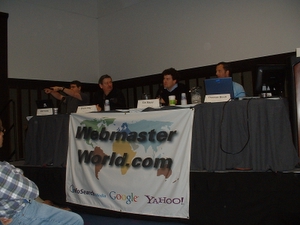
WMW Boston ended at a nice Pub on Devonshire in Downtown Boston. This conference seemed to get better each day and although I felt some of the sessions covered "much of the same" things I'd been hearing at the last two Pubcons the special sessions and networking were great as always.

I'm kind of burned out right now from hundreds of new people, conversations, and ideas but I'll have some time tomorrow to pull together my notes on the site reviews session which was very good.

I think the highlight of this conference was a very enjoyable dinner with Aaron Wall, one of those very few who is *so good* at search optimization that Matt Cutts was asking *him* questions.

Aaron is an excellent guy. Buy his book!

Webmaster World Day 2 – Jeremy, Matt, Robert on blogging


DSCF0082.jpgDSCF0080.jpgDSCF0079.jpg
The blogger session at PubCon Boston was a crowd favorite. Jeremy Zawodny, Matt Cutts, and Robert Scoble talked about their experiences as the key "unofficial" spokespeople for Yahoo, Google, and Microsoft. The big item here was "Where is Matt's Mom's blog?"   

Jeremy also gave an interesting summary of his experiences blogging about the troubled history at Yahoo Finance.   He compared it unfavorably to Google's new product suggesting Google was doing things Yahoo should and could have done long ago.  His gutsy post got him a meeting with the new Finance program manager who was new and wanted to brief him on what appear to be excellent upcoming features.  The moral of the story seemed somewhat in line with Scoble's insistence that companies need to "blog or die" and that allowing this type of open examination is healthy, leading to faster action and enlightenment.

I'm not so sure that on balance negative blogging episodes have a positive impact on the company, but I do think that the long term, honest blogging by Zawodny and Scoble and Matt's new efforts send a very powerful credibility signal to the community and indicate their companies "get the new web" in an important way.   

I hope that YPN and other "official" blogs work to retain an honest, creative voice.   I'm skeptical and waiting to see if that is even possible when the blog is under corporate management.   Better to just cut your people loose, treat them well, and involve the whole world in the conversation.