
Unknown's avatar

About JoeDuck

Internet Travel Guy, Father of 2, small town Oregon life. BS Botany from UW Madison Wisconsin, MS Social Sciences from Southern Oregon. Top interests outside of my family's well being are: Internet Technology, Online Travel, Globalization, China, Table Tennis, Real Estate, The Singularity.

Asphalt, the underrated innovation


Billions use it daily on roads and on roofs, but Asphalt really does not get the respect it deserves. Concrete too, but everybody loves a cement mixer and I think many boys fondly remember their toy truck cement mixer. However I don’t know any kids with a toy asphalt hot mix street paving vehicle.

“Mommy, I’m sorry I spilled tar all over the dog again….”

They are paving the road behind our house and I’m enjoying the symphony of engineering, construction, and innovation involved. The concrete sidewalk routine was impressive but the biggie with road building is the pavement itself.

I thought the Scot MacAdam invented it but NO WAY.

In fact I bet YOU didn’t know this Babylonian Asphalt fact:

The first recorded use of asphalt as a road building material was in Babylon around 625 B.C., in the reign of King Naboppolassar. In A Century of Progress: The History of Hot Mix Asphalt, published by National Asphalt Pavement Association in 1992, author Hugh Gillespie notes that “an inscription on a brick records the paving of Procession Street in Babylon, which led from his palace to the north wall of the city, ‘with asphalt and burned brick.’”

We know that the ancient Greeks were familiar with asphalt and its properties. The word asphalt comes from the Greek “asphaltos”, meaning “secure.” The Romans changed the word to “asphaltus,” and used the substance to seal their baths, reservoirs, and aqueducts.

Many centuries later, Europeans exploring the New World discovered natural deposits of asphalt. Writing in 1595, Sir Walter Raleigh described a “plain” (or lake) of asphalt on the Island of Trinidad, off the coast of Venezuela. He used this asphalt for re-caulking his ships.

Surely this proves that King Naboppolassar really deserves more of a place in history than he currently commands?
Search game score: US History: 37,600 US History Regents: 866,000 !


I actually grew up in New York and took the New York State Regent’s Exams but even I didn’t initially make the connection when doing some research to see how our site U-S-History.com is doing for various “US History” searches at Google.

Incredibly, the number of Google (and presumably other SE) searches for “US History Regents” appears to be many times those for US History. us history.com was pretty high with 216,000 but the “US History Regents” win by a landslide.

Update:  I may have been confusing the number of *results* with number of *searches* here…

Generalizing from this, Myspace success, etc we are starting to confirm a hypothesis that suggests online search activity is high school centric. I’m suggesting far more than most studies suggest – perhaps due to survey response bias or time online issues or the fact many studies are looking for info about more commercially viable audiences than a 15 year old teen boy.

Blog readers vs writers III – Cicarelli’s fleeting fame


Even thanks to a highlight by A-list blogger Jeremy of my AOL lawsuit post yesterday it looks like my Cicarelli “test post” is by far the top interest item here at Joe Duck, and it appears this is due to high placement at MSN for the term … Cicarelli.

This little Cicarelli experiment is suggesting to me that the gap between readers and blog writers is much wider than I’d thought, and it may change my approach to blogging.   Perhaps throwing in junk topic posts every so often is a good way to shake up search prominence even for non-junk topics.   Hard to test that but it seems to be happening – presumably as people who come for Cicarelli stay to read about …. Web 2.0 or Global health and welfare?!

But alas at Technorati we see that Cirarelli is down to search term number 9. I fear her fame, and mine, shall be as fleeting as a teenager’s search preferences.

Posts that contain Cicarelli per day for the last 30 days.
Technorati Chart
Get your own chart!

Mall of America on Travel Channel


Hey, I really like the Mall of America.    When we visit our Minnesota relatives we often head over there for a day and it’s really an intriguing place.   In some ways it’s the capital of American retail consumerism, a dubious but interesting distinction.   In a world fraught with violence, intolerance, war, disease, and hardship isn’t it nice to have four miles of enclosed, climate-controlled store fronts, amusement park, aquarium, and theme restaurants?   No?   C’mon, you call yourself an American?

Travel Channel notes:

The Mall of America is effectively an entire enclosed city. Designed by 40 architects and designers over a period of four years.

Giant Rectangle, allowing strolling without backtracing.
Each floor has over a MILE of storefront space.

4 malls in one with different themes:
North Garden

West Market – RR station theme.
South Avenue – Southern grand hotel theme.
East Broadway – modern high tech design

Glass sphere spy cams document shopper’s every move.

120 security gaurds plus dogs to sniff out trouble.

250k visitors daily during peak times

Camp Snoopy makes 25 million per year.

20,000 parking spots in 3 square miles of parking. State, symbol, and color designations to help mall visitors find their car.

20 sit down restaurants plus 30 fast food.

14 screen movie theater.

Chapel for marriages is the “Chapel of Love”.

5 themed restaurants and Hooters is the most popular watering hole in the mall.

Underwater Adventures is a huge aquarium located in lower sections.

AOL lawsuit over data release and, more importantly, storage of search database of intentions


Over at TechCrunch there’s a discussion about the lawsuit against AOL for releasing search data and also challenging their right to store the search histories of AOL users. I’m surprised this took so long because Google, Yahoo, MSN, etc have been storing all of our searches for some time and probably are using that data to adjust the search experience including refinement to advertising and organic results.

It frustrates me (or I should really say it pisses the heck out of me) that 1) Search engines think they should have rights to my search info with no obligation to tell me what they do with my info and 2) there is a lack of concern in the online community about this. John Battelle has been one of the few voices pointing out that this issue is big and getting much bigger, that these privacy issues need a lot more clarification, and that search companies are sneakily dodging many key issues with search and privacy.

Contrary to many comments I read from other onliners, the Government viewing my data is low on my list of privacy concerns because I doubt they’ll choose to or be able to effectively process the information in sinister ways. However it bothers me a LOT that my search “fingerprint” is getting used without my consent, understanding, or permission in an effort by Google, Yahoo, et al to sell me things and adjust my search and internet experiences.

If they want to do that they need to let me know the process they use to do it. If they think sharing that process violates their need for commercial secrecy then…do NOT use my stuff. I never gave you permission, and you should not assume you have my permission. In fact few people even know that Google and Yahoo and MSN store every single one of their searches – Google, Yahoo, MSN cannot reasonably claim they have implied permission for the search storage identified to individual computer level when very few people are even aware they are doing it!

Relevancy + Targeting = $123,490,000,000


Although this article suggests “infinite” reasons for Google’s success, I’d say there are only two that have made Google worth about 123 billion dollar bills.
The article supports that there have only been two truly notable reasons: A superb PPC model of advertising combined with the most relevant= best search engine to date.

Both the engine and the ad model were largely built by the time of huge expansion.   The story is nicely chronicles in John Battelle’s “The Search”, which also notes how Google’s ad model came about somewhat serindipitously, and basically as a copy of the Goto.com model developed by Bill Gross.  This serendipitous refinement of good ideas  lies at the heart of many great innovations and challenges the idea that greatness comes from stable, consistent, well organized forces of change.

Sure Google has the best technologists, leadership, and corporate culture, but it was the PPC model that was necessary for the success and that is largely ignored in most external analyses (Google knows this all too well).

Good points that without relevancy you’ll lose the audience and the PPC revenues. *Together* these two factors lie at the heart of Google’s success and both are unstable territory, so all are in for more fun in the search sun.

The Ghost in the Machine … is a Human Being!


Last week or so Matt was asking what new gadgets we’d see in the future. Some suggested Star Trek style devices, but I think they (and Star Trek) are wrong to suggest that we’ll continue with our current model of humans using separate function, hand-held devices. Rather we’ll soon see human integration with devices in ways analogous to the evolution from spectacle to contact lens to corneal implant. When that corneal implant can go online you can sign me up for one whether I need it or not.
Although many people cringe at the idea that we’d implant chips in ourselves and connect them to our brains they are ignoring the logical progression of biology and technology. The recent invention of a bionic arm controlled by nerve feedback is only the beginning.

Seems to me that we want to *completely* erase the physical distinction between gadgets – especially phones and computers – and ourselves. In fact I think most sci -fi treatments really miss this as an inevitability of our technologically innovative future lifestyle.

I’m Hoping to see more human/gadget interfaces so we can directly access computerized info with our non-computerized brains. This would really enhance creativity, and I’d even suggest we’ll see a lot of spin off benefits.

For example if world leaders can instantly access extensive, encyclopedic treatment of history, languages, and other topics their ability to make wise decisions will be elevated.

Well, maybe that’s too optimistic.

John Battelle’s Search Mob. Mob Rules. Rules for the Mob. Search Mobsters?


John has launched “SearchMob”, a Digg-like story submission and review community thing where users send stories they find which are reviewed by others to attain popularily. He asked for feedback and I suggested this:

I’m somewhat confused by the voting both in terms of low numbers but also because the articles with many votes usually show only 2 or 3 names under the discussion list.

Without trying to be too provocative here I’ve wondered if the articles with high votes are simply folks who are voting for their own articles – or asking others to vote – from different machines. In this environment it’s easy to spoof interest and attain the top spot.

Based on limited data I’m now thinking that most of the people come here for John Battelle insights (ie the JB filter) and simply getting articles by other users (ie the JB Search community filter) is not stirring much interest.

Therefore instead of Searchmob, John, you need to become a Search Cult leader and hole up in a heavily armed Palo Alto Coffee Shop with your search apostles while the FBI files motions to get YOUR database of intentions.

Blog readers and blog writers redux II.1 The downfall of Cicarelli?


This blog readers vs writers thing remains intriguing. Now, “Jonny” is the top blog search and I’m having trouble figuring out exactly why since the name refers to several pop icons. In fact that may be why it’s up top – it’s a term that overlaps several popular searches for people named Jonny. My own “cicarelli” post is getting some traction but the top referrer for me by far is a reference to my first post about this readers vs writers issue and it’s coming from people over at Technorati searching for “Assparade”.


From an SEO perspective it appears we may be seeing signs that writing about the top term is less likely to get a lot of traffic than writing about highly searched but secondary term that is getting much less press. Still way too early to come to this conclusion though.


The Technorati search list is changing more day to day than I would expect, perhaps an indication of the fleeting nature of human interest and big media focus. The tag list seems more stable and that would make sense if we assume the following about writers vs readers:


Blog writers are a smaller, more focused group

Blog writers tend to stick to same general topics

(?) Blog writers tend to address richer, more stable, deeper subjects and therefore these don’t change at the whim of masses and mass media.


Top Searches

  1. Jonny
  2. Cicarelli
  3. Pinky
  4. Xing
  5. Bitacle
  6. Openbc
  7. Stuff Happens a…
  8. Bin Laden
  9. Lindsay Lohan
  10. Video
  11. Asian
  12. Paginas Da Vida
  13. Ubuntu
  14. Mandingo
  15. Axis of Sketchy…


Top Tags

  1. Islam
  2. Bush
  3. youtube
  4. Iraq
  5. Microsoft
  6. Politica
  7. Terrorism
  8. ebay
  9. sexy
  10. War
  11. web2.0
  12. foto
  13. bin Laden
  14. web-20
  15. Poesie

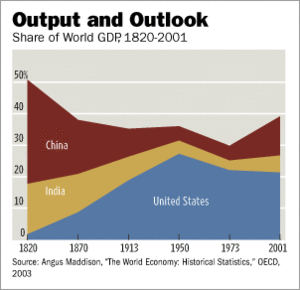
China and India accounted for half the global economy in 1820!


Venture Capitalists make good bloggers because they often have a broad view of the world. I just found this fascinating graph over at Ed Sim’s blog that compares GDP for US, India, and China from 1820 to 2001.

The amazing thing is that back in 1820 India and China together accounted for fully half of the global economy!

What we typically describe now as “the rise of China and India” in the modern economy is actually a *resurgence* of two economic superpowers from their previous dominance. With a little help from … Wal -Mart.
Share of GDP