Death on Everest. Would YOU have stopped climbing to save the guy?


News Item:
David Sharp, 34, died apparently of oxygen deficiency while descending from the summit during a solo climb last week.
More than 40 climbers are thought to have seen him as he lay dying, and almost all continued to the summit without offering assistance.

Our first reaction is to be appalled at the lack of concern and I'm anxious to hear from those who passed him by to hear their rationalizations. A Semper Fi sensibility hardly seems to apply to the new Everest hiking crowd. Sir Edmund Hillary observed this in his harsh criticism of the decision to put the summit above saving a life.

YET don't we ALL do this every day when we choose to distance ourselves from far more pressing global concerns where saving lives requires nothing like the efforts needed in this case? The key difference is proximity rather than ability to help. A modest Unicef contribution is more likely to save a life than attending to an oxygen deprived climber at 27000 feet in 80 below zero weather. Yet we don't have to look the malnourished kid in the face and thus we condemn and abhor the feelings of those who passed by the climber but absolve ourselves of what are probably more justified feelings of guilt for doing little in the face of great need.

It's a cruel world, right?

Update 

Book ’em!


I just read that we Americans have 1 in 136 people locked up. Right now. Incredibly, about 1 in 37 Americans have served time.  Among industrialized nations (and most others) we are the world's leading incarcerator. This is not a statistic to be proud of by any means and is an alarming indicator of an unhealthy society.

The Sentencing Project tried to answer the question "why?". This from a 2003 study comparing incarceration rates around the world:

The high rate of imprisonment in the United States can be explained by several
factors:
· A higher rate of violent crime than other industrialized nations.
· Harsher sentencing practices than in other nations, particularly for property and drug
offenses.
· Sentencing policy changes over a period of three decades, particularly the shift
toward mandatory and determinate sentencing, restrictions on judicial discretion, and
a greater emphasis on imprisonment as a preferred sanction.
· Policy changes adopted as part of the “war on drugs,” leading to a vastly increased
use of the criminal justice system as a means of responding to drug problems.

Playstation 5 = Human Brain says leading UK futurist


Playstation 5 , said leading UK futurist Pearson, will be as powerful as a human brain.  He notes the dramatic increase in power as video games evolve, and predicts that by 2050 we'll be able to download our brains into computers.    Combine this notion with the recent brain blueprint experiments for a neat look into the probably future of …. self.  

The implications are nothing short of staggering for a world filled with machine housed consciousnesses, communicating at near light speed via global networks.  

How would these entities, perhaps AKA "you and me", view those who have chosen NOT to download into the machines?     I'm guessing favorably unless the physical entities became threatening which would seem unlikely.  Machines – conscious and otherwise – by that time will be so capable that it seems unlikely serious conflict would be to anybody's advantage.

I just hope I can make it to 2050 and have enough cash for the download.  Pearson think's it'll take 25 MORE years before the procedure becomes cheap enough to be routine. 

“With enough money … current technology could compute the billions of neurons in the brain”


Thanks to Politech for pointing out this remarkable attempt to Blueprint the Human Brain using high speed computing.   I'll be very surprised if we can't duplicate human style thinking within a generation.  In fact I'm optimistic that machines will so far exceed our abilities that many complex problems will have solutions available to us as part of this process.  I'm not nearly as optimistic that we'll accept/implement these solutions.   Many pressing global problems are solvable NOW, but the forces of ignorance, selfishness, and politics prevent the implementation.

People and/or/for/non Profit?


Time Magazine:

Last month Gates-funded scientists announced that they had created the technology to manufacture artemisinic acid synthetically. Within five years, the cost of a lifesaving supply is expected to drop from $2.40 to 25 cents. Lead researcher Jay Keasling says it would not have been possible without a $43 million Gates grant. "I had companies call me and say, 'This is great, but we can't give you any money. We can't make a profit on this,'" he says.

I tend to be in the crowd that says profit is a great motivator to get companies to do bigger and better things, in turn raising the standards for most people and societies that intersect with those businesses.    At first glance the quote above indicates that in this case profit was getting in the way of optimizing development of new drugs where it will do the most good – in the developing world fighting easy-to-cure diseases or conditions like dehydration that kill millions every year.   But why didn't the Govts of those nations pony up for this effort?    Since the pharmaceutical industry was NOT the beneficiary of this was it reasonable to expect them to bear the entire financial burden?

Since the $43 million from the Gates foundation basically started out as profits distributed from Microsoft to Bill Gates, who in turn funded this life saving effort, we need to be cautious about saying profits are the problem here since they were the solution here as well.   Thus one could argue, and I think I would, that without a capitalistic infrastructure to create this wealth it's unlikely we'd see this development at all.

But most important is this question – how do we find the MOST effective mechanisms to create innovations on this scale?   I think the new breed of corporate foundations are part of the answer because they apply many of the successful principles of business to development projects.  Combine this growing force with tax and other incentives for companies that use their brainpower and expertise innovating for the broad social good.

And as for us everyday folks?  What can we do?  We can stop looking so narrowly at our own little niches, and instead look to the low hanging fruit solutions such as increased support for global health care.  We can broaden our perspective to a global one and recognize that we have to make small sacrifices in an effort to save entire generations who are threatened with disease and starvation but for the lack of simple remedies.   Even the most selfish person should realize that the satisfaction that comes from helping those in need is generally a much more profound experience than almost any other.

Darfur and the media


George Clooney deserves a lot of credit for bringing the media back on track about developments in what is arguably the world's most newsworthy and troubled place – Darfur, Sudan.    Unlike Rwanda the media has not ignored Darfur, but as with Rwanda the dangers, complexities, and lack of interest in USA have led to under-reporting which in turn sends politicians a signal that they don't have to act.

However it does not reflect well on the media or on us as media consumers that all it took was a bit of Clooney star power to snap this tragic story back to the top of the news where it should be.

Today's development is encouraging.  The Government of Sudan has accepted the peace agreement that could bring an end to horrible violence between Government sponsored militias and rebel forces.    As with many conflicts there are millions of regular people trapped in violence between bad Governments and groups of fighters with questionable agendas.

Darfur Conflict at Wikipedia

News about Darfur

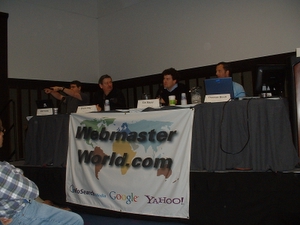
WebmasterWorld Boston moves to the Elephant & Castle


DSCF0053.jpg

WMW Boston ended at a nice Pub on Devonshire in Downtown Boston. This conference seemed to get better each day and although I felt some of the sessions covered "much of the same" things I'd been hearing at the last two Pubcons the special sessions and networking were great as always.

I'm kind of burned out right now from hundreds of new people, conversations, and ideas but I'll have some time tomorrow to pull together my notes on the site reviews session which was very good.

I think the highlight of this conference was a very enjoyable dinner with Aaron Wall, one of those very few who is *so good* at search optimization that Matt Cutts was asking *him* questions.

Aaron is an excellent guy. Buy his book!

Liberal Agendas + Republican Politicians = innovation?


It'll be very interesting to see if Gov Romney (Republican of Massachusetts) has come up with a solution to some of the biggest challenges in US health care. Clinton likes it and I think we'll see that the MA approach, which blends fiscal responsibility and quality care for all, may be just the shot in the arm our ailing health care system desparately needs.

Meanwhile Gov Schwartzenegger (Republican of Caleeeforneea) is coming up with some innovative ideas and a strong environmental agenda (his Humvee fetish excepted?).

And then there is presidential hopeful, in many ways the Republican "front runner", John McCain who is anything but a traditional conservative.

It would sure be nice to see a new breed of politician cut in the mold of progressive, penny pinching reformers. Americans are tired of the old, tired, wasteful, and ineffective ideas of both traditional liberals who are stuck in the anti-business big-government mode and traditional conservatives who are stuck fighting for military imperialism and cultural norms that are no longer relevant to the changing and growing American experience.

Golfing…in space


A Russian astronaut may get to drive a golf ball out into space as he orbits in a space station.   It is likely the ball would stay in orbit around the earth for some time, meaning the drive could measure hundreds of thousands of miles – maybe millions of miles.

If you'd suggested this to golfers back in 1900 I'd guessing they would have said you were insane.  

What unusual things wil we be up to in 2100?