People and/or/for/non Profit?


Time Magazine:

Last month Gates-funded scientists announced that they had created the technology to manufacture artemisinic acid synthetically. Within five years, the cost of a lifesaving supply is expected to drop from $2.40 to 25 cents. Lead researcher Jay Keasling says it would not have been possible without a $43 million Gates grant. "I had companies call me and say, 'This is great, but we can't give you any money. We can't make a profit on this,'" he says.

I tend to be in the crowd that says profit is a great motivator to get companies to do bigger and better things, in turn raising the standards for most people and societies that intersect with those businesses.    At first glance the quote above indicates that in this case profit was getting in the way of optimizing development of new drugs where it will do the most good – in the developing world fighting easy-to-cure diseases or conditions like dehydration that kill millions every year.   But why didn't the Govts of those nations pony up for this effort?    Since the pharmaceutical industry was NOT the beneficiary of this was it reasonable to expect them to bear the entire financial burden?

Since the $43 million from the Gates foundation basically started out as profits distributed from Microsoft to Bill Gates, who in turn funded this life saving effort, we need to be cautious about saying profits are the problem here since they were the solution here as well.   Thus one could argue, and I think I would, that without a capitalistic infrastructure to create this wealth it's unlikely we'd see this development at all.

But most important is this question – how do we find the MOST effective mechanisms to create innovations on this scale?   I think the new breed of corporate foundations are part of the answer because they apply many of the successful principles of business to development projects.  Combine this growing force with tax and other incentives for companies that use their brainpower and expertise innovating for the broad social good.

And as for us everyday folks?  What can we do?  We can stop looking so narrowly at our own little niches, and instead look to the low hanging fruit solutions such as increased support for global health care.  We can broaden our perspective to a global one and recognize that we have to make small sacrifices in an effort to save entire generations who are threatened with disease and starvation but for the lack of simple remedies.   Even the most selfish person should realize that the satisfaction that comes from helping those in need is generally a much more profound experience than almost any other.
Darfur and the media


George Clooney deserves a lot of credit for bringing the media back on track about developments in what is arguably the world's most newsworthy and troubled place – Darfur, Sudan.    Unlike Rwanda the media has not ignored Darfur, but as with Rwanda the dangers, complexities, and lack of interest in USA have led to under-reporting which in turn sends politicians a signal that they don't have to act.

However it does not reflect well on the media or on us as media consumers that all it took was a bit of Clooney star power to snap this tragic story back to the top of the news where it should be.

Today's development is encouraging.  The Government of Sudan has accepted the peace agreement that could bring an end to horrible violence between Government sponsored militias and rebel forces.    As with many conflicts there are millions of regular people trapped in violence between bad Governments and groups of fighters with questionable agendas.

Darfur Conflict at Wikipedia

News about Darfur

The Dovecote


I’m enjoying the great hospitality of my old friend Tom and wife Diane here in their cozy house in Concord, just around the river bend from the Old North Bridge. It’s called “The Dovecote” and was Louisa’s model for one of the sister’s houses in “Little Women”.

Benjamin Hosmer, a minuteman at the first battle of the American Revolution, lived in this house in 1775. The Alcotts were here some 50 years later. Louisa Alcott’s first poem was written here. Among the greatest thinkers of their time, Emerson, Thoreau, and Bronson Alcott very likely met on occasion here to discuss their progressive vision of the new American experience and ideas about social life, nature, and philosophy called the “trancendental movement”

Taxation within celebrations is Tyranny?!


Due to the Patriots Day holiday, residents of Maine, Maryland, Massachusetts, New Hampshire, New York, Vermont and the District of Columbia will have until Tuesday, April 18.

Is this fair?  I think NOT!    I say everyone is entitled to an EQUAL right to procrastinate until the last dang minute and this denies me, a citizen of Oregon, an equal right to the good people of Mass.

I think it was New England patriot Patrick Henry who said "Give me more time to file my taxes or give me a deduction"

The shot heard ’round the world


Concord and Lexington argue over which town can claim the first shot of the American Revolution. Lexington is where some shots first took place as the British moved out of Boston to look for guns hidden in Concord, but Concord's North Bridge is where the more organized and successful resistance to the British gathered early on April 19th, 1775. Several colonian "Minutemen" and British soldiers were killed in this skirmish.

Tomorrow they will reenact that historic battle.

"The Shot Heard Round the World" is a line from Ralph Waldo Emerson's "Concord Hymn" about the battle at the North Bridge, a song / poem he wrote in 1827 to commemorate the event.

By the rude bridge that arched the flood,
Their flag to April's breeze unfurled;
Here once the embattled farmers stood;
And fired the shot heard round the world.
The foe long since in silence slept;
Alike the conqueror silent sleeps,
And Time the ruined bridge has swept
Down the dark stream that seaward creeps.
On this green bank, by this soft stream,
We place with joy a votive stone,
That memory may their deeds redeem,
When, like our sires, our sons are gone.
O Thou who made those heroes dare
To die, and leave their children free, —
Bid Time and Nature gently spare
The shaft we raised to them and Thee.


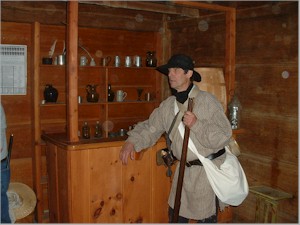
Inside Hartwell Tavern on the "Battle Road" from Lexington to Concord.   Hard Cider was the drink of choice here in the 1770s and one can only imagine the conversations as local farmers plotted … the American Revolution.

Hartwell Tavern

MinuteMan National Historical Park – Patriot Days!


Hanging out here in lovely Concord, MA with my most excellent old Pal Tom and his wife Diane. They live just down the street from Minuteman NHP where in many ways the Revolutionary War began.

This weekend and Monday the town celebrates "Patriot Days" with historical reenactments all over the area. Here at Hartwell Tavern on the Battle road Minutemen fought with retreating British troops.

MinuteMen

HUZZAH!

Liberal Agendas + Republican Politicians = innovation?


It'll be very interesting to see if Gov Romney (Republican of Massachusetts) has come up with a solution to some of the biggest challenges in US health care. Clinton likes it and I think we'll see that the MA approach, which blends fiscal responsibility and quality care for all, may be just the shot in the arm our ailing health care system desparately needs.

Meanwhile Gov Schwartzenegger (Republican of Caleeeforneea) is coming up with some innovative ideas and a strong environmental agenda (his Humvee fetish excepted?).

And then there is presidential hopeful, in many ways the Republican "front runner", John McCain who is anything but a traditional conservative.

It would sure be nice to see a new breed of politician cut in the mold of progressive, penny pinching reformers. Americans are tired of the old, tired, wasteful, and ineffective ideas of both traditional liberals who are stuck in the anti-business big-government mode and traditional conservatives who are stuck fighting for military imperialism and cultural norms that are no longer relevant to the changing and growing American experience.

Learning curves


What if most task learning takes place very early in the learning process, with refinements and “expertise” coming later and at much greater cost in time involved in the task?

For example what if most of our driving skills come from the first 50-100 hours of driving? Interestingly this is the amount if driving time required to get a license in Oregon so the state seems to feel it’s “enough time” to drive safely, I’d agree and suggest this is the case for most task learning.

IF TRUE across many tasks, then I’d suggest we should be spending a lot LESS time teaching people refined skills because the return on that time investment goes way down as we continue. Rather we should be *introducing* kids to more things so they can choose which to pursue in depth later in life. This is done to some extent – I think more than in the 1950s – but I see little reason to push calculus on students who often lack basic investment math skills UNLESS they’ve chosen a career where calculus is important. There are not many of those, and you hardly close doors by substituting practical life skills for advanced math (or science, or literature) studies.

As adults we should focus on learning new approaches and information rather than refining our expertise in very restricted areas *unless* our life depends on that expertise. Though I’m not even sure in this latter case that broader learning won’t trump specialized learning in terms of producing a well rounded intellect capable of handling the varied and sundry tasks of the modern world.

guns or butter?


This clever site offers some insight into the cost of the Iraq War in dollar terms.   Human costs are of course ultimately more important than money, but most people simply refuse to recognize that when you are talking about things like war and hunger the *human costs* often boil down to dollar costs.

You can save  LOT of people in the developing world by allocating a relatively small number of dollars, especially if they are spent on famine or health items. More about that later as politically and emotionally motivated spending is a fascinating examination of human irrationality.

The human death toll in Iraq (or even the total global WAR death TOLL) simply pales in comparison to the global hunger OR health tolls.   It's a factor of many thousands of preventable hunger deaths for every ONE (arguably NON-preventable) Iraq war death. 

Unlike most fiscal conservatives I simply stagger from the failures of the neocons when it comes to intelligent budgeting and ROI.    McCain, very much to his credit, was talking about this years ago and is talking about it now.