Misplaced compassion … kills


One of the most obvious things I assert is also the thing that bothers people the most.   It’s that most of us tend to fret or show  compassion over trivial or questionable things while we ignore the catastrophic circumstances that plague so many people around the world.

A great recent example is the effort to “find Paco”, a dog that was “lost” by Delta Airlines during a trip back to (the UK?) from Mexico.     As with most stories like this, the perception  at first glance is heart wrenching.    But then the facts clear up why this story is ridiculously overblown.

Paco was a stray, picked up by a tourist couple, who then had him shipped home.   It appears he escaped from his cage while on the tarmac in Mexico City and  (I’m speculating here) headed back to the places where he’s more comfortable living.    Sad for the couple, but hardly all that newsworthy, especially given the apparent outrage against Delta.

Delta’s offer to credit the couple only $200 for a lost pet was obviously a stupid move on their part, but I resent that people don’t get all the facts out there when trying to push these stories to a gullible public.    If you are a compassionate person you MUST IGNORE PACO and spend your time thinking about the daily deaths of thousands from Malaria, rotovirus, and lack of clean water.    Yes that task is more than  overwhelming, but the whimpy “Find Paco”  sentiment that people think makes them a “compassionate person” does nothing of the kind – it hardens them to the plight of millions who live in conditions we could largely fix if people would pay as much attention to that as they pay to missing stray dogs in Mexico.      (How?   If the developed world cut defense and entitlement spending by about 10% we could rebuild most of the developing world’s infrastructure  IN ONLY A FEW YEARS.     The strategic benefits alone would be staggering, but military enthusiasts are too blinded by irrational post-cold-war thinking while entitlement enthusiasts are too busy sending subsidies to the American lower and middle class, who contrary to our constant whining cost far more in bureaucracies and benefits than we pay for  (can you say “National Debt”?)

The millions spent sending poor Free Willie back into the wild also comes to mind (he died soon after, lacking the skills needed to survive).       Did people seriously think Willie would be happier in the wild?    It was as if their *need* to fight against captivity programs trumped the animal’s own well being.

So instead of fretting over things that don’t matter much, why not pick your favorite extreme poverty charity and help out – then you can feel good…. AND actually do some good too!    Here’s a start:   http://twitter.com/charitywater
Hope for Haiti Concert – Beyonce


Donate Now: 1-877-99-HAITI in US/Canada, or go to www.hopeforhaitinow.org

http://www.mtv.com/videos/misc/474738/beyonce-halo-live.jhtml

The music from this concert was pretty amazing, and if you buy it from iTunes it’ll help Haitians recover from what now appears to be one of the greatest natural disasters in many years.

There’s a lot of political discussion that should center around how to best help developing countries, but I think that should wait until after we address the emergency needs with water, food, medicines, and security. After that I hope we start an international discussion about what it takes to rebuild a failed state into the healthy and vibrant democracy people deserve to live in – the kind of country we in the USA take for granted.

Cost Benefit Analysis and the Environment


One of the most interesting topics right now is how to allocate risks and costs with respect to environmental problems like climate change.    I’m having an email discussion with my good pal John and thought I’d bring some of that online for others to comment:

RE:  Cost Benefit Analysis and Environment:

John’s:  It is very easy to distort their definitions towards a point of view rather than towards something necessarily valid.  Not that cost/benefit is never useful.  It is very useful when the costs and benefits are relatively simple to define.  Unfortunately costs from environmental degradation and benefits from efforts to change behavior are very difficult to delineate.  In the end through the early environmental movement persistence and intelligent thinking about clean water and air prevailed over those who used cost/benefit analysis.

Joe:  Very good points except I’m not at all convinced about your last sentence.   I used to agree with that but (without enough research) I’d say we needed cost benefits and failed to do them, leading to massive spending or bans on things that had little impact on the overall quality or simply shifted industrial damages to poor countries.   I’ve lost a LOT of respect for mainstream US environmentalism because I think it is not a global perspective and it’s mostly emotional rather than analytical, leading to bizarre policy and spending recommendations that don’t line up with long term planning and well being. Kyoto – now partially discredited even in environmental camps as an ineffective and bad approach – is an excellent example of how emotion drives policy.

Although there is enough right wing froth to confuse the analysis, another example of emotion trumping reason seems to be the Silent Spring / DDT ban which as far as I can tell will eventually be seen as one of the greatest and catastrophic (in terms of lives lost) errors of environmental thinking – though it would be very hard to model/evaluate the damages to ecosystem if we’d kept spraying.  Still, the facts suggest we had a moral imperative to keep using DDT which would have saved *tens of millions* who have since died from Malaria.   If those had been US kids there is NO WAY the ban would have stuck.
The same imperative – I would argue – that should focus us on malaria and malnutrition while we should largely ignore climate change.
You are certainly right about Lomborg being a lightning rod for controversy, but I’d encourage you to look at his TED talk or other writings.   I’d suggest he’s a very clear thinker, pilloried unfairly by the vested interests of an increasingly entrenched climate and environmental bureacracy.    It’s not logical to think that the public sector is above all economic and political influences while the private sector is a prisoner to them.  Both are compromised, which is why the clearest voices come from people like Lomborg who have no dog in the fight other than “optimizing human experience”.   We can disagree about how to optimize things, but I want to hear more from people who have no stake in how we allocate resources.   That leaves out industry scientists …. and NASA as well, leaving us with thin pickings.    Still, I’d argue strongly – very strongly – that the best policy recommendations are coming from the economists who are looking at both costs and benefits.

Comments very welcome!

Developing World Statistics – are probably not what you thought.


This fast paced presentation presents a cleverly graphed view of several important global development statistics. Dr. Hans Rosling is working to teach us all to work more with the data and less with our preconceptions about the ways of the world, especially with respect to approaches to health and poverty reduction. His site / project is www.GapMinder.org

Changing the world, one PR firm at a time


The CES 2010 pitches are coming in strong now as John and I get ready to cover the year’s biggest technology event over at  Technology Report.

I was so happy today to see one of them signing off saying they were a proud supporter of the Room to Read Project, which is a major effort to work towards world wide literacy and education.   Readers of this blog know I’m a huge fan of that kind of project, and one of the reasons I’m very optimistic about the world’s future is that for I think the first time in history it’s become very, very “fashionable” to support global poverty reduction efforts in even the strongest bastions of capitalism (e.g. big time PR firms).

Now, cynics will suggest – correctly to some extent – that part of the motivation when capitalists support charity is to benefit from the positive buzz.    However I’m fine with that, and furthermore I’m *glad*  to see potential win-win economic relationships develop around charities like this.

Have a Merry Microloan Christmas


This year I won’t be giving out more than a few tiny token presents to my friends and family, but I will be giving some of the best gifts I have ever given.   The Nobel prize winning efforts of the Grameen Bank have sponsored the poor with small loans to start businesses, and this tactic has proven to be one of the most effective poverty-fighting measures ever developed.

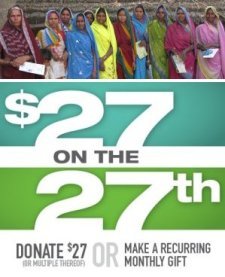
I hope you’ll consider gifts to Grameen or other charities as part of your happy holidays as well.     Grameen’s founder started the project with $27 business loans to poor businesses in India.      These were interest loans but historically have had a nearly 100% repayment rate.    The spectacular success of Grameen has also inspired other charities to approach development with more of an eye to entrepreneurship and small business and less of the “top down” mega project bureaucracies that have run into many problems as locals resisted them.     Small Business, Innovation, and Entrepreneurship is near and dear to the heart of many in the USA and I hope you’ll join me  in supporting Grameen with some green this Christmas.

Think about it –  $27 loans that often will positively reshape the lives of  entire families from this point forward.

More about Grameen.   If you are feeling *sassy*, you also might want to click to the right on the Grameen logo and donate via the Grameen page I just set up for a Christmas Campaign.     Frankly, if I was presented to this by anybody but a  friend I’d be a little concerned that the money would wind up at Grameen – they use a URL that is not easily recognizable as secure and connected to them.    But don’t let that deter you – just give at the Grameen Website in that case.

Grameen Foundation – Microloans WORK


The Grameen Bank was the simple but brilliant innovation in poverty fighting by Muhammad Yunus, who won the Nobel Peace Prize along with the Bank he founded.   The Grameen Bank provides very small loans to women in developing countries who then start businesses and almost alway pay back the microloans with interest.

Microloans have proven to be one of the most effective poverty fighting instruments ever, and continue to lift families out of the conditions faced in much of the developing world.    I’ll be giving to this cause and I hope you’ll consider doing so as well!

27th

Misguided Environmentalism – Don’t let it happen to YOU!


When ideology gets in the way of feeding people, everybody needs to start shouting “Stop the Madness”.    Try it, it’s cathartic.

Mega-philanthropist Bill Gates is no longer busy with Microsoft.  Instead, he’s one of the key people spearheading the largest and best funded effort in history to bring better health to hundreds of millions in the developing world.    The Bill and Melinda Gates Foundation has already saved over a *million people* with their international health efforts and they are on track to save tens of millions more.

Speaking at a Food Prize conference last week Gates observed that misguided environmentalism – specifically the fight to ban genetically modified foods – threatens to thwart some very innovative food programs.

I cannot agree more emphatically although I have to be less diplomatic than Gates, because it’s imperative that we stop paying so much attention to the incoherent rantings of those who oppose such innovations on the basis of their non-hunger-focused principles rather than because they have studied the science and the cost benefit relationships that often make this type of agriculture so compelling.

Too many who claim to be promoting environmentalism are busy with agendas that are often at odds with basic human needs.     The concept of  “sustainability” is invoked far too often now as an excuse to disparage business practices and promote questionable actions rather than address the real and optimized long term needs of planet earth and the human race.

Genetically Modified Food:  http://en.wikipedia.org/wiki/Genetically_modified_food

Gates on this issue: http://www.reuters.com/article/marketsNews/idUSN1530051720091015

The importance of the Green Revolution:  http://en.wikipedia.org/wiki/Green_Revolution

Acumen Fund’s Novogratz on Charlie Rose. Fighting Poverty with Profits.


Charlie Rose was rocking today with two superb interviews that enhance and challenge our perceptions of how to think about the world’s most pressing problems of poverty and health in the developing world.  [yes, I realize the global economy is part of this massive problem equation and agree that fixing it is of primary importance to developing world as well as to those of us who live higher on the hog].

Jacqueline Novogratz, a former Wall Street Banker turned Venture Capital Do-Gooder, on her book “The Blue Sweater” and her personal and business adventures using microfinance and entrepreneurial innovations.   Brilliant:   http://www.charlierose.com/view/content/10176

Connecting poor and wealthy to solve pressing problems in developing world: Acumen invests in innovative projects around the world, using the power of entrepreneurial capitalism to solve pressing problems of human need.

These approaches to development and poverty reduction are *so powerful* and *so effective* that it’s painful to watch how many people get bogged down fretting about issues like privitization of water and corporations as evil. We must focus on what *works*, regardless of our ideology.  The best representatives of that approach are folks like Novogratz, Gates, Yunis, and many others who bring their business brilliancies to the challenges of international development.

Rose’s next guest was ethics professor Peter Singer on the ideas from his book “The Life You Can Save: Acting Now to End World Poverty”.   Singer notes the major success of the Gates Foundation and also the fact that  while most Americans tend to say they think “too much” tax money goes to international Aid yet fail to understand how small our contributions are to international development projects, and actually suggest we should send “about 5%” when the real amount is about 1%.     Also makes the case that international development is actually in our own selfish best interest, but for many is not in our *perceived* self interest.   http://www.charlierose.com/view/interview/10174