First Scoble, then Battelle! Web 2.0, are you bubbling?


John Battelle, always insightful, is worried about Web 2.0 as a bubble.    Given that he’s one of the great 2.0 enthusiasts this comes as a bit of a surprise.    John writes:

… one of the really cool things about Web 2 is that you can keep making new companies, see if they work, then disassemble them and try again. Only, that won’t happen if the companies are kept falsely alive by a preponderance of venture capital and VC-related spending …

It’s a very provocative point, and I can see this happening during trips to Silicon Valley where some of the efforts simply … suck … yet they have enough funding to keep on trying.   I’m not even convinced some of these folks believe in their companies – they just show up at the trade shows and go through the motions until the money runs out, then head to a new gig.

That said I’m not as worried as Scoble or Battelle about a bubble, because I think this is what is going on right now and I think it’s a healthy and natural, though “new”, model for business development.

* The internet business ecosystem is inherently unstable and ripe with uncertain outcomes.

* This instability and uncertainty leads to an experimental, rather than “sweat equity” approach to  building businesses.

* For the Venture Capital community the best approach is to fund many Web 2.0 startups at modest levels, hoping that perhaps one in ten will become a solid business OR an aquisiton target and yield 10-100x the VC investment.

* For the big players like Google, MSN, Yahoo, the best model is to let the new 2.0 companies shake out on their own and aquire the successful ones as Google did with Keyhole maps, Picasa, etc, etc and Yahoo with Flickr, del.icio.us, etc, etc.

Ummmmm …. but what is the best model for aspiring 2.0 companies?    I think it’s to stay away from the VC fray and build lots of *inexpensive* experiments.     One of the best examples of this approach is the brilliant site PlentyofFish.com by Markus Frind, which started almost as a lark and has become a top tier site in a short time.
Does Web 2.0 success flow from the seven deadly sins?


Yahoo reports a neat quote by Reid Hoffman who founded LinkedIn.com the business networking site and has invested in many other 2.0 companies. He was asked for investment criteria and replied: “Which of the seven deadly sins does it appeal to?”

Let’s review the seven deadly sins to see if internet success stems from addressing them.
Thanks to deadlysins.com for this summary of the seven deadly sins:
Pride is excessive belief in one’s own abilities, that interferes with the individual’s recognition of the grace of God. It has been called the sin from which all others arise. Pride is also known as Vanity.

Envy is the desire for others’ traits, status, abilities, or situation.

Gluttony is an inordinate desire to consume more than that which one requires.

Lust is an inordinate craving for the pleasures of the body.

Anger is manifested in the individual who spurns love and opts instead for fury. It is also known as Wrath.

Greed is the desire for material wealth or gain, ignoring the realm of the spiritual. It is also called Avarice or Covetousness.

Sloth is the avoidance of physical or spiritual work.

OK, we’ve got a problem. I suppose you could argue that Google and Yahoo are not “2.0” companies, but clearly the big online money is not coming from the sins as much as from *search* which may be indirectly related to the sins as in people searching for sins, but I think the seven sins criteria falls short in favor of simple curiosity, socializing, and habituation (~aka branding) criteria which drive the top sites like Myspace, Google, and Yahoo and can be expected to drive future 2.0 successes.

Yahoo! too much 2.0 can be a … confusing…. thing.


Awhile back I failed to make my point about Yahoo doing “too good” a job at 2.0 for their own good, but now I see they are back at it again.    Yahoo Photos looks like some really good stuff, and if I remember correctly they have a huge library of pix and a user base  that is something like 10x greater than Flickr.    But I’m already confused.   Yahoo owns Flickr, which is a great application.   Are they expecting Flickr users – and more importantly developers of picture applications – to switch to Yahoo Photos?  Why? Are they rebranding here?   Sure I could spend a little time trying to answer these questions but this is not high on the list.  I know Flickr and love it and I’ll use it until further notice.

My earlier point was that offering people too many choices, or unclear choices, gets in the way of people *accessing* those quality innovations.   One of Google’s virtues has been to offer simple, targeted  solutions.   MSNs vice has been to offer cumbersome, bloated and confusing applications which change names every 6 months.

Yahoo, please follow the Google “instructions for use should be obvious and intuitive” plan.

If Scoble is worried, your 2.0 should worry too.


Robert’s concerned about potential failures of Web 2.0 companies.   He’s one of the best connected online people and his departure from Microsoft last month to join podtech signalled some *optimism* about the potential of Web 2.0.   Now that he’s in the trenches with other 2.0 startups it makes me nervous to hear him worry, though I think his concerns are legitimate and notable.

To me a key question remains unanswered, and relates to how people will relate to community niches which I predict will dominate the future of online activity, though I’m not sure how search will fit into the mix and it may continue to generate most of the revenues.

Will people primarily:

1) Join online communities as they grow up organically from the ground up ?
(e.g. Myspace, Facebook, PlentyofFish, Flickr)

2) Join communities that they are directed to via advertising and other activities at Google, Yahoo, MSN, AOL?
(e.g. Yahoo360)

3) Start with 1 and finish with 2 after the big company aquires the 2.0 company?

There are other possibilities but I think option 3 is going to be the pattern we’ll see for most companies.  FOX’s aquisition of Myspace and Yahoo’s of Flickr suggest that the big guys may just wait to see what creamy companies rise to the top and skim them off.    This experimental approach seems logical given the very high level of uncertainty associated with all things online.

SES San Jose – exhibitors are followers, not leaders


Note to middle sized companies that have exhibit staff – you’d probably be surprised to see them in action. Although I’m usually impressed by the people from Google and Yahoo who are typically well informed, enthusiastic, and polite, many of the technology exhibit folks seem poorly informed about the marketplace and too focused on their own pitch and “sale”.

I’d guess that the return on investment is negative for all but a few exhibitors, though perhaps the leads they get at an event like SES San Jose – the world’s top Search related conference – are golden and therefore hugely valuable?

The good news for me is that I now understand *very* clearly that outsourcing any search optimization I want to do would probably be a waste. Some of these places don’t even keep up with the freshest SEO news from Matt , WMW , or even SES. There are some exceptions to this SEO ignorance by SEO companies. I’m always very impressed with Bruce Clay . His approaches reflect recent SEO information. Bruce is always very well informed and helpful even to non-clients. Another exception would be freelance guys like Aaron Wall of SEObook fame. However, I’d say there are only a few hundred people in the world who know enough about SEO to make their insight more valuable than, for example, a clever high schooler who spends a few days absorbing information from Matt Cutts, the Google Guidelines, and Danny Sullivan posts. I’m increasingly skeptical that time spent at WMW and SES forums does more than create noise and confusion. This idea was supported even at a conference party by comments from the real engineers at MSN and Google who post at WMW as “MSNdude” and “GoogleGuy”.

SES San Jose – it’s almost like I’m not … here.


I’m sitting in my San Jose hotel room a few blocks from the Search Engine Strategies conference thinking how much better the information about the conference is … right here on my pc … than at the conference itself.   I’m not knocking SES (yet), just noting that a broadband connection and good website coverage means that even up in my little Oregon town I can “see” the emerging online world as well – in some ways much better – than hanging out in the middle of things here in Silicon Valley.  Microsoft’s MIX06 had more PCs all over the place where SES, like last year, has a long line to check mail unless you want to lug your own pc all over the place.   Also an inconvenience if you want to check up on blogs or conference updates.   The key point?  The virtual 24/7 conference online is rocking, and will only get better over time.

I shouldn’t knock the conference because I’m just an “exhibits only” attendee and SES clearly has emerged as the key search conference.   Also, Danny Sullivan is arguably the sharpest SEO observer in the world and based on comments by some presenters I know he treats his peeps well …

YET …  it sure seems they have the same tired “Our SEO is the best ever” exhibitors and perhaps as many as 60+% of the same presenters show after show, most pretending they are better at or more helpful with PPC and organic optimization results than … a smart high school kid … which is not supported by much evidence I can see, especially on the organic side of SEO.   I do hate to miss Matt Cutts comments and the Eric Schmidt interview but maybe I’ll bump into them at the party at Google tonight.

After going to 3 full Webmasterworld conferences, two SES as exhibits only, and one AD-TECH (where they more-nicely-than-SES allow exhibits people to attend the keynotes which are the best part of that conference), I think Webmasterworld offers the best insights and networking.  One presenter who appeared at both told the WMW crowd he had to dumb down the presentation for SES. Perhaps he says the opposite here, but I think SES, at three times the price, is not even as valuable as a WMW conference for all but a handful of niches such as Vendors, who’ll do better at this venue because they are selling things rather than dispensing quality information.   (Man there are a lot of SEO clueless salespeeps in SEO!)

Of course personal contacts are important, but I know I’ll find some people I know over at the Google Party later this evening.

Can the long tail wag the big internet dog?


Obviously niches of human interests will be a very powerful force in the shaping of the online world, and it would seem the best way to serve niches, especially a small one, is more along the lines of medium or  small business rather than big biz.  However the mega sites seem to be increasing their share of the action, and are shaping the new access and community tools.

I’m wondering which of the following models, if any, will be most prevalent in the future.  How much will the long tail wag the internet dog ?
Big Corporate Website model:  Yahoo, Myspace, Google, MSN as giant info, tools, purchasing portals, community centers.
Medium Website model:  I see this as content aggregator sites like technorati that serve large niche markets and use Web 2.0 sensibilities to help users slice and dice the overwhelming amounts of online content.

Mom and Pop model:  Local or niche specific info-rich sites where users will spend most of their time researching/buying/socializing.

Obviously there will be all of this and more, but I think the trends are important and it *makes intuitive sense* to me that onliners, especially the next generation, will seek niche specific social interaction that is not handled well by anybody right now.   Big sites mostly lack enough of a human element and sites like Myspace that do have a powerful human element fail to deliver a high quality or info rich experience.

With that in mind I’m off to Silicon Valley to hear 1) pitches from the Search Engine Strategies vendors about how they can get me to the top of the search heap (thanks, but I’ll just take the T shirt for now).  2) Google Party!   Always fun to talk to the search and labs teams there.  They be clever folk.

Google Party at SES 2006


Tuesday is the 5th annual Google Party in Mountain View at the GooglePlex, one of the biggest social events of the internet year. It’s held in conjunction with the Search Engine Strategies conference at the San Jose Convention Center. I was just down in Silicon Valley about 3 weeks ago for Mashup Camp 2, but I can’t miss the Google Party!

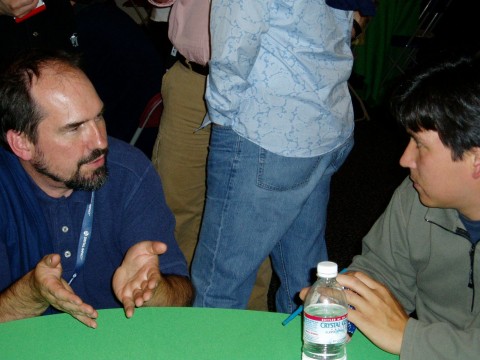
One of the highlights last year was a chance to talk to several of the Google Search Engineers. Here I am pestering Kekoa – I think about 302 vs 301 redirection and ranking items:

Kekoa at Google Party

Matt Cutts is generally in *high demand* at conferences as well as here at the 2005 Google Party webmaster talks, which are held away from the really big crowd outside. In fact in Boston at Webmasterworld he told me he hardly got anything to eat at this 2005 Google bash because he was constantly mobbed.  Thanks to my good friend John for shooting these pix.   He’ll be joining me again this year at the Party.

Matt Cutts at Google Dance 2005