Time has a nice summary of the latest rules on prohibited items.
Also see TSA’s Website for the latest guidelines.

Time has a nice summary of the latest rules on prohibited items.
Also see TSA’s Website for the latest guidelines.
The Google vs Kinderstart Lawsuit was dismissed though judge Fogel suggested that if Kinderstart can show a case of “manual intervention” by Google the outcome might be different and it’s now clear they’ll refile in September, probably as a class action. If the judge means they only need to show that Google’s done manual intervention *in any case* then this is going to get interesting, because everybody in SEO knows that Matt’s spam team routinely zaps sites that violate guidelines from the index. I doubt this was Kinderstart’s problem though – rather a severe algorithmic downranking that many sites have suffered over the past few years. However the Google lawyers may have failed to understand the nuances of the algorithm vs violations and how humans interface with this at Google (I think no single person knows everything over there). Thus if the judge felt Google claimed “no manual intervention whatsoever” then I think he might get pissed to know how often violating sites get killed off.
If this is any indication of the thinking that could guide the decisions I have no idea what’s going to happen here.
Robert’s concerned about potential failures of Web 2.0 companies. He’s one of the best connected online people and his departure from Microsoft last month to join podtech signalled some *optimism* about the potential of Web 2.0. Now that he’s in the trenches with other 2.0 startups it makes me nervous to hear him worry, though I think his concerns are legitimate and notable.
To me a key question remains unanswered, and relates to how people will relate to community niches which I predict will dominate the future of online activity, though I’m not sure how search will fit into the mix and it may continue to generate most of the revenues.
Will people primarily:
1) Join online communities as they grow up organically from the ground up ?
(e.g. Myspace, Facebook, PlentyofFish, Flickr)
2) Join communities that they are directed to via advertising and other activities at Google, Yahoo, MSN, AOL?
(e.g. Yahoo360)
3) Start with 1 and finish with 2 after the big company aquires the 2.0 company?
There are other possibilities but I think option 3 is going to be the pattern we’ll see for most companies. FOX’s aquisition of Myspace and Yahoo’s of Flickr suggest that the big guys may just wait to see what creamy companies rise to the top and skim them off. This experimental approach seems logical given the very high level of uncertainty associated with all things online.
I really like the ONE campaign because I think it’s doing something other development efforts have failed to do – harness celebrity power and “coolness” into the mix which encourages those who otherwise do not think about these issues to …. think about them a lot and jump on the bandwagon. One is making it “cool” to care about poverty, and I can think of few more powerful forces of change than the coolness factor. http://www.one.org
Thanks to the clever chat tool by Chat Creator I just participated in an informal gathering that was helping Robert Scoble pick a name for his upcoming PodTech.net TV show. I wasn’t up on the details of the show until now. Looks like a kind of TechCruch TV with a lot of 2.0 sites, news, and people. Looking forward to it!
I’m sitting in my San Jose hotel room a few blocks from the Search Engine Strategies conference thinking how much better the information about the conference is … right here on my pc … than at the conference itself. I’m not knocking SES (yet), just noting that a broadband connection and good website coverage means that even up in my little Oregon town I can “see” the emerging online world as well – in some ways much better – than hanging out in the middle of things here in Silicon Valley. Microsoft’s MIX06 had more PCs all over the place where SES, like last year, has a long line to check mail unless you want to lug your own pc all over the place. Also an inconvenience if you want to check up on blogs or conference updates. The key point? The virtual 24/7 conference online is rocking, and will only get better over time.
I shouldn’t knock the conference because I’m just an “exhibits only” attendee and SES clearly has emerged as the key search conference. Also, Danny Sullivan is arguably the sharpest SEO observer in the world and based on comments by some presenters I know he treats his peeps well …
YET … it sure seems they have the same tired “Our SEO is the best ever” exhibitors and perhaps as many as 60+% of the same presenters show after show, most pretending they are better at or more helpful with PPC and organic optimization results than … a smart high school kid … which is not supported by much evidence I can see, especially on the organic side of SEO. I do hate to miss Matt Cutts comments and the Eric Schmidt interview but maybe I’ll bump into them at the party at Google tonight.
After going to 3 full Webmasterworld conferences, two SES as exhibits only, and one AD-TECH (where they more-nicely-than-SES allow exhibits people to attend the keynotes which are the best part of that conference), I think Webmasterworld offers the best insights and networking. One presenter who appeared at both told the WMW crowd he had to dumb down the presentation for SES. Perhaps he says the opposite here, but I think SES, at three times the price, is not even as valuable as a WMW conference for all but a handful of niches such as Vendors, who’ll do better at this venue because they are selling things rather than dispensing quality information. (Man there are a lot of SEO clueless salespeeps in SEO!)
Of course personal contacts are important, but I know I’ll find some people I know over at the Google Party later this evening.
Tuesday is the 5th annual Google Party in Mountain View at the GooglePlex, one of the biggest social events of the internet year. It’s held in conjunction with the Search Engine Strategies conference at the San Jose Convention Center. I was just down in Silicon Valley about 3 weeks ago for Mashup Camp 2, but I can’t miss the Google Party!
One of the highlights last year was a chance to talk to several of the Google Search Engineers. Here I am pestering Kekoa – I think about 302 vs 301 redirection and ranking items:
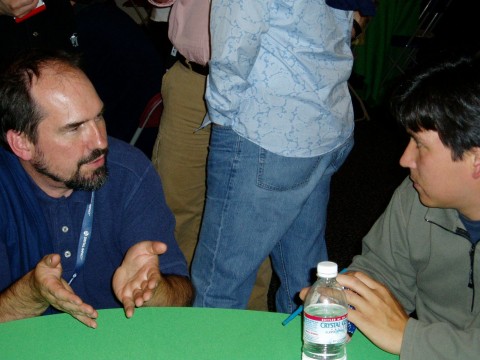
Matt Cutts is generally in *high demand* at conferences as well as here at the 2005 Google Party webmaster talks, which are held away from the really big crowd outside. In fact in Boston at Webmasterworld he told me he hardly got anything to eat at this 2005 Google bash because he was constantly mobbed. Thanks to my good friend John for shooting these pix. He’ll be joining me again this year at the Party.

I’m not usually a fan of corporate blogs because they usually suck in that sucky self-serving way, but based on a quick take the Yahoo blog, Yodel Anecdotal (I like it!) is going to be a light hearted view from and of a company filled with very clever people. I’ll still turn to Jeremy for the unvarnished insider view, but this looks like the place to get a feel for a company that’s breaking a lot of new Web 2.0 ground even though they are not getting nearly enough credit for it.
Now, if only the Panama team could get their act in gear maybe I’d be right about Yahoo stock potential.
Myspace and other social networking sites won’t be accessible from schools or libraries as a result of congressional legislation passed a few days ago. The Myspace ban was a fairly predictable type of response from congress, reflecting increasing concerns by adults who basically had no idea what their children were doing online.
The Myspace ban is very unlikely to have much of an effect on anything since kids, and the predators the bill is supposed to help thwart – probably were not using these access venues very much. Hopefully the news about this will get some parents to pay closer attention to their children’s online activities, which in general should be supervised far more than they are by all but a few parents.
As a parent I’m more supportive of restrictions and content filtering than most other internet folks, but I think the entire debate is missing a key point regarding a dramatic change in social norms.
I’d suggest that changes in social norms are something like those that happened in the USA in the 1960’s in both scope and substance, but that these changes in morality, personal identity, and social responsibility are “going global” thanks to online activities, online communities, and the explosive cross-cultural connectivity facilitated by 24/7 broadband access and online awareness.
Silly laws like this will hardly put the online Pandoras back in their boxes. However it will also be funny to hear free speech zealots whining about government intervention which will never have a chance of making truly significant changes.
The ships of sweeping social change sailed long ago and they are powered by exploding global online communities. Our best course is to look forward to the uncharted waters.
 Joe Duck