Web 2.0 adapter for Grandparents is needed.


Don has a very insightful look at trends in Web 2.0 based on a couple of recent conference experiences.  What I found particularly interesting was the graph which correctly noted the large missing link in Web 2.0, which is a simple (ideally I’d say a seamless, one-click) way to integrate the tons of independent content “silos” out there with the collectivce online body of work that falls under the Web 2.0 categories.

For example wouldn’t it be interesting if you could unleash a program that would scour your computer for pictures and writings, then ask you “do you want to send this out to the world?”, then shoot stuff off to the legions of online content repositories that might have an interest in that topic?      Despite the growth of online photo sites like Flickr, I bet they contain less than 1 in 1000 of all existing digital pictures.

Some tech people will say “hey, I already make sure the stuff I want online makes it online”, but tech people often forget how averse a lot of regular folks are to the interactive part of the internet, let alone to figuring out how to place their own stuff online.    This aversion won’t change anytime soon, and ironically it’s often the people with the stuff of the least interest who are mose likely to post it online.  For example gossipy myspacy party pix are plentiful where an old-timers thoughtful travel recollections often are relegated to Christmas letters and photo albums only found in a dusty old file cabinet.  Unleashing this treasure trove of experience and wisdom would be neat.

Privacy, Google, Sex, Lies, ISPs, and Query String Theory


Matt’s  got a great post and comment section going on the issue of online privacy.   His point is well taken – Google stores less information about you than most other players online and your ISP is the place that has a history of *all sites visited* where Google would have somewhat less information.

My take on this is the same as it’s been for some time – the dangers are more likely to come from commercial abuses than governmental ones.  Here’s what I wrote over there:

Matt this is an excellent post and comments conversation. Battelle was just talking privacy at his (neat!) online forum today. I’m guilty of “forgetting” that ISPs have more info about users than Google, and that it’s probably via ISPs or Carnivore-style intrusions that people’s privacy will be compromised, not via Google.
However, there are commercial issues that need to be addressed and IMHO are very poorly dealt with by Google and others. As a user I should own my own stuff, not the company making the application I use to produce stuff. This includes reviews, comments, and even search data. This ownership is routinely compromised, and this will piss people off more and more as they come to understand the big picture.

Battelle Online WebEx Conference: Web 2.0 digitizes the customer


Hey, I’m (sort of) liveblogging John Battelle’s search presentation which is currently … online via WebEx conferencing. John’s always interesting to hear, but this is more about the process than the content. I did like his slide noting that Web 2.0 is about digitizing the customer where early efforts were digitizing the office.

John’s talking about search and it’s neat to have some real time attention and the chance to ask questions via a text control panel – but HEY, nobody answered my questions yet! The WebEx system is not quite as navigation friendly as I’d expected but that’s OK because it’s trying to do a lot of things – polls, questions, and the audio broadcast itself. However I think Pirillo’s videocasting efforts may be a good lesson for WebEx as they move ahead with these approaches.

Even on my laptop with WIFI the audio is fairly stable and good quality. There appear to be about 64 people online per the poll results.

After attending about 10 conferences last year I’ve wondered how much better learning and retention I’d have if I’d just read up on the presenters and topics rather than actually go to the conferences. Shmoozing is fun and often educational, but even that might be done better away from conferences.

Advertising as Snake Oil. Wanna buy a bottle?


Via Aaron Wall an excellent article post by John Andrews suggesting how difficult it is to find legitimate SEO people among the ocean of pretenders and deceivers. There is some irony here though. This point is not lost on many advertisers who now (correctly) view most SEO people like used car salesmen. However a far more important point has been lost in the SEO quality scandals, and that is the fact that in advertising almost all salespeople and agencies are *absolutely* not to be trusted and generally are misinterpreting flimsy research to their own ends. They are not lying to you, they are simply interpreting results to favor their needs rather than yours. You think not? How many times has your agency recommended they be fired in favor of better teams they know about, or made recommendations that cost your agency big money in favor of your success?

Here’s a good advertiser mantra, and it should be repeated with each campaign:

Trust no one.
Independently verify results.
Change spending according to results.

Incredibly, I think 90% of all advertisers don’t use this approach, preferring to treat advertising salespeople and agencies or magazine and TV research reporters as “marketing” experts which of course they are not. Salespeople make money selling their own stuff, not selling success. As long as advertisers fail to follow up with metrics and/or trust the salesperson/ Agency’s claims it’s impossible for them to appropriately adjust the spend and define failure vs success. I used to think this was a problem only in small business, but it’s clear that even the largest corporations often fail to properly test, preferring (I think bureaucratically) to go with comfortable approaches that can be justified to spending committees.

The extreme failures of print and TV advertising (and other forms) to deliver has fueled the PPC revolution, though even PPC often has a negative ROI and testing is needed. Fortunately for those fortunate advertisers who realize how much better PPC will likely be than other forms of advertising it’s easier and cheaper to measure online advertising successes.

I commented over at John’s:
A simply excellent post John, getting to the heart of the challenge facing SEO customers and providers as well as a possible solution – forms of success metrics that are fairly standardized and/or easy to digest.

But good metrics are a gaping void in advertising and have been for decades. I’m often floored by the ignorance of advertisers who think they can count on salespeople to advise them on the effectiveness of the campaigns, which in my sector of travel are often horrible.

I’d suggest that TV and print salespeople are the most conspicuous deceivers, even more than many SEO pretenders. Although I agree that the overwhelming majority of SEO claims are bogus or deceptive, it’s important for advertisers to realize that even a modest PPC campaign, run themselves, will often outperform *their best print or TV efforts*.

Advertising in all forms, for the most part, is a lie. It often fails and people are too mathematically ignorant to discover the problems and realign the spend.

Tweet, Tweet?


New York Times is talking about Twitter, the social media chat application that is storming onto the internet faster than you can twitter to your friends as well as the public at large about what you are doing at the moment.

My initial reaction to Twitter was that I was somewhat underwhelmed but now I’m thinking that Twitter is appealing partly because it takes so little time yet keeps you “up” on a bit of the lives of friends and biz folks you know. This may even have a practical application when you run into them in person in that you’ll be able to communicate more effectively having a bit of background that will help frame your “catching up” during conferences or whatever. Twitter’s success may be in it’s simplicity of use. Unlike blogging you can quickly post a note and preview your pals, all in a few moments. If there’s one thing we like to see online, it’s things that cater to our increasingly *short* attention spans.

Startups … often suck


Pete Cashmore has been coming up with very clever titles (and as always great insights on social networking) over at Mashable. A good example is today’s “Web Startups and the Lying Liars That Lie About Them” where he basically makes the case that in general startups suck worse than one would think if one simply took what is written about them in blogs (including his) for granted.

This point hits home hard when you note, as Don Dodge recently did, that it appears startups absorb more money from venture capitalists than they return to the VCs that keep new web companies spinning out of the web, and often (more in the old days than now) keep them spinning out of control even after the startup’s business model has failed.

Interestingly, my own experience with our travel startup Online Highways was something of the opposite of the normal deal. We grew fast, did not get VC money, and started to make enough that we could open new offices in India and a second in Oregon. Initially by many measures we were not a great travel site but we were doing spectacularly well – by July of 2003 we had over 3 million monthly unique visitors. However, after pouring over a million of revenues into developments, maps, and other improvements we actually got nailed by Google for reasons that remain unclear, but as always make the internet a darn interesting place to hang out whether you are a startup that sucks or one that rocks.

Great article by Marc Andreessen about VC

More on this from NYT May 11th

Myspace is better than sex


Bob at Tech Consumer is noting the recent article in the Economist suggesting that Social Networks are about to dethrone “sex” as the top item of internet interest. The interesting graph notes that where sex stuff is becoming a smaller fraction of the total internet searches, social networking items are moving higher and higher.

In one sense this is a bit misleading. One of the key drivers of social networking is “dating” and meeting people, so it’s fair to say that what we might call “primal urges” are still the top search theme online. But it’s probably encouraging that the porn economy is growing *less fast* than the social online economy, which continues to explode. (Porn segment is growing but not as fast as the social economy segment of online traffic – and also probably economic – activity).

What’s going on with this? It’s really not surprising at all that socializing online is a very powerful part of the online experience. The internet is about people more than it’s about technology, and people tend to be very interested in …. other people.

Myspace News Launches … almost invisibly.


Myspace has become such a dominant player that the launch of Myspace News was a big story in the blogosphere. Ironically you could hardly find it at Myspace and it just took me a few minutes and Pete Cashmore’s Mashable.com links to find the darn thing. I agree with Pete that it currently is not very inspired, but has simply enormous potential to dethrone DIGG as the key hip news site.

Myspace is probably rolling this out slowly so they can manage the new traffic routing and bandwidth issues that will come up.   I remember at MIX06 where the Myspace CTO showed some slides indicating CPU usage on their server farm.    When they implemented the more efficient (Microsoft?!) architecture the CPU usage dropped dramatically.    The key point though was how for a huge site things like power, bandwidth, and CPU use become a big deal with every change.

I remain concerned that most of the news stories that are ranked and generated socially primarily appeal to prurient, adolescent, and technology interests rather than the deep and provocative intellectual stuff you’d get on, say, Charlie Rose. But it’s our free wheeling superficiality that makes America great (or at least makes us more fun than Finland), right?

Governor’s Tourism Conference


Oregon’s premier travel event is the Governor’s Tourism Conference. This year it was held in Sunriver, Oregon (about 15 miles south of Bend, Oregon) where the resort did a simply super job with food, accommodations, and hospitality.

My first Oregon Tourism conference was at Sunriver ten years ago and I think I’ve only missed one since then. It was great to catch up with folks I don’t see much since I stopped my internet marketing work with for the Southern Oregon Visitors Association a few years ago.

Although it’s been ten years since the internet became a key travel marketing tool, it’s still remarkable how print advertising remains the key marketing vehicle despite ROI measures that would make any truthful marketeer blush. Print enthusiasts, and even some silly “online marketing experts” have kept alive the myth that print ads lead to more than a trivial amount of web activity. I now attribute this to the fact people simply do not understand how cheap Pay Per Click advertising is as a destination marketing tool. It’s not uncommon for places to spend *several dollars* for a single print ad lead where a similar lead could be obtained online for as little as a nickel. I’d assumed years ago this gap would push people to PPC but as with most human behavior there is a huge level of psychological momentum that prevents them from changing behaviors. This is even true for huge companies like Ford that is *finally* moving to a much bigger online spend after a study showed how cost effective the online advertising has been for Ford.

One of the best presentations was from Golf Digest where even their head of research misconstrued results from a study of print vs online activity in planning golf related travel. He noted comparable numbers for the categories of “used print info” and “used online info” and suggested this meant that print advertising was therefore comparable to online in terms of effectiveness. This is technically true but it seems to me *extremely* misleading in terms of return on investment for advertising which won’t be comparable at all (they did not study this). Online you can target an ad and get *global reach*, all for pennies per click. With magazines you’d have to spend tens of millions *per ad* to get comparable reach on your message. Thus, as a marketer if you are deciding whether to run an ad in Golf Digest or run a comparably prices online campaign it is very likely that in almost all cases the PPC campaign will outperform the print one.

Google barely (corrected from “not”) shading search advertising links!


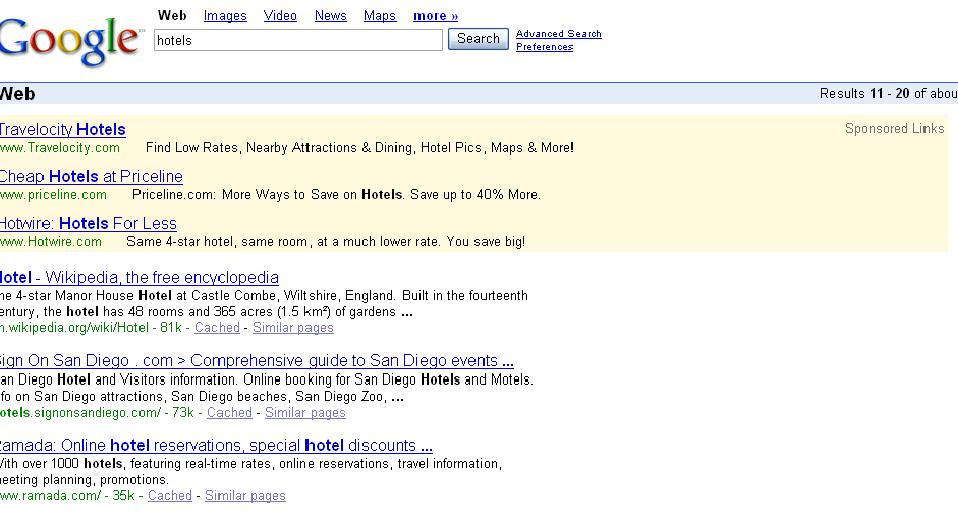
Google is no longer narily, barely shading the advertisements that appear at the top of the organic listings on the left of the search web page. This may be a regional thing or experimental (I’m in Oregon on Charter ISP), but it’s very conspicuous and frankly it makes it very difficult to distinguish between ads and real content.

Although I’ve always held that Google has a right to do this type of thing, I’ve always been frustrated with the pretense that they always take the high road and “don’t do opportunistic things”. This is a huge departure from Google’s previous approach and claims, which suggested how critical it is to separate organic and commercial listings. As this screen shows it is now *impossible* for the user to make that determination. Good for advertisers but bad for users and somewhat misleading.

The FCC actually claims to object to this approach, telling search engines some time ago that they need to make a clear distinction between commercial content and non-commercial.

I’m assuming they are testing the affect on clicks and revenue, and clearly it will be enormously profitable to do things this way as smart users typically look first to organic listings and last to advertising. However, in the long run it challenges the idea that Google’s primary interest is providing “unblemished” results. At the very least Google owes people an explanation here, and if it does not include the fact they’ll make a lot more money this way, and that that was a prime motivation, clear thinkers are going to call foul on this new practice.

googlenoshade.jpg