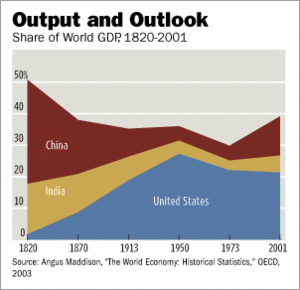
China and India accounted for half the global economy in 1820!


Venture Capitalists make good bloggers because they often have a broad view of the world. I just found this fascinating graph over at Ed Sim’s blog that compares GDP for US, India, and China from 1820 to 2001.

The amazing thing is that back in 1820 India and China together accounted for fully half of the global economy!

What we typically describe now as “the rise of China and India” in the modern economy is actually a *resurgence* of two economic superpowers from their previous dominance. With a little help from … Wal -Mart.
Share of GDP

Hugo Chavez and Noam Chomsky


Thanks to Hugo Chavez, Noam Chomsky’s book Hegemony or Survival: America’s Quest for Global Dominance (The American Empire Project) is now number one at Amazon.

Chomsky has always bothered me … a lot …. He’s a good linguist, a foolish economist, and a terrible social scientist / political commentator. Ironically it’s only the last two topics where Chomsky gets any attention and he’s an expert in neither.

He’s the the guy who suggested back in the 70’s that the regime of Pol Pot was not a great threat to the people of Cambodia. When it became clear that Pol Pot’s communist government, the Khmer Rouge, had murdered by many accounts over a million Cambodians Chomsky’s tune changed to suggest it was American destabilization of the region that was to blame.

Although this latter argument has some merit, clear thinkers will note that Chomsky’s failure to hold ruthless Communist regimes accountable while at the same time holding America “overly accountable” for virtually all the bad in the world is a very suspect political philosophy. Here’s a good critique of Chomsky’s hypocrisy.

However, I should caveat all this by pointing out that in a world where so many people and countries are challenging GW, Dick, and the Neocons imperial vision of the USA it’s very important to have more points of view out there than our commercialized media allows. Chomsky is one of the most articulate spokesman for an intelligent radical vision of the world and I’d like to see more of him rather than the inane ranting of intellectually lobotomized right wing radio talk show hosts.

Perhaps careful consideration of many points of view will lead us to some answers. We sure need them.

Posts that contain Hugo Chavez  per day for the last 30 days.
Technorati Chart
Get your own chart!

Blog readers and blog writers redux. Cicarelli still rules


Gee, the top blog search is still Cicarelli.


My earlier post with these technorati search terms seems to be getting a some attention for the term “Assparade” rather than the post I thought entitled “Cicarelli“, but I don’t have good stats yet.


I shall say with great pride and elitism that at Technorati this morning I was the top search result for “Assparade”, apparently simply because I put up the technorati list on my blog.


Today’s technorati terms are different but still indicative of the chasm of diversity between blog readers and blog writers.


Top Technorati Blog Searches September 23 (or maybe Sept 22?) – what are blog readers trying to find?

  1. Cicarelli
  2. Jonny
  3. Xing
  4. Pinky
  5. Openbc
  6. Bin Laden
  7. Bitacle
  8. Hugo Chavez
  9. Assparade
  10. Asian
  11. Axis of Sketchy…
  12. Grey’s Anatomy
  13. Richard Hammond
  14. Daniela Cicarel…
  15. Google

Top Technorati tags – what people are writing about.

  1. Bush
  2. Islam
  3. Pensieri
  4. Comedy
  5. Microsoft
  6. youtube
  7. Amore
  8. iPod
  9. sexy
  10. fashion
  11. foto
  12. Politica
  13. wordpress
  14. Politik
  15. torture


Although I do understand the diversity to some extent, particularly interesting is that “real” news like “Hugo Chavez” is not getting written up as much as it’s getting searched for.   I’m guessing that the blog writer demographic is still very narrowly “tech focused” but I wonder how it is politically?    Probably polarized, such that people with “strong” political views are far more likely to blog in that space.

Virtual thermometers are better than real ones. Cheaper too!


Matt was pointing out something I’m noticing about using the computer to find information you *used to find* by going to yellow pages, a calculator, or other gadgets.

We broke our outdoor thermometer painting the house, and just a few minutes ago this forced me to look online for the temperature.   I’d assumed I’d have to settle for the temp in larger cities of Medford or Ashland which are each about 6 miles away, but even here in rural Oregon there is a weather station less than a mile away from my house reporting continuously.

Thus I no longer need a thermometer at the house to know the temp to within 0.1 degrees and by using that virtual tool I get other info I could only have with a weather station (and meteorologist!) in my yard such as precipitation, humidity and forecasts.

If you are in it only for the money you won’t get as much … money.


When he’s not coming up with self serving pseudo communities like Squidoo, (am I too harsh? maybe…) , Seth Godin has lots of excellent marketing insights such as this one that suggests the big innovations come from passion about the topic and not from the quest for the holy big buck, which Seth suggests forces people to *stop innovating* too early.  He cites Apple Computer, Google, and others that really do support the hypothesis.

I don’t think this is the *main* story of success however.  I still prefer to view success as an evolution of ideas where 99.9% become “extinct” and .01%  survive due to forces outside of the control of the company – forces like global economics, weather, personalities, lucky timing, zeitgeists, etc, etc.

We tend to look only at “survivors” and forget that an analysis of corporate success would take a large number of company starts and follow them to their demise or success and then look at the factors that led to their fate.

Flickr  even suggests an evolutionary model both as idea and within the company.   Flickr started as a game maker rather than a photography sharing community.   Flickr’s evolution seemed to be a combination of luck, serendipity, brilliance, and (Caterina Fake might say most importantly) her realization of the potential of the “little idea” that became a huge online community.   Also important is that from Yahoo’s perspective Flickr probably needs to generate a LOT more cash before it’ll be considered worth the $20-30 million they paid for it.      Hmmm – I wonder if founders Caterina and Stewart are eyeing Yahoo’s possible 1 billion dollar offer for Facebook with any envy?

“Dear, we should have held out for a hundred million more!”

But as Seth suggested these innovators are not in it for the money so no worries there I’m sure…. hmmmmmm……