Google to Viacom: See YouTube in Court!


Viacom’s Google suit may actually go to trial, though I think everybody is just blowing smoke right now with Viacom looking for a nice payoff and Google looking to minimize the payoff to keep within the 400 million they allocated in the YouTube sale to copyright infringement payoffs.

Unless Google is lucky enough to get a silicon valley jury with an average age of 25 it seems to me they’d handily lose a lawsuit.   The notion that Google (let alone everybody with a PC and internet connection), didn’t realize YouTube contained vast amounts of copyrighted material and that Google didn’t have the technical capabilities to screen for copyrights is absurd.    I presume they’d make the fairly technical case that they can’t be held responsible for users uploading stuff, only for taking it down when they get complaints, but I think this (reasonable in the future) notion will wear thin under the weight of current (old fashioned) copyright rules.

Another victim of Google’s cleverness? Zunch Marketing goes belly up.


I don’t know Zunch, but I’d argue that it’s generally good riddance when overpriced fancy SEM firms go belly up. As Google creates easier, better, and cheaper ways to do great in-house SEM (e.g. Analytics and PPC management) it’s not surprising places are opting for this approach. For the most part the big SEM firms are dramatically overselling types of SEO that cannot be done at all or are best done in-house or with the greater expertise found in small SEM shops and freelancers. My $9600 bad experience with a fancy SEM firm last year led to a refund, but that was thanks to threatening to blog about it and the written guarantee of increased traffic. I think very few get refunds despite generally poor performance.

After a clever and intense process of selling me on the service it was frustrating to watch them apply generally good but obvious principles of SEO. Also frustrating to note that I knew more about SEO than they did from attending a few Webmaster World Conferences.

So, is Zunch the beginning of a new trend? Perhaps a good trend.

Privacy, Google, Sex, Lies, ISPs, and Query String Theory


Matt’s  got a great post and comment section going on the issue of online privacy.   His point is well taken – Google stores less information about you than most other players online and your ISP is the place that has a history of *all sites visited* where Google would have somewhat less information.

My take on this is the same as it’s been for some time – the dangers are more likely to come from commercial abuses than governmental ones.  Here’s what I wrote over there:

Matt this is an excellent post and comments conversation. Battelle was just talking privacy at his (neat!) online forum today. I’m guilty of “forgetting” that ISPs have more info about users than Google, and that it’s probably via ISPs or Carnivore-style intrusions that people’s privacy will be compromised, not via Google.
However, there are commercial issues that need to be addressed and IMHO are very poorly dealt with by Google and others. As a user I should own my own stuff, not the company making the application I use to produce stuff. This includes reviews, comments, and even search data. This ownership is routinely compromised, and this will piss people off more and more as they come to understand the big picture.

Google barely (corrected from “not”) shading search advertising links!


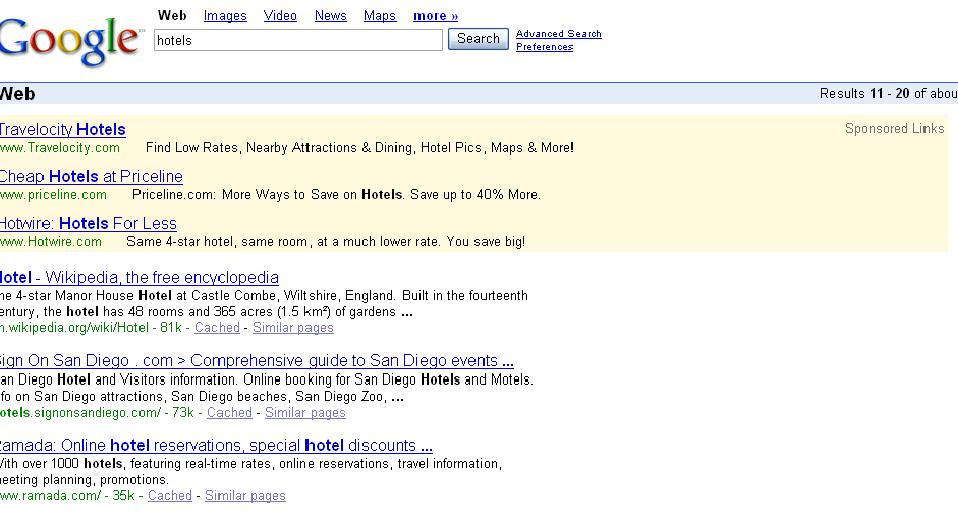
Google is no longer narily, barely shading the advertisements that appear at the top of the organic listings on the left of the search web page. This may be a regional thing or experimental (I’m in Oregon on Charter ISP), but it’s very conspicuous and frankly it makes it very difficult to distinguish between ads and real content.

Although I’ve always held that Google has a right to do this type of thing, I’ve always been frustrated with the pretense that they always take the high road and “don’t do opportunistic things”. This is a huge departure from Google’s previous approach and claims, which suggested how critical it is to separate organic and commercial listings. As this screen shows it is now *impossible* for the user to make that determination. Good for advertisers but bad for users and somewhat misleading.

The FCC actually claims to object to this approach, telling search engines some time ago that they need to make a clear distinction between commercial content and non-commercial.

I’m assuming they are testing the affect on clicks and revenue, and clearly it will be enormously profitable to do things this way as smart users typically look first to organic listings and last to advertising. However, in the long run it challenges the idea that Google’s primary interest is providing “unblemished” results. At the very least Google owes people an explanation here, and if it does not include the fact they’ll make a lot more money this way, and that that was a prime motivation, clear thinkers are going to call foul on this new practice.

googlenoshade.jpg

Google buys DoubleClick for 3.1 Billion


Google as advertising juggernaut continues the aggressive “advertising baron” expansion with today’s purchase of DoubleClick. I doubt it was DoubleClick’s technology that made this attractive to Google, rather the stable of existing advertisers and – perhaps most importantly – keeping DoubleClick away from Google rivals. It seems to me a key part of the Google strategy is to buy technologies and sites like YouTube and DoubleClick to effectively dry up the lake of opportunity for advertising rivals, especially Yahoo and MSN.

Yahoo’s also got good news today with a big newspaper deal, coming on the heels of Yahoo’s Viacom deal. I was surprised Yahoo stock didn’t reflect these positive developments but Yahoo’s stock fate seems to be tied more to the perception of Yahoo as a second fiddle to big and brilliant Google than to developments in the marketplace.

More from NYT 

Google Advertising Rumor


I really appreciate Robert Scoble‘s great insights but I’m skeptical of the party rumor he cited today that suggests this about Google Advertising:

… fewer ads mean less revenue SHORT TERM. But long term the advertising revenue actually goes up. Why? They found their users started trusting the advertising more and were more likely to click on ads.

This is possible but seems unlikely. Heavy users are generally going to want a bunch of ads to quickly scan because Google context matching and user queries are usually not specific enough to come up with the “right” ads.

Revenue per click goes down as you add more ads at lower per click rates so it complicates things as well, but I don’t get the ‘trust’ factor cited by Robert – it just does not make sense to me that Google is effectively training people to click on ads more often by offering fewer ads.

Maybe I’m missing something in this case, but these trends are huge because online advertising is arguably the most significant change in the landscape in decades, and thanks to having accurate conversion measures we are going to see a huge shakeup in the ad world.   That’s a very good thing in an industry that is, to a large extent, based on either misleading people or, at the very least, changing their behavior opportunistically.

Oscars look out – The YouTube Video Awards are exploding in a microwave near you.


Pete reports that YouTube will announce today their version of the Oscars – a “Best clips of 2006” sort of Academy Awards for YouTube. Scoble suggests it’ll be a way to find “more great video” but I’m skeptical.

Hmmm – After YouTube eliminates all the copyrighted clips, SEO marketing scam clips, and lame junk will there be anything left to win the awards?

“And the Oscar for best explosion in a Microwave goes to ….”

Although I’m a fan of the YouTube concept of user driven content freely and easily distributed, and I see this as a key transition to a vide-ized world, I’m intrigued by how little discussion there is about how lacking in quality are 99.9% of YouTube videos. I see it as a testament to the alarming lack of creativity in the techno-savvy population, especially when you consider that those uploading are, on average, MUCH smarter and probably more creative than the people who have not figured this stuff out yet.

As things shake out we will hopefully see improvements and creativity flow to the clip medium, and we are also seeing glimmers what is potentially the highest use of video sites – news and clips of things that cannot or will not make it to conventional media. Things like eyewitness stories from Iraq and closed societies like North Korea, or small town football games so Grandpa can cheer on the kid from 3000 miles away.

All these types of media, in abundance, would demonstrate the huge potential of citizen driven media, but this stuff is pretty lacking right now on YouTube, which favors at it’s best *clever* junk clips like exploding bottles of Coke, microwaveable silliness, or Dell Laptops.

So, good luck to all the nominees for best clips of 2006. All 100,000,000 of you. And may the best exploding Coke bottle win!

Who owns your attention anyway?


Too deeply buried in the (very interesting) discussion here  and here bout how hard it is to get enough traffic to a website to make it generate big money is a more provocative question, to wit:

Who owns YOUR attention and how much is your attention worth?

Big players are making huge profits reselling your attention in the form of placing targeted advertising while you search and surf for info. I have no complaints about that in principle (in fact I feed my kids from that!) , and even agree, somewhat reluctantly, with the assertion that advertising can often enhance the search experience by providing you with sales info on products related to your searches and surfing.

However I’m not sure the power curve is properly placed right now. Rather the big players like Yahoo, Google, MS call most of the shots and reap most of the profits while we, the little sheeples, use their (good) services, often at no charge. It’s certainly a win-win scenario for most, but you can make a strong case that Google, as the big recipient of the big bucks, wins more than you do. Frankly though I don’t know the equation here – what am I worth to Google or Yahoo or MSN?

Over at Battelle’s during a discussion of Microsoft’s new plans to pay big users to use MS products a reader suggested it would take over $50 per month for him to switch to MS search rather than his preferred Google. This raises a very interesting question about what he’s worth to them. I wrote over there:

Pay to use may be the shape of things to come as users begin to realize that they, and not the big players, are the key to internet success. Yaacov’s point is key – would he really want $600 annually to use MS search? If so he’s not typical. I bet you could get most people to abandon Google in favor of LIVE (which is close, but not as good as Google), for $50 per year or less.

In fact I bet you could get most people to switch engines for $10 per month and some for $5 or less. Why don’t they do it? MS had plans and I think they eventually will try this “pay to search” model, which is strong and moves closer to the user ideal of owning their own attention.

When you sell my attention to the highest bidders, shouldn’t I get a piece of the action?

Another related NYT Article

Fixed mindset vs Growth mindset = Microsoft mindset vs Google mindset?


Google’s legendary success, especially in light of Microsoft’s lackluster performance, leads one to wonder about the differences at these two techno behemoths.

Stanford Magazine has a nice feature on the work of Carol Dweck on personal achievement. Here is a summary of the work in a single diagram.

Perhaps the big difference between Google and Microsoft is that the Google culture inspires what Dweck calls a “Growth Mindset”, which the MS culture inspires the “fixed mindset”.

Supporting this model is the idea that where MS seems to ignore criticism Google often embraces it. Also, Google remains open to change – flexible – while Microsoft seems to resist change or even force square pegs into round holes with bloated or “bad fit” applications. For Google, the modifications to the world view are reflected in Google products. This leads to the simpler, more friendly technologies Google is known for.

Meanwhile the MS products rely more on their virtual OS monopoly, big businesses reluctance to change, and their sheer size which allows them to move the market.

Where does Yahoo fit in all this? (disclaimer – I have Yahoo stock) . I think they are the sleeper here, with a culture and people that have the potential to adopt the growth mindset but are currently stymied by market forces and the Google glow.

Related:  Scoble today bashes his ex, Microsoft, for talking BS before action.

Viacom “Austin Powers” to Google: We want ONE BILLION DOLLARS!


Viacom has sued Google/YouTube for copyright infringement, filing papers today and asking for a billion bucks in damages. The Viacom Press release summarizes their point of view. In short Viacom says of YouTube:

Their business model, which is based on building traffic and selling advertising off of unlicensed content, is clearly illegal and is in obvious conflict with copyright laws.

Here’s the Reuters Story

Mark Cuban warned about this type of legal challenge overwhelming the YouTube deal several months ago.  Here’s his take on the latest news.   It seems possible Google may wind up regretting their purchase of YouTube, proving to be a hornets nest of potential litigation that seems to be increasingly expensive. This while it remains unclear how well YouTube content can be monetized, to the extent there is much left after all this litigation. Google allocated about 400 million of the 1.65 billion purchase price to settle these claims but if the Viacom lawsuit it any indication it may get more expensive than that.

Ultimately I’m guessing it’ll be judges reaction to the new ethos surrounding IP law. Onliners big and small routinely disregard many longstanding content distribution rules so judges may decide that the legal issues have become so universally murky that they’ll start ruling in favor of the new media distributors like YouTube/Google, though I’m guessing the first sets of judgements will seek to penalize them in the name of respecting existing copyright laws. The swirl of legal challenges to YouTube content may be a case where Google’s freewheeling, usually innovative approaches come back to bite them, but it’s too early to know.