George Soros on Zakaria GPS


Hedge fund manager George Soros is one of the world’s richest and most successful market watchers (and market manipulators?). Zakaria reports that Soros’ recent plays have netted him over 2 billion. He’s very controversial for his political views though my take is that great business folks can easily separate their politics from their business decisions.

Consuming more than you produce:/ That game is over.

Houses as piggy bank, instead of savings. [BAM! We are seeing this obvious but profound observation coming up a lot]

Misconception: Markets will correct themselves. They won’t. We have reached the end of a bubble cycle started in the 1980s when massive global markets and deregulation frenzy began.

Mortgages as the “detonator” of the nuclear bomb that is the current global crisis. Stock market in capitulation phase that has followed credit problems.

Can’t predict future because it depends on decisions. He says he was wrong in 1998 to predict some sort of climax to the bubble.

“The cost will be greater, the damage will be greater”.

“You need a government that believes in government”

Paulson bailout plan as ill concieved – same kind of financial engineering that got us into the mess. Paulson as behind the curve “all the way” because he buys into market fundamentalism.

The authorities have lost control of the situation.

Soros recommends: Mobilize private capital to buy into distressed banks and lift minimum reserve requirements to free up lending.

Reduce number of foreclosures by renegotiations to sound mortgages that will not exceed 85% of house value. Loss to be absorbed by mortgage owners (banks?). Govt will then guarantee mortgages to 85% value, which would encourages renters to buy. Some losses, short recession.

Soros: I understand the flaws which allows me to profit, but as a citizen I want better regulation. Markets and Govts are flawed. Less regulation, better regulation.

Soros (like Gates and Buffett?)  believes the anti-tax positions are false because supporting infrastructure with taxes is so critical to wealth formation.

Soros said he does have inordinate influence as a rich person on politics but , unlike many other rich folks, does not use it to improve his financial positions.  He thinks market fundamentalism abets power abuses in politics.

China built assets while we built debts.   Tremendous power shift.   But America will remain a leader and could be *the* leader with some changes.
Sequoia’s Slide Show on the Economy


Sequoia’s Advice to startups has been the subject of speculation for the past few days, but now VentureBeat has posted the actual slide show from a recent major meeting where startups were told to prepare for some seriously bad economic stuff and a recession that could last for many, many years.

Sequoia Slide Show

———————–

I was particularly glad to see the slide noting that people have been using home equity as a “piggy bank”.

My current take on the huge Government actions trying resurrect the prosperity economy is subject to change faster than you can say “The Dow’s Down 500”.  However I would like to hear more talk about how the economy got too big for it’s britches and most of us, and certainly the country as a whole, have been living pretty large for no good reason, fueling both economic growth and personal living off of home equity that …. ain’t … here …. no …. more.     We’ll need to work harder and get less for awhile, and perhaps forever as the rest of the world catches up to our levels of prosperity.    Welcome to the new global economy.

Another factor I’m confident about is that the banks are going to act very opportunistically with the new sources of funding, though I’m not sure what form this will take.  Assume, for example, that you run a totally solvent bank and have managed risk appropriately.   Yet you know the feds are about to absorb disproportionate risks in order to get the macro economic juices flowing.    Your best play is to lay low for awhile, waiting for potential free money, lower risks, and most importantly saving up the benefits of your solvency so you can scoop up smaller banks and deals as they become available.    Although I assume there are some safeguards in place I think one of the Fed’s miscalculations right now is that the big bank players *want to play* when in fact the best of them *want to hang out and make a killing* as the insolvencies rip through the system and are removed at taxpayer expense.    This behavior by solvent banks *also* increases uncertainties because nobody currently knows who is good to go and who will be dead later in the month.   I *absolutely* agree with those calling for a massive increase in financial transparency throughout the banking sector – e.g.  requiring banks to place much more itemized information about assets and liabilities online for all to see.   This should be a condition of *doing business with the Federal Government*, which means every bank would be required to do it.   The initial effect would probably be a massive shift in resources toward the healthier banks but this is where the Government, again with total transparency, could balance things out to avoid potential catastrophic failures.

Hello UK, and welcome to the bail out club…


I’m not seeing enough about the 500 billion pound UK Bailout (that’s $865 Billion US) on US Financial news.

That’s more than our USA bail out despite the fact that our economy dwarfs that of the UK.  Probably a sign that here in the US we are in for massively more bail out spending before the financial bloodbath is over.

The scale of this measure suggests to me what the markets already seemed to know – the situation is worse than we’ve been told.

So, market activity remains jittery and unhappy even though we’ve now got a massive global bailout in progress with the global .5 rate cut combined with 700 billion here and 865 billion there and the large global rate cut.  Gee whiz, pretty soon this could add up to real money.

I’m uncertain about this but I think the only remaining certainty is uncertainty, and that’s … for sure!

Will 2010s be like 1930s? I sure hope not.


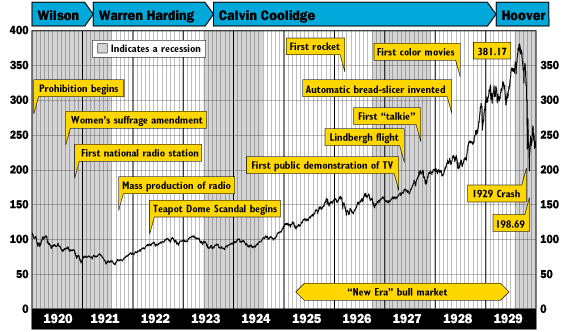
Wow.   I thought the crash in October 1929 brought the market down to  the low levels that signalled the great depression.  So I was surprised to learn that after a large rebound in the DOW it was really the declines of 1930 that brought the DOW down into the depression era numbers.   Look at the 1920’s rise of the DOW and fall to about 250 after the crash of October 1929:  Graphs Source is Dow Jones Indexes

Now comes the scary part.    Post crash DOW of about 199 was about FIVE TIMES the DOW lows seen during the great depression with a DOW at 41 (yes, that would be forty-one) in 1932.

OF COURSE you can overgeneralize from the depression data.   Today billions of shares trade in a market far greater than at that time, the global economy is totally different, etc, etc.

However what really concerns me is the fact that the drops we’ve seen of some 40% from DOW highs of the late 1990s look more like the 1929 prelude to a depression than I’d been thinking.   Are we in for just the modest rebound we’ve seen from the market lows of a few years ago and then a long slide into economic despair?    Is this even knowable?

Warren Buffett, in an excellent interview on Charlie Rose a few days ago, seemed to think that the bailout / rescue plan will avert a catastrophe, but he was clearly thinking there was at least some trouble ahead bailout or not.

Bailout Blues + Red Ink = Spending Revolution Needed.


Washington does not understand why taxpayers are so angry about the bailout.   Some pundits are calling this ignorance, but I think to the extent *anybody* can predict things taxpayers know pretty much what is going on here, and realize there is major hardship ahead whether or not the bailout moves forward as proposed, as a modified bailout, or does not happen at all.    Some of this is already reflected in the stagnant broader markets we’ve seen for the past few years, and some reflected today in the Dow’s drop of about 700 at the close.  But this is not a meltdown, suggesting to me that the rumors of total market meltdowns have been at least somewhat exaggerated.

Paul Samuelson noted today in an excellent article that we are basically seeing the bankruptcy of modern economics:

Our leaders are making up their responses from day to day because old ideas of how the economy works have failed them. These ideas were not necessarily wrong, but they’re grievously inadequate at the moment

The American experiment was spawned in large part as a revolution against military-inspired spending taxation from Britain.    Few today realize that the taxation levels of the 1770’s were so tiny by today’s standards that they would not raise a modern eyebrow, let alone spawn any kind of spending revolution.

Over the past 230 years times have changed and we now expect Government to tax us at what the founders would have seen as enormous and totally unacceptable rates, and spend *even more* than they take in, leading to a deficit so large it is in my view of greater economic concern – far greater – than the current recession (which will be getting a lot worse, bailout or not).

What would restore most taxpayer’s confidence?    Massive Government spending *cuts*, not massive Government spending as proposed in the bailout.

For most of the modern era Washington’s response to problems has been massive debt spending, pushing problems forward to future generations who’ll have to pay down our debt.   The Bailout was a similar response unless you accept the optimistic notion that all of that 700 billion will come back after the toxic assets were sold off by the Government.   Most likely based on my take some but not all will come back.

Wen Jiabao interviewed by Zakaria


Wen Jiabao is the Premier of China, making him one of the most influential international figures of this generation. Today on Fareed Zakaria’s GPS – one of the best shows on TV, we are hearing from Wen Jiabao on several topics of extreme relevance to the global community.

I can’t compliment Zakaria enough for a journalistic style that does two things I’d argue are necessary to get *access to people* while at the same time getting real rather than canned insights. First, he’s polite, which gets access and creates a relaxed atmosphere where real dialog can take place. Second, he asks the *big* questions in a way that brings us real insights into the thinking patterns of the key political and thought leaders he interviews.

Rather than summarize things here I want to link to CNN’s GPS page where I think they will post the interview, because anybody with an interest in where things are going should be paying very close attention.

Much of the current debate in this country about China (as well as many things) takes a sort of cartoon form, where people are stuck on oversimplifying a handful of complex talking points like China’s economic relationship to the USA and China’s Tibet policy (which in my view could largely be solved by shifting treatment of Tibet to an autonomous region like Hong Kong, a relationship that is working fairly well).

Asked about the prevailing economic philosophy who did Wen Jiabao quote? None other than Adam Smith, suggesting that the free hand of capitalism should be balanced by Government regulations to keep things fair and orderly (FYI he’s right that Smith was an advocate of some regulation and application of “morality” to free markets – a historical point often lost in debates here over free market virtues).

What’s Wen Jiabao reading? Stoic Marcus Aurelius apparently is one of his favorite philosophers, a thoughtful but sometimes ruthless Roman emperor who advocated social responsibility and internal progressive social reforms even as he persecuted wars and treated some dissenters ruthlessly.

The megabillion bailout better be transparent


Most of us are still trying to wrap our heads around the fiscal crisis also known as the US banking system.   I’m listening now to the Bush economics crew (Cox, Paulson, Bernanke)  in their congressional testimony.

It is too early to analyze how we went from an economy these guys were describing as healthy to an economy these guys now say is teetering on the brink of economic collapse, but it’s very clear now that the Bush adminstration, and to a lesser extent a clearly incompetent “do nothing” congress, have over the past several years failed to prevent the worst financial crisis since 1929.    Completely reckless Government spending and irresponsible fiscal policy were present during this debacle and it’s tempting to blame the problems on Government’s failure to prevent Wall Street from excesses that were totally predictable – namely always trying to turn a buck and fighting regulations that would inhibit profit making, regardless of the long term effects on the economy.

Ron Paul has what to me is the most thoughtful take on the situation to date, though it seems there is now a near consensus among economic experts that failing to do the bailout will lead to catastrophe.   I have not heard enough to make an informed decision, but I am very concerned that there will not be enough transparency in this process.

I want *every dime* of my tax money accounted for in this process.  I want information on *every salary* of everybody I’m bailing out, and I want CEOs held fully accountable even if that has some short term problems with stability.   Accountability matters.

Templar Treasure Refund?


The Knights Templar are suing the Vatican to recover the treasure that was taken from them 700 years ago:
http://www.theregister.co.uk/2008/08/04/knights_templar_pope/ (thanks Glenn for the tip!)

Just when you thought Facebook employees were making out like bandits and as if the Catholic Church didn’t have enough economic trouble on their hands, let’s assume a very modest initial value of 10 million in Templar treasure.

Now compound that annually at a modest 7% …  for SEVEN HUNDRED YEARS!

This would be a doubling every 10 years, so we have 70 doublings of the ten million or
10 x 2 to the 70th power =  1.18 × 10 to the 21st power.

Thus we have about 1.18 x 10 to the 22nd power million dollars owed to the Templars since we started with 10 million dollars.

$11 800 000 000 000 000 000 000.00   = Eleven septillion, 800 pentillion dollars.

Wow – since the annual global economy is only about $150 trillion….. I hope the Templars will take a personal check for the rest.

240k Kindles with books on the wall, 240k Kindles with books


OK, so now TechCrunch is reporting that their secret source informs them that Amazon has sold  240k Kindles in less than a year.   That would be pretty good though it does not lead me to retract my May suggestion that the analysis by Citbank is bogus.

In that analyis Mark Mahaney suggested that the Kindle would sell only 189k units in 2008 but then blow the lid off with sales in 2010 of 2.2 million.    That key part of the analysis – huge sales after modest early adoption – still seems unlikely to me, though I might be swayed to Kindle mania if the sales trend over the past months was clearly up.    That would indicate enough consumer satisfaction to suggest they might become a gadget of choice with enough mainstream adoption to see the huge profitability projected by Citibank.   Hey, on the internet anything is possible.

Google’s KinderGate: Your kids are welcome here for $57,000 a year.


When I first read about trouble in Google land over child care costs I thought it would be another case of the how super well paid but whiney Silicon Valley parents were unreasonably complaining about a minor bump in their charmed luxury lives. But maybe not.

Google appears to be on a search for the holy grail of child care, and even after charging parents for the service Google wound up subsidizing things to the tune of 37,000 *per child per year* – managing to spend the approximate average national income on every kid lucky enough to reach the nirvanesque kinderplex environment. The solution to this negative cash flow – unusual for the company known for showering employees with benefits like laundry service and free meals – was to raise the child care rates to about 2500 per month per child.

The NYT reports that two kids in Google childcare will run you $57,000. Although Googlers take home an average of something like $140,000 per year this isn’t going to ruin them, but this sure ain’t a page from the Brady Bunch days.

The situation is interesting economically but I think even more interesting as an experiment in Google’s approach to social engineering, which I think argue may be failing because it may not be able to scale in the same fashion as many of Google’s magnificent technological innovations.

Although Silicon Valley employees have historically enjoyed some great benefits, Google shined as the company that outdid everybody with free gourmet meals, free laundry, and great parties all within a context of individual freedom to work pretty much as you pleased as long as you were productively engaged, and even that was defined in some part by the employee.

This approach seemed to be working well, but I wonder how much of this was just an illusion caused by Google’s huge wash of incoming cash. The NYT article suggests that the company hardly even noticed the child care subsidy until recently. I’m guessing that only recently have the Google bean counters been called up from their free lunch to sharpen their pencils and find ways for Google to trim the company budget.

There are obviously two huge human resource pressures on Google now as it grows within the context of providing the world’s best company bennies. First is the fact that the legions of Googlers are for the most part…kidless. As employees age, especially the key folks from the early days, Google will see a lot more departures of key folks and a lot more demands for family time and benefits. Even stronger will be the pressure from the growing number of employees in Google’s empire, far more of whom are likely to be “in it for the money and perks” than in the early days. I remember touring the Googleplex a few years ago with an exec who, when asked about this problem, said it was not happening. But I think that was about 10,000 employees ago and before the level of concern over Google’s KinderGate scandal.

I will be very interesting to see if Google can scale their sometimes pesky human resources as effectively as they have scaled their technological and commercial resources.

I’m guessing…make that strongly predicting….the answer is no.

New York Times Reports