Nikola Tesla


‘The Prestige’ is a very enjoyable film that is set about a hundred years ago and features a battle of wits, romance, and magic between two brilliant magicians.

I’d assumed they had taken great liberties with the character of Nikola Tesla, played wonderfully by David Bowie. Tesla was an inventor of spectacular brilliance whose place in history has been somewhat eclipsed by his contemporary Thomas Edison.

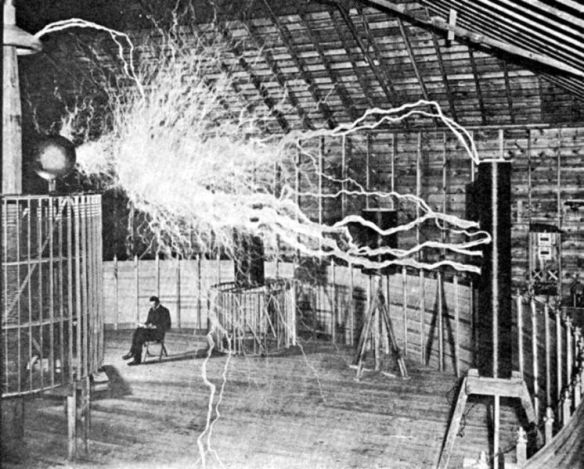
Remarkably, the film has only taken a few liberties with the remarkable feats of Tesla. This actual photo of Tesla’s colorado “office” looks a lot like his Colorado Springs place in the film. (This is a double exposure – the guy was not sitting there at same time as the artificial lightning was created).

Tesla was decades – perhaps even a century – ahead of his time. His invention of alternating current revolutionized factory power during the industrial revolution. He also developed ways to transmit electricity wirelessly such that he illuminated light bulbs from a distance without wires (this idea is featured in another great scene in the film).

Despite his undisputed brilliance Tesla’s odd demeanor and immigrant status appears to have kept him from the later respect he deserved, and may have kept Tesla from other amazing inventions such as a particle beam weapon and unified field theory (Tesla challenged parts of Einstein’s vision of physical reality).

Tesla, one of the greatest geniuses of modern science, died in poverty.

Excellent Wikipedia Article

Here is Tesla’s Autobiography.
tesla_colorado.jpg

Black Holes = Worm Holes = Dimensional portals to new universe? Maybe….


You’ve got to love it when highly respectable, real science collides with science fiction as in this recent study suggesting that black holes may actually be worm holes that connect our universe to others.

This appears to be consistent with the provocative ideas in string cosmology that suggest the possibility of many parallel universes existing together without much interaction between them. Some string theorists think that gravity – a very weak force in terms of the universe – may represent a force that exists simultaneously in several universes and thus could possibly be used to communicate between them.

It’s very hard to wrap your head around ideas relating to dimensions in space that are not what we commonly experience as the three physical dimensions plus time, but these extra dimensions are becoming a key part of the way physicists describe the underpinnings of the universe. Perhams more importantly, they are … fun and educational!

Of Mice and Men … and mouses brains


IBM has just simulated half of a mouse brain on a supercomputer. The significance of this research cannot be overestimated, as projects like this are very likely to lead to the next state in human evolution itself – human-like artificial intelligence. This does not appear to be directly part of the similar IBM Blue Brain Project, an incredible and ambitious attempt to reverse engineer a human brain.

I think there is less popular interest in these projects than one would expect because for many it’s painful or difficult to accept that all the things we hold very dear – most notable our consciousnesses and our intelligence, will soon be duplicated electronically and probably surpass us in many respects. I’m very optimistic about this state of affairs because I think we do a fairly lousy job of managing resources and providing for our individual and collective welfare. Computers already play a role in managing stuff and as they become conscious it’s very likely they’ll be able to allocate resources far more effectively. Hopefully this will usher in a new era of prosperity for all, though my guess is that it will take humans at least a few generations to start “trusting” the excellent advice we’ll get from the electronic intellectual sector.

Also frustrating to some is to come to grips with the rather insignificant, but interesting, role we play in the cosmic scheme of things. Merging with machines offers a lot of potential to transcend our feeble human intellects and physical limitations, but I suspect this will also cause some consternation, especially with those who prefer 12th century sensibilities.

But technology will prevail and hopefully we humans will have the insight and fortitude to let computers rise to the thing they’ll be able to do much better than we ever will:

Think.

Brain scans yield key first step to … reading your mind.


A provocative experiment in Germany raises questions about the future of keeping our thoughts private and even free will itself.   Researchers have been able to predict, with modest accuracy, the *intention* of a person to complete a mental task.     Predicting physical actions with brain activity has been done before but this appears to be the first example of predicting mental activity from brain activity as measured by MRI.

Here’s the story

The implications are significant both philisophically and in practical terms.    What exactly is “free will”?   If our decisions are effectively made *before* we actively process the information then what exactly is in control of our thoughts and actions?      If your future “decisions” are simply a product of a bunch of your past thoughts and behaviors then you may be a lot more predictable than you think.

From a practical side this could make for a marketing dream world (or nightmare world?), where persuaders in advertising or politics would tailor the message to your specific brain activity, or even try to “short circuit” activity in their favor.

Hmmm – I suddenly feel compelled to vote Ray Kurzweil for president …

Thinking about the IBM Blue Brain Project … thinking …


The IBM Blue Brain
project is working to model a human brain using computers. They expect to have a neocortical column, which they think is likely the key building block for conscious thought, modelled by 2008. If they succeed the next step will be to connect these columns and allow them to exchange information. At the point where enough information is exchanged it seems reasonable to assume the machine will probably become conscious, and that will be … cool.

Lomborg on “Climate Hysteria”


As concerned as I have been about the scientific sensationalism and downright deceptive presentations in Al Gore’s “An Inconvenient Truth“, I was rooting for Al last night at the Oscars. Perhaps as consolation prize for losing the US Presidency?

Contrary to what many think it’s clear to me that Al Gore is sincere in his crusade against climate change, and also it’s important to remember that if the US electoral system OR the ballots in a critical county in Florida did not have significant quirks he is *extremely* likely to have won the presidency, shifting global affairs over the past 6 years about as much as you can imagine since Gore was strongly against the Iraq war and would have brought an entirely different agenda to the American political table.

As Arnold Schwarzenegger pointed out at the National Press club recently, political compromise and partnerships are the practical approach to solving problems. I really like that guy!

With this in mind I’ve been feeling too strident in my criticism of focusing far too much on Global Warming, but whenever I read Lomborg’s clear headed analysis…I know I’m right to be upset at the hysteria mongers who are deflecting us from caring about ongoing health and human welfare catastrophes in the 3rd world.

Lomborg’s got it right .. again… but nobody is listening … again.

PS – for anybody who thinks Katrina was from Global Warming *please* at the very least, review the comments by key, mainstream scientists which suggest quite clearly that it’s absurd to suggest Katrina is from warming.  Also interesting.  People have become so immune to the Global Warming truth they aren’t even reading any science. READ the IPCC summary!

Robots and emotions


The BBC reports that a project is trying to teach robots to react to humans in emotional ways.   Sounds cool, though I’d suggest it’s always important to make a distinction between when a thinking mechanism can *talk* so much like a human that we can’t tell it’s a machine vs when that machine starts to *think* like a human thinks – ie it becomes conscious.

Many wrongly use this distinction to make that case that mechanisms will never attain human-quality intelligence even if we reach the point where the machines behavior (e.g. answering complex questions) is indistinguishable from human answers.    It seems likely we’ll have both, though I’m guessing consciousness for computers is at least 10 years away.

I remain wildly optimistic about the advent of *artificial consciousness*, though I think it’s possible that artificial intelligence may come to us in a sort of backwards fashion.  That is, humans will increasingly use technologies that are integrated with our biological processes until eventually we’ll realize that our intelligence has become more mechanism than biological process.

That said I think I still lean to the notion tht the human intellect and consciousness are purely algorithmic processes driven primarily by the interaction of neurons in the cortex and therefore we could have a computerized version of these processes soon.   I sure hope so because I’d like to know what they’ll recommend we do with the pressing problems of the world.

Page to scientists – get marketing, PhDudes!


Google Founder Larry Page spoke to the American Scientists Friday and encouraged them to market science projects better and also to look for solutions to pressing problems.    Good advice indeed.    I’m frustrated to see so much of the innovation and brainpower of American science go to the study of obscure or abstract things when it would be put to better use solving the pressing problems of out time like global health, infrastructure improvements, etc, etc.

Come on PhDz, let’s move those intellects into practical problem solving gear!