Startups … often suck


Pete Cashmore has been coming up with very clever titles (and as always great insights on social networking) over at Mashable. A good example is today’s “Web Startups and the Lying Liars That Lie About Them” where he basically makes the case that in general startups suck worse than one would think if one simply took what is written about them in blogs (including his) for granted.

This point hits home hard when you note, as Don Dodge recently did, that it appears startups absorb more money from venture capitalists than they return to the VCs that keep new web companies spinning out of the web, and often (more in the old days than now) keep them spinning out of control even after the startup’s business model has failed.

Interestingly, my own experience with our travel startup Online Highways was something of the opposite of the normal deal. We grew fast, did not get VC money, and started to make enough that we could open new offices in India and a second in Oregon. Initially by many measures we were not a great travel site but we were doing spectacularly well – by July of 2003 we had over 3 million monthly unique visitors. However, after pouring over a million of revenues into developments, maps, and other improvements we actually got nailed by Google for reasons that remain unclear, but as always make the internet a darn interesting place to hang out whether you are a startup that sucks or one that rocks.

Great article by Marc Andreessen about VC
More on this from NYT May 11th

Myspace is better than sex


Bob at Tech Consumer is noting the recent article in the Economist suggesting that Social Networks are about to dethrone “sex” as the top item of internet interest. The interesting graph notes that where sex stuff is becoming a smaller fraction of the total internet searches, social networking items are moving higher and higher.

In one sense this is a bit misleading. One of the key drivers of social networking is “dating” and meeting people, so it’s fair to say that what we might call “primal urges” are still the top search theme online. But it’s probably encouraging that the porn economy is growing *less fast* than the social online economy, which continues to explode. (Porn segment is growing but not as fast as the social economy segment of online traffic – and also probably economic – activity).

What’s going on with this? It’s really not surprising at all that socializing online is a very powerful part of the online experience. The internet is about people more than it’s about technology, and people tend to be very interested in …. other people.

Myspace News Launches … almost invisibly.


Myspace has become such a dominant player that the launch of Myspace News was a big story in the blogosphere. Ironically you could hardly find it at Myspace and it just took me a few minutes and Pete Cashmore’s Mashable.com links to find the darn thing. I agree with Pete that it currently is not very inspired, but has simply enormous potential to dethrone DIGG as the key hip news site.

Myspace is probably rolling this out slowly so they can manage the new traffic routing and bandwidth issues that will come up.   I remember at MIX06 where the Myspace CTO showed some slides indicating CPU usage on their server farm.    When they implemented the more efficient (Microsoft?!) architecture the CPU usage dropped dramatically.    The key point though was how for a huge site things like power, bandwidth, and CPU use become a big deal with every change.

I remain concerned that most of the news stories that are ranked and generated socially primarily appeal to prurient, adolescent, and technology interests rather than the deep and provocative intellectual stuff you’d get on, say, Charlie Rose. But it’s our free wheeling superficiality that makes America great (or at least makes us more fun than Finland), right?

Governor’s Tourism Conference


Oregon’s premier travel event is the Governor’s Tourism Conference. This year it was held in Sunriver, Oregon (about 15 miles south of Bend, Oregon) where the resort did a simply super job with food, accommodations, and hospitality.

My first Oregon Tourism conference was at Sunriver ten years ago and I think I’ve only missed one since then. It was great to catch up with folks I don’t see much since I stopped my internet marketing work with for the Southern Oregon Visitors Association a few years ago.

Although it’s been ten years since the internet became a key travel marketing tool, it’s still remarkable how print advertising remains the key marketing vehicle despite ROI measures that would make any truthful marketeer blush. Print enthusiasts, and even some silly “online marketing experts” have kept alive the myth that print ads lead to more than a trivial amount of web activity. I now attribute this to the fact people simply do not understand how cheap Pay Per Click advertising is as a destination marketing tool. It’s not uncommon for places to spend *several dollars* for a single print ad lead where a similar lead could be obtained online for as little as a nickel. I’d assumed years ago this gap would push people to PPC but as with most human behavior there is a huge level of psychological momentum that prevents them from changing behaviors. This is even true for huge companies like Ford that is *finally* moving to a much bigger online spend after a study showed how cost effective the online advertising has been for Ford.

One of the best presentations was from Golf Digest where even their head of research misconstrued results from a study of print vs online activity in planning golf related travel. He noted comparable numbers for the categories of “used print info” and “used online info” and suggested this meant that print advertising was therefore comparable to online in terms of effectiveness. This is technically true but it seems to me *extremely* misleading in terms of return on investment for advertising which won’t be comparable at all (they did not study this). Online you can target an ad and get *global reach*, all for pennies per click. With magazines you’d have to spend tens of millions *per ad* to get comparable reach on your message. Thus, as a marketer if you are deciding whether to run an ad in Golf Digest or run a comparably prices online campaign it is very likely that in almost all cases the PPC campaign will outperform the print one.

Google barely (corrected from “not”) shading search advertising links!


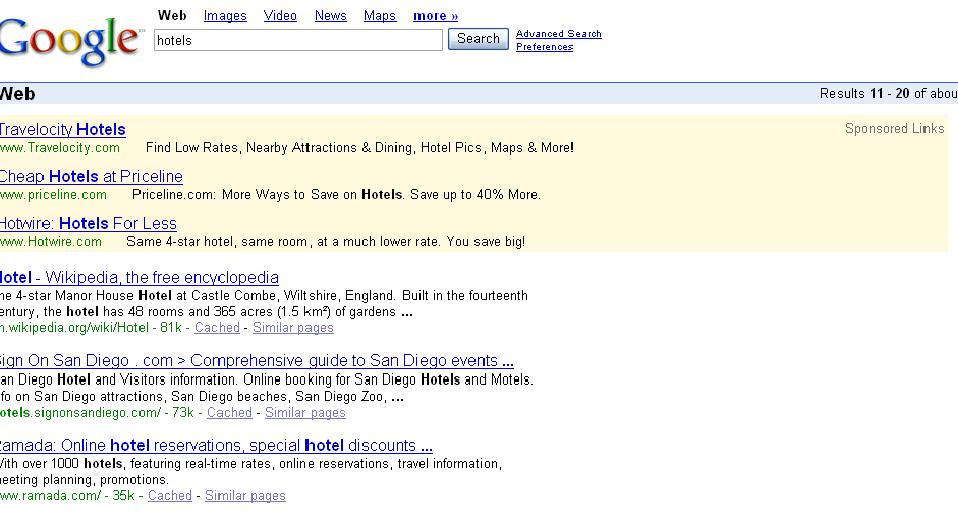
Google is no longer narily, barely shading the advertisements that appear at the top of the organic listings on the left of the search web page. This may be a regional thing or experimental (I’m in Oregon on Charter ISP), but it’s very conspicuous and frankly it makes it very difficult to distinguish between ads and real content.

Although I’ve always held that Google has a right to do this type of thing, I’ve always been frustrated with the pretense that they always take the high road and “don’t do opportunistic things”. This is a huge departure from Google’s previous approach and claims, which suggested how critical it is to separate organic and commercial listings. As this screen shows it is now *impossible* for the user to make that determination. Good for advertisers but bad for users and somewhat misleading.

The FCC actually claims to object to this approach, telling search engines some time ago that they need to make a clear distinction between commercial content and non-commercial.

I’m assuming they are testing the affect on clicks and revenue, and clearly it will be enormously profitable to do things this way as smart users typically look first to organic listings and last to advertising. However, in the long run it challenges the idea that Google’s primary interest is providing “unblemished” results. At the very least Google owes people an explanation here, and if it does not include the fact they’ll make a lot more money this way, and that that was a prime motivation, clear thinkers are going to call foul on this new practice.

googlenoshade.jpg

Google buys DoubleClick for 3.1 Billion


Google as advertising juggernaut continues the aggressive “advertising baron” expansion with today’s purchase of DoubleClick. I doubt it was DoubleClick’s technology that made this attractive to Google, rather the stable of existing advertisers and – perhaps most importantly – keeping DoubleClick away from Google rivals. It seems to me a key part of the Google strategy is to buy technologies and sites like YouTube and DoubleClick to effectively dry up the lake of opportunity for advertising rivals, especially Yahoo and MSN.

Yahoo’s also got good news today with a big newspaper deal, coming on the heels of Yahoo’s Viacom deal. I was surprised Yahoo stock didn’t reflect these positive developments but Yahoo’s stock fate seems to be tied more to the perception of Yahoo as a second fiddle to big and brilliant Google than to developments in the marketplace.

More from NYT 

Tim O’Reilly, Blog Sheriff with a shiny new badge


How to enforce more civility at blogs is the hot topic of the past few days.   Here at the Joe Duck blog I recently encountered the tricky nexus between censorship and civility when I chose to ban a sometimes insightful but almost always abusive commenter.  He was the type of person who seems compelled to be abusive.  I think it’s fine to ban that type of person, but I object when people say this is not a a form of censorship – it certainly is and to some degree any censorship can hurt the quest for truth.

Jarvis takes Tim to task about his ideas.

In the latest debate I’m concerned people are confusing two different problems: Blogger Kathy Sierra had some death threats recently.  Mike Arrington suggests this is what got this debate going.    Death threats are illegal and need police follow up.  However Mean-spirited comments are hard to regulate effectively, regardless of any policies, because the line is subjective, unclear, and very dependent on context (e.g. discussion of a savage serial murderer vs a new cell phone).

So as much as I’d like to agree with Tim that we should work to invoke some standards I’m very skeptical of any approach that tries to define civility.   Skeptical enough I’d say there really is no reason at all for a new approach, sheriff badged or not.

New Bear Camp Road Warning Signs


New warning signs have gone up in the Bear Camp Road area to warn travelers of the dangers there.    The sign effort was from John Rachor, the helicopter pilot who was instrumental in the rescue of Kati Kim and the Kim Children back in December.  A lot of people were asking John about the signs and he asked me to post these pictures:

bear-camp-sign-001.jpgbear-camp-sign-003.jpg

Happy Easter. Let’s solve some problems.


As well-fed comfortable primates our interests tend to turn to the superficial, but wouldn’t it be interesting if we could focus our great resources and enthusiasm on the real problems of the world, and focus attention in proportion to their impact on the globe?

This list of Global problems and potential solutions from the Copenhagen Consensus:

Challenge   |   Opportunity

Communicable Diseases   |     Scaled-up basic health services
Sanitation and Water        |    Community-managed water supply and sanitation
Education                            |    Physical expansion
Malnutrition and Hunger  |   Improving infant and child nutrition
Malnutrition and Hunger  |   Investment in technology in developing country agriculture
Communicable Diseases    |   Control of HIV/AIDS
Communicable Diseases    |   Control of malaria
Malnutrition and Hunger  |   Reducing micro nutrient deficiencies
Subsidies and Trade Barriers | Optimistic Doha: 50% liberalization