Twitter less?


Seems to me that Twitter is, in fact, a very important issue with far too much discussion about downtime and not enough about why Twitter appears to be replacing blogging, Facebook, and email as the communications paradigm of choice for the digital elites, which often means  the rest of the online world will soon follow.

Twitter’s system failures have become so common that several of the silicon folks like Mike Arrington are suggesting that people should be moving  to other services – most noted is FriendFeed which now allows “room” conversations as a way to sort noise from signal and talk with a group about specific topics.   I think if they’d come along at same time FriendFeed would be winning the war for the hearts and minds of the legions of twitterers, but Twitter has such a foothold as the microblogging / communication tool of choice it’ll be hard to unseat Twitter unless their services fail to improve over the coming months.   Improvement is likely given their recent Venture capital injection which effectively valued Twitter at about 100 million – enough that money will  soon pour in as needed to beef up their shaky infrastructure.

Why is Twitter important?   It’s really a form of A.D.D. blogging – fast and furious with links out to full treatments which can be read only if they really look interesting.  Because Twitter caters to short attention spans and also throws everybody in regardless of laptop color or digital creed, it’s going to keep catching on fast with the business and tech crowd.   I am NOT convinced it’ll be a big hit for grandma or even Nascar dads, who will see Twitter for the time waster it tends to be…

Yikes.. my Twitter Deficit Disorder makes me think a blog post of more than 143 letters won’t generally get read anyway, and makes it harder to write.

Online Abuse Part II: Pownce TOS Violations


Ariel Waldman is a prominent tech blogger and also the community manager at Pownce.  She has ignited a huge online debate about Twitter failing to police a harassing commenter at Twitter, comments that appear to have come from a person who had been harassing her for some time. 

I’ve really been leaning to her point of view though I’d like to see the dialog and I’d like to see the community working harder to make sure this type of abuse is dealt with more harshly.    Ariel seems to think Pownce does a great job here.

However, at Ariel’s own Pownce page commenters are calling Sarah Lacy the C** word, with only a small admonishment from Ariel and no removal of the comment.     Ariel can correctly say that ongoing harassment is a lot more serious than a “one off” insult, but the use of th c**  word plays heavily in her critique of Twitter’s response to her harassment.

The point here is NOT that Ariel is wrong here or that she should be banning everybody at Pownce that uses the c* word, though maybe that is a good idea as you can hardly make a case this noun can’t be replaced with less objectionable material to get any point across.   Ariel presumably has the power to ban comments and/or users as the community manager at Pownce.  

The point is that the community standards *including Ariel’s* are far too low.   Twitter is only a small part of the problem here.   The problem is … all of us, and only all of us can fix this.


Online Abuse and Harassment: Where are the Rules?


I’m reposting from my WebGuild post about the Ariel Waldman case where she is accusing Twitter of failing to enforce their Terms of Service over a what Ariel says was a case of very bad harassment and abuse on Twitter:

Are there appropriate standards of conduct for social network communication or does anything go in the wild west of social networks, twitter, and blogging?

Ariel Waldman was the target of an online “stalker” who posted abusive comments about her via Twitter. She’s understandably upset about the harrassment and posted a long note about getting no satisfaction from Twitter despite responses including a call with the Twitter CEO, who seemed to feel the case fell outside of Twitter’s responsibility.

I’m trying to get Twitter’s response to Ariel because I have a feeling there actions may hinge on a couple of twists that complicate what at first appears to be a clear cut case of putting free speech – which should be protected at great cost, above threat speech – which is a plague on the online world and should be harshly policed by the online and offline community including law enforcement.

The first issue is that Ariel blogs about some very “emotionally charged” topics with sexually charged language (though I saw no sign of what I would call abusive language in a quick scan of her blogs). However Twitter may be thinking that to censor comments about her or her topics while keeping Ariel’s own stuff online would not be in keeping with some sort of fairness standard (I agree this would be a weak argument based on Ariel’s description of the abuse).

The more relevant twist is that Ariel is the community manager of Pownce, a social microblogging site that is very much in direct competition with Twitter. Unless Ariel is certain that Pownce would handle this situation very differently from how Twitter is handling it she really needs to explain why this is calling out Twitter so powerfully rather than making more general statements about how the very lax online abuse standard are threatening the online social fabric.

This problem very powerfully emerged last year when Kathy Sierra, a prominent and excellent blogger, quit blogging entirely after several death threats against her. Although most of the community expressed outrage an alarming number of prominent bloggers suggested that free speech issues trumped the death threats, and came irresponsibly close to supporting what they seemed to see as the right of harrassers to threaten violence against others.

So it is important to make clear here that my personal view (which is not necessarily that of WebGuild) is that Twitter is wrong as are any social networks that allow harassment of community members. Whatever tiny advantages we might gain in free speech from an “anything goes” policy are washed away as debate is stifled under the threat of the virtual violence turning into real violence.

Update: Twitter Replies to Ariel

In their reply at GetSatisfaction, a customer resolution website, Twitter suggests that this case might be viewed differently by people if the comment stream was available. Presumably both Ariel and Twitter have a copy, so it should be published in the interests of fairness to everybody concerned.

Update 2:  Ariel’s Mom Checks in at her blog:

Mom Says:
May 22nd, 2008 at 10:31 pm

Yes, this is Ariel’s real mother. Those of you who are easily manipulated by media driven celebrity conspiracy theories or actually believe there is no such thing as integrity any longer will ignore this post. Too bad for you.

I am not here to comment on twitter, TOS, freedom of speech, the “sexiness” of ShakeWellBeforeUse or if Ariel is a c—. If I said she wasn’t, you wouldn’t believe me anyway.

I CAN attest to one thing. It IS a fact Ariel’s stalker has been after her for over 3 years beginning in her home town—before she had a high profile on the web. I have seen the physical evidence and know it to be threatening. Ariel did nothing to initiate this situation, the person in question is mentally unbalanced and deeply insecure. The person found out where she lived and made it known to her. Ariel has done everything within her power (talking to the person and friends of the person, police, legal advice, adjustment of lifestyle) to defuse the situation all to no avail. I had thought when she moved to the city, these attacks would end, but they have not. There is more than mere name calling going on. There is a history of vindictive harrassment. Whatever else you think about how she is handling it is your opinion, but she did NOT make this up.

Since I have known Ariel all her life I can tell you one thing. She plays by the rules. She does not manipulate people or situations for her own gain. And she is too smart to screw up her own reputation as a consultant in social media to try and play competing services against each other. All speculation on that account is ridiculous.

And Mom to Ariel: you could have told me you were going to blog this rather than let me randomly find out about it on my own.

Mike Arrington, Chris Anderson on Charlie Rose


TechCrunch’s Mike Arrington is on my favorite show tonight talking about the future of technology along with Chris Anderson of Wired.   (not to be confused with TED conference coordinator Chris Anderson).

Here are the videos

Ha – just got a Tweet from Mike that he hasn’t even seen himself yet since it’s not on in CA yet.    

Chris Anderson:
On sharing his next book before it is even out:   “Open Source” the idea, leading to a flood of more ideas, which in turn enrich everybody.   “Google doesn’t show up on your credit card bill”. 

Anderson’s provocative points are about how “free” is becoming a key concept in the digital economy, and may trump

Where does the some $360,000,000 that Craigslist saves the economy go?    Back to us, says Chris.   Hey thanks for the fish Craig Newmark!

Commodity information “needs to be free” vs unique information which may need to be expensive.

Radiohead as using digital economics for what it’s good at, and stimulate demand for the scarce thing – seeing the band in person, endorsements, and T shirts.

You cannot erase yourself from the web.    Shifting from privacy to self-promotion. 

Anderson:  Yes, MS will get Yahoo.    

Google as algorithms, Yahoo as a people business.   Google and the “machines first” culture are winning.    Microsoft, a pre-web culture, believes in software.   Their success kept them from being hungry, but now they are.  

Tech Bubble of 2000 was different.   Softer landing this time?

Facebook:  We’ll see narrowing of social networks (a GREAT point!).    NING model may prevail.  e.g. Chris’ own  www.DIYdrones.com    What is the right level of granularity? 

Chris: “Everything I believe is written on the back of an iPhone”: 
Designed in California, Made in China

Mike Arrington
Big issues:
* Net neutrality.
* China.   Sites are filtered and slowed rather than outright deleted from the network.   Companies are not happy with the policies, but reluctant to leave 187,000,000 internet users to the competition.
* Mobile space.   Fundamentals are changing such that USA can compete now with other countries in the mobile space.
* Identity theft.   US has done too little to fight this.  Even Sen John McCain had his ID stolen a few years back.
* Education, computers, and internet access for schools.    Government weak in this area, but also true that computers are often an educational distraction rather than enhancement. 
* Economic implications: TV ads suck (great point Mike!), so internet ad share will increase.  However also we’ll see TV and internet increasingly converge.

Mike’s online “about 100% of the time I’m awake”.     TechCrunch startup database is one key focus.    “We’re not worth 100MM”.   (for more on TC valuation issues see the excellent Yahoo Tech TV interview with Mike).

Microsoft won’t back down and be embarrassed by the Yahoo deal.    MS failed in search and fell off the online map.    All the major search engines are roughly equivalent (great point Mike!).  But Google has lots of publishers and lots of action at their own pages.

Amazon – transitioning to a services model.    Renting services in the cloud is eliminating yet another high cost business barrier by providing high level infrastructure at low cost. 

Startups and entrepreneurs:    Modern day pirates.   Gamblers.  They value risk cf risk averse folks.  YouTube’s 1.65 Billion sale as a surprise.

Can Facebook have their “Google Moment”, which for Google was figuring out pay per click advertising.     Facebook as more innovative than Myspace.   Can they invent something to generate a LOT of revenue?   If yes, another Google is born. 

Facebook’s friend based advertising model may be illegal because it’s implying an endorsement without the consent of the person. 

BBC as a great site to review the condition of the world.   Blogs as taking page views from the ‘big guys’.    Comments as important.    Blogs following Silicon Valley as a “trainwreck”, but blogs in general on the rise.

Is privacy an illusion?   Harder to get email address than SSN (hmmm – I don’t think so…).

Obama fan.   Tech potentially will make our lives much better.  3rd world education as exciting.    Worrying about Virtual Reality.   What happens when people want to spend all their time in VR? 

TechMeme, Twitter, and Pownce


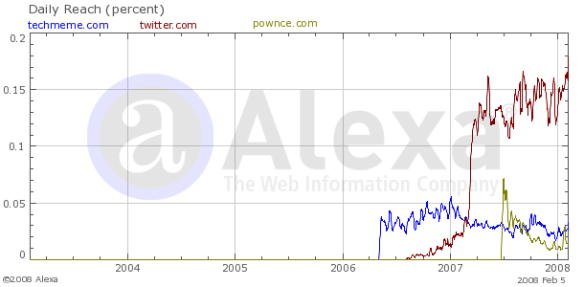
For some time my working hypothesis about new niche tech sites is that they appear to have explosive early growth followed by traffic stability or only slight traffic increases as all the early adopter tech enthusiasts sign on, and other people show little interest.     The following Alexa data really supports this hypothesis:

Alexa Graph

TechMeme is one of my very favorite sites and I know this is true for many others.   I’m surprised TechMeme’s growth seemed to have tapered off so early, but in some ways this makes sense because there are only so many people – a small percentage of all onliners – who are heavily absorbed with the latest buzz from the technology world.    Twitter would have broader interest and appears to be growing still, yet I’m skeptical enough people have time to play the Twitter game to make this a mainstream application.   Pownce is a great application but I think people are unlikely to abandon Twitter for Pownce, and thus Pownce will struggle to grow from an entirely new set of social networking non-twitterers.

Pownce vs Twitter


I’m experimenting with Pownce, on which I’ve had an account for some time but which is now taking off as a social application after public release a few days ago.     So far it seems a lot like a “prettier” twitter with a few more features.   I’ve been very impressed with the way you can import friends and contacts from Gmail, Facebook, Twitter, and many more applications.    I still don’t like the fact that no productive person has enough time to really engage with any of these networks – thus the idea application would be one that would carry me around as I’m online rather than force me to log in and off and participate on the applications terms rather than mine.    MyBlogLog still – for me – offers the best functionality of all of them and now with their new API I think it might be the best platform for our US History and Travel website where we are hoping to build something of a travel community from the many users who just drop in for a bit of info.

Dodgeball vs Twitter


alexa3

Originally uploaded by JoeDuck.

In a recent analysis for TechDirt Insight Community I was looking at mobile social networking. Although Alexa comparisons leave something to be desired this Twitter vs Dodgeball reach comparison is pretty darn striking, and shows how the more “robust” Dodgeball has been crushed by Twitter. My take on what happened with Twitter is simple: Twitter rocked the SXSW conference last year as the key networking application for a large number of “alpha” onliners. This popularity has carried over as mobile networking moved into the techno mainstream.

It’s not clear to me if Twitter – or any similar application – will hit regular folks in the same way only Myspace really has done so far with Facebook as a distant second in total social networking. Myspace’s popularity stands in stark contrast to the way it is largely disparaged in much of the hardcore tech community where people will use Twitter and LinkedIn and to some extent Facebook, but would probably laugh out loud at somebody who asked them to check out their Myspace page.