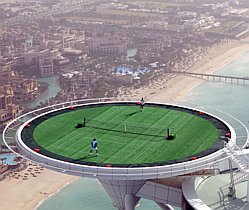
Tennis at the Burj-al-Arab?


Burj-al-Arab

This is one of those real things that at first seems too amazing to believe until you do a little research to confirm that it is in fact a real Tennis Court – the highest in the world.  The Burj-al-Arab is one of the world’s most luxurious and spectacular hotels.   Rooms are $2000 per night unless you opt for a top suite where you can expect to pay some $28,000 per night.

The helipad at the top of the hotel was turned into a tennis court for Andre Agassi and Roger Federer when they were visiting for the Dubai Open.    Amazing.

Hotel Pictures

Burj-al-Arab website

Madonna Rocks the Music


Madonna’s $120,000,000 deal ( Wall Street Journal story) with Live Nation signals a powerful shift in the music industry that hopefully will lead to a cutting out of the middlemen in favor of the best for the artists and for the music consumer.  I don’t follow this industry all that closely but my take on the coming trend is different than most of what I’ve been reading.  It seems to me that over the coming decades we will see music thankfully shifting to a less sensational and more “niche genre” focus.   We’ll see more emphasis on quality music, and perhaps on quality concerts because the human to human aspect of music will not go away anytime soon, and may even be enhanced as artists move to online communities where they can interact with thousands effectively and somewhat intimately.    We’ll see more independent artists who can make an “OK” living thanks to an online global fan base, and this will thankfully come at the expense of the Britney Spears and Madonnas who have been rather spectacular beneficiaries of the giant music marketing empires that made all stars what they are today.  

The idea that individuals are the key component in these things is absurd.  They matter in the big profit and entertainment equations but the key component is generally the huge support system that starts as a small gathering behind promising talent and then blossoms to a cast of hundreds as the promoters step in to “discover” the new talent. 

American Idol’s brilliant model created a huge fan base for the participants as the weeks went on, and many of the top 10 American Idol singers are now doing quite well as actors or singers.   This “social networking” approach will become increasingly important in a music world ruled by the fans and not the big players.

LitLiberation


LitLiberation is a new idea about raising money for charity.   Because of the “prizes” for top fundraisers I was thrown off a bit but when I saw the list of donation folks, which includes Matt Mullenweg and Marc Andressen, and saw the neat way they are having people help build schools in developing countries I thought I’d help point people to this great cause. 

A bit later…. I’m really warming up to this great idea because it is connecting donors to the recipients and I think that is a key thing that has been somewhat lacking in aid, and is one of the reasons it’s hard for people to support US aid projects and other charities where you don’t generally see the results of your contributions.   There is a practical reason for this – my understanding is that NGOs have to spend valuable resources arranging for visits and such.   However I think connecting donors to recipients is a key part of expanding the global reach of charities.

 I have not set up my own donation page but I just gave to this Vietnam “build a school” project  by the founder of the LitLiberation idea, Tim Ferrisshttp://www.firstgiving.com/timferriss

 From LitLiberation: 
…. 30-percent of rural children in developing countries aren’t enrolled in school. As one project, a group of people can choose to build a school for $17,000. When split among 10 friends, it breaks down to $1,700 each or $850 if 20 people contribute.  Those involved will provide education to tens of thousands of children, have their names forever associated with the school, and also enjoy the opportunity to visit it in the future.  

In conjunction with DonorsChoose.org and RoomToRead, Tim Ferriss formed LitLiberation to raise $1 million in 30 days, and in the process, help educate children around the world.

Described as a scalable education revolution, LitLiberation makes it incredibly simple for anyone to fund a specific project in developing countries or support U.S. public schools. It is the first time that anyone can, in five minutes, sign-up as a fundraiser and compete to raise money, winning world-class prizes in the process

Fred Wilson at 30,000 feet – brilliant!


What a GREAT blog post from Fred Wilson as he flew to Portland!  He rapid fires 30 things including his thoughts on the bubble 2.0  (maybe about to pop, maybe not), and most importantly offers up this billion dollar company idea:

 15)    Why hasn’t anyone been able to aggregate all of my comment activity across the entire web and turn it into a feed that I can put into my lifestream on Tumblr? There are a bunch of companies working on it, but I don’t think anyone has nailed it yet. And I am not just talking about blog comments, I am talking about ratings and reviews on Amazon, Yelp, Menupages, Digg, etc, etc.

Fred, I don’t get this either because the technology is definitely in place and although I think this would take a pretty substantial server infrastructure – to cache and search a lot of content regularly – it seems like the payoff would be the best social networking environment out there. 

I’m saving up my money so, someday, I can be a cool VC guy like Fred and ride coach class even though I don’t *have* to ride in coach.  Kudos to him for that.   Frankly, I have a feeling the people back there are more interesting anyway.

TechMeme on … TechMeme


Gabe Rivera’s TechMeme is a favorite info destination for thousands of technology enthusiasts and news junkies all over the world.   However Bobbie Johnson over at the Guardian  has taken a mini-swipe at TechMeme, suggesting that the relative low traffic from the site shows that people are overrating TechMeme’s importance in the scheme of things technological.    

Robert Scoble, in response, has a  great  summary of how he gets very different traffic depending on the source.     Although he does not focus on the *topic*, clearly that matters a lot as well.    Scoble’s blog is influential enough that it would often send more traffic to a linked site than TechMeme.     I’ll have to check my own stats to be sure but I the times I’ve had links from “A list” bloggers like Robert Scoble, Jeremy Zawodny or Matt Cutts  it has sent more traffic than my frequent links at TechMeme – though I have never had a post be a “headliner” at TechMeme.    In fact I don’t think Gabe’s algorithm would allow his “second tier” sites to have featured posts.   My (wild) guess is that TechMeme has at least two lists of blogs/sites, and only sites and blogs on his top tier list can have the posts featured prominently – others are relegated to the comments section even if it’s a more detailed, more linked, or better post.  

I think this “small stable of premier technology sites” may be a potential defect at TechMeme that keeps the Tech echo chamber very loud but not very diverse, though Gabe may have learned that this helps keep irrelevant posts out of the mix.     At SES I was talking with Matt Cutts about how the TechMeme algorithm might work, and how it might be applied to a broader set of blogs as a ranking mechanism.  

Nick Carr jumped on this TechMeme traffic bashing bandwagon suggesting “juicelessness” which is a  cleverly coined phrase but  misleading because TechMeme clearly reaches a lot of key technology folks and that’s a juicier kind of audience in terms of advertising and influence than, say, 16 year old Diggers.  

So, I’m sticking with TechMeme and redict it’ll get bigger and better. 

Information Sharecroppers of the World, Unite ! ?


Update:  I think Nick (and I) may owe Newsvine an apology, because Newsvine does not really practice sharecropping.   The members own their own content and this means a lot more control than otherwise.    Obviously the landscape is complex with any social media but I don’t think I can object to Newsvine’s model.    My concern is where the site takes ownership of the member content.

—-

Nick Carr  has a good post today noting how the Newsvine aquisition, and other deals like this, can lead to some information “sharecropper” dissent.     As I pointed out yesterday social media is a great thing, but it seems to be dramatically failing to fund the very forces that make it a great thing – the hardest working content providers that often form the backbone of these entities.     Kevin Rose is worth tens of millions because tens of millions of diggers work for him – for free.   Sure, he’s smarter than most of his minions and he pulled it all together which means he should get a big digg payday some day, but should he, the founders, and the VC funders get *all* of the money when even they’d all agree that digg is valuable primarily because of all the people that do the digging.

Newsvine was a superb project that was beautifully implemented, but like Nick I wonder how long those who helped make Newsvine such a great site will keep working for nothing.     Is  Web 2.0 simply a new twist on feudal economics?

Social media frenzy may kill high quality content. Somebody fix this!


The news last month that Microsoft may wind up offering Facebook $500,000,000 for a 5% stake is great news … for the tiny number of Facebook insiders who stand to gain from this move which would effectively value the social media giant at about $10,000,000,000.    For the millions of Facebook folks like me who provide the content and faces that drive Facebook it means … um … more advertising.   

Gee, thanks Facebook.   

When people wake up they may start to realize that we’ve got a potential crisis as small numbers of “info intermediators” like Google and Facebook scoop up the lion’s share of the online ocean of cash while the “info creators” are distinctly second class citizens in the big show.   Small time web publishers and mom and pops are in this group.  So are major newspapers like the New York Times and Washington Post and most other print outlets who tend to make relatively little online despite offering much of the web’s best content to date, especially now that the foolish paywalls of some newspaper outlets like NYT are coming down.   Having no paywall will allow them to make more, but it’s not clear to me they’ll make enough to keep all that high quality content coming.  

Print and newspapers are  hurting and that is going to continue.   That’s OK as long as websites and blogs continue to provide great insight and breaking news, but it’s about time the big players in the online world start working *a lot harder* to feed the hands that are feeding them.  It’s about time they realize that the best web ecosystem encourages high quality content and not just socializing for the sake of hanging online with friends.

Yes, it is true that revenue sharing programs like Google adsense give publishers a nice share of revenues that come directly from activity at their websites.  However lost in this debate is the fact that *most* of Google’s money  (and virtually all of Myspaces), goes into the pocket of Google and Fox (owners of Myspace).   This is because most of the cash comes from searches done at Google.com rather than publishing affiliate sites, and Google keeps all that despite the fact it’s generated *indirectly* from the ocean of content Google has categorized.  Sure Google should make *a lot* from categorizing *your content* so effectively, but should they make 100%?   You can argue this arrangement is fine if the big players turn around and do things with that money that make the internet ecosystem thrive and grow in ways it could not without their involvement.  I think that argument was far more valid a few years ago than it is now.  Literally thousands of  startups are dying off as the Youtubes and Facebooks – built squarely on the shoulders of other people’s content  – scoop up the super gigantic big money.    It is not a problem that startups die – in fact it’s a good part of the ruthless evolution of things – but it’s problematic when the lion’s share of online resources from the work of so many are redistributed to so few.    Not because this is “unfair”,  but because this type of  inequity does not lead to optimal system efficiency and growth.

Social media in all its various and sundry forms is a wonderful development.  Finally we see clearly that people, not computers, will be at the heart of future online developments – probably for some time into the future.    Facebook users are now leading the innovation in this area, though Alice at NYT thinks this could lead to unintended consequences.

To protect this new socially charged online environment from the ravages of our silly, stupid and prurient human interests we’ll need better incentives than the big players currently offer to quality content producers.   Those incentives will ultimately shape the quality of online content for years to come.

.travel domains – beware your expirations!


Attention .Travel domain owners!   

If you own a .travel domain you’ll want to make sure you renew it.   Many are coming up for renewal about now due to the auction format that was used to distribute the .travels two years ago.    

It’s still not clear to me if this format is worth the usurous $99 annual registration fee  (compared to about $8 per year for .com, .net, .org, .info, .biz).   However as things shake out one of the ways search engines may determine site legitimacy will be using new barriers to cheap spammy entries, and one of these could be specialized domain names for special niches.  

In any case, if you have a .travel I’d recommend you contact your registrar ASAP.   I use Stargate for my only .travel domain:   “highways.travel”, and their system is making it very hard to renew the .travel even after emails and phone calls and account logins that show no activity pending.     

The Kingdom * * * Quacks


The Kingdom offers one of first blockbuster movies in the “USA vs Terrorists” genre that will  predictably become a mainstay of the box office for years to come.   This was a good action film, though I think it could have toned down the excessive and gratuitous violence in favor of the crime drama and sometimes thoughtful cross cultural tensions that drove the film.     

Hollywood always struggles so much with complex topics, usually with painfully simplistic and superficial results.   The Kingdom is neither an exception to that or the rule, rather it’s a good action film wrapped in an OK cultural clashing motif.

The Kingdom is worth seeing simply for the excellent montage piece at the beginning of the film that very quickly summarizes the rise of Saudi Arabia as a kingdom, a nation state, and a reluctant US ally in the Middle East.

Also, The Kingdom shows that we could quickly end the war on terror simply by using the F word a lot more and then sending Jennifer Garner in to really kick some ass.

The film’s odd final scene will be disparaged by some, but I felt in some ways it rescued the film from treating things too simplistically.