Twitter Gets Search


Twitter has aquired Summize, a search utility that will make Twitter a lot more friendly than it has been if you want to drill down in Twitter results and find more relevant information and people.

Twitter is practically gushing about the aquisition of Summize, so it’s likely that Summize is solving a major problem they have been struggling with for some time.

Here’s the scoop

I’ve been somewhat skeptical in the past that Twitter will ever be much more than a sort of social post it note service, but if they add enough functionality to the existing design Twitter’s huge and influential social network could turn this into the major application that some suggest Twitter could become.    It already seems to me that key folks often prefer microblogging to Facebook or email, though I’m still not convinced that Twitter will catch on with regular folks as it must to compete with Facebook and Myspace.
Twitter, Identi.ca, and the future of the internets


Open source Twitter competitor Identi.ca has had a lot positive buzz and powerful early adopters, but it sure does not feel to me like they’ll have any more luck than Pownce or Plurk has in overtaking Twitter as the microblogging platform of choice.

Some of the challenge is simple convenience – people who are on Twitter are going to be reluctant to spend the (small but annoying amounts of) time needed to sign up new contacts and reconfigure devices.

But mostly I think Twitter just enjoys the big advantage of being the service the introduced a lot of people to the art of posting notes to friends and followers and linking to blogs and articles as you see fit.    I don’t like the term “microblogging” because I think few of the twitter comments rise to the level of a blog post, but clearly this approach is gaining ground and perhaps more widespread appeal than blogging because it requires so little time and effort.

Twitter less?


Seems to me that Twitter is, in fact, a very important issue with far too much discussion about downtime and not enough about why Twitter appears to be replacing blogging, Facebook, and email as the communications paradigm of choice for the digital elites, which often means  the rest of the online world will soon follow.

Twitter’s system failures have become so common that several of the silicon folks like Mike Arrington are suggesting that people should be moving  to other services – most noted is FriendFeed which now allows “room” conversations as a way to sort noise from signal and talk with a group about specific topics.   I think if they’d come along at same time FriendFeed would be winning the war for the hearts and minds of the legions of twitterers, but Twitter has such a foothold as the microblogging / communication tool of choice it’ll be hard to unseat Twitter unless their services fail to improve over the coming months.   Improvement is likely given their recent Venture capital injection which effectively valued Twitter at about 100 million – enough that money will  soon pour in as needed to beef up their shaky infrastructure.

Why is Twitter important?   It’s really a form of A.D.D. blogging – fast and furious with links out to full treatments which can be read only if they really look interesting.  Because Twitter caters to short attention spans and also throws everybody in regardless of laptop color or digital creed, it’s going to keep catching on fast with the business and tech crowd.   I am NOT convinced it’ll be a big hit for grandma or even Nascar dads, who will see Twitter for the time waster it tends to be…

Yikes.. my Twitter Deficit Disorder makes me think a blog post of more than 143 letters won’t generally get read anyway, and makes it harder to write.

Online Abuse Part II: Pownce TOS Violations


Ariel Waldman is a prominent tech blogger and also the community manager at Pownce.  She has ignited a huge online debate about Twitter failing to police a harassing commenter at Twitter, comments that appear to have come from a person who had been harassing her for some time. 

I’ve really been leaning to her point of view though I’d like to see the dialog and I’d like to see the community working harder to make sure this type of abuse is dealt with more harshly.    Ariel seems to think Pownce does a great job here.

However, at Ariel’s own Pownce page commenters are calling Sarah Lacy the C** word, with only a small admonishment from Ariel and no removal of the comment.     Ariel can correctly say that ongoing harassment is a lot more serious than a “one off” insult, but the use of th c**  word plays heavily in her critique of Twitter’s response to her harassment.

The point here is NOT that Ariel is wrong here or that she should be banning everybody at Pownce that uses the c* word, though maybe that is a good idea as you can hardly make a case this noun can’t be replaced with less objectionable material to get any point across.   Ariel presumably has the power to ban comments and/or users as the community manager at Pownce.  

The point is that the community standards *including Ariel’s* are far too low.   Twitter is only a small part of the problem here.   The problem is … all of us, and only all of us can fix this.


WebGuild’s Guide to Twitter


What?  You are not Tweeting like a twittering maniac?    Daya at WebGuild has a nice feature – a guide to Twitter and how to set up and use the messaging and “microblogging” service that has taken the tech world by storm.   In fact Twitter is now as important to many tech folks as blogging because I think it has connected people in a fast, fun, and informal way as well as allow links to blog posts which have more substance.    Although I still prefer blogs because I think they offer more thoughtful, detailed information, Twitter is a far better people connector, allowing people to keep in touch with friends, allowing thousands to “eavesdrop” on conversations, and allowing everybody to participate actively with tech movers and shakers.


Breaking News or Broken News?


This silly Reuters article suggests that a recent Twitter episode suggests that Twitter has  attained some significance as a news mechanism.     I’m a huge fan of Twitter and use it regularly and think it’s representative of a lot of interesting online social trends, but (unlike normal blogging)  Twitter microblogging is hardly a threat to journalism and probably will never be a threat.

The scoop was that Dave Winer asked on Twitter about an “Explosion” in Virginia and the chatter stream (aka Tweets), eventually led to the correct answer – a tiny earthquake in Falls Church VA.     More important than the fact this tiny event was hardly “breaking news”, it was very broken news and probably worried a lot of people until the “explosion” became a tiny rumble.

Again, Twitter is great, but let’s not go stupid here and start thinking Twitter represents a radical restructuring of our information universe.  


TechMeme, Twitter, and Pownce


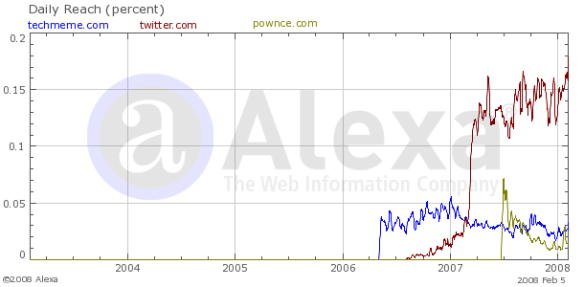
For some time my working hypothesis about new niche tech sites is that they appear to have explosive early growth followed by traffic stability or only slight traffic increases as all the early adopter tech enthusiasts sign on, and other people show little interest.     The following Alexa data really supports this hypothesis:

Alexa Graph

TechMeme is one of my very favorite sites and I know this is true for many others.   I’m surprised TechMeme’s growth seemed to have tapered off so early, but in some ways this makes sense because there are only so many people – a small percentage of all onliners – who are heavily absorbed with the latest buzz from the technology world.    Twitter would have broader interest and appears to be growing still, yet I’m skeptical enough people have time to play the Twitter game to make this a mainstream application.   Pownce is a great application but I think people are unlikely to abandon Twitter for Pownce, and thus Pownce will struggle to grow from an entirely new set of social networking non-twitterers.

Pownce vs Twitter


I’m experimenting with Pownce, on which I’ve had an account for some time but which is now taking off as a social application after public release a few days ago.     So far it seems a lot like a “prettier” twitter with a few more features.   I’ve been very impressed with the way you can import friends and contacts from Gmail, Facebook, Twitter, and many more applications.    I still don’t like the fact that no productive person has enough time to really engage with any of these networks – thus the idea application would be one that would carry me around as I’m online rather than force me to log in and off and participate on the applications terms rather than mine.    MyBlogLog still – for me – offers the best functionality of all of them and now with their new API I think it might be the best platform for our US History and Travel website where we are hoping to build something of a travel community from the many users who just drop in for a bit of info.

Dodgeball vs Twitter


alexa3

Originally uploaded by JoeDuck.

In a recent analysis for TechDirt Insight Community I was looking at mobile social networking. Although Alexa comparisons leave something to be desired this Twitter vs Dodgeball reach comparison is pretty darn striking, and shows how the more “robust” Dodgeball has been crushed by Twitter. My take on what happened with Twitter is simple: Twitter rocked the SXSW conference last year as the key networking application for a large number of “alpha” onliners. This popularity has carried over as mobile networking moved into the techno mainstream.

It’s not clear to me if Twitter – or any similar application – will hit regular folks in the same way only Myspace really has done so far with Facebook as a distant second in total social networking. Myspace’s popularity stands in stark contrast to the way it is largely disparaged in much of the hardcore tech community where people will use Twitter and LinkedIn and to some extent Facebook, but would probably laugh out loud at somebody who asked them to check out their Myspace page.