
Can the long tail wag the big internet dog?


Obviously niches of human interests will be a very powerful force in the shaping of the online world, and it would seem the best way to serve niches, especially a small one, is more along the lines of medium or  small business rather than big biz.  However the mega sites seem to be increasing their share of the action, and are shaping the new access and community tools.

I’m wondering which of the following models, if any, will be most prevalent in the future.  How much will the long tail wag the internet dog ?
Big Corporate Website model:  Yahoo, Myspace, Google, MSN as giant info, tools, purchasing portals, community centers.
Medium Website model:  I see this as content aggregator sites like technorati that serve large niche markets and use Web 2.0 sensibilities to help users slice and dice the overwhelming amounts of online content.

Mom and Pop model:  Local or niche specific info-rich sites where users will spend most of their time researching/buying/socializing.

Obviously there will be all of this and more, but I think the trends are important and it *makes intuitive sense* to me that onliners, especially the next generation, will seek niche specific social interaction that is not handled well by anybody right now.   Big sites mostly lack enough of a human element and sites like Myspace that do have a powerful human element fail to deliver a high quality or info rich experience.

With that in mind I’m off to Silicon Valley to hear 1) pitches from the Search Engine Strategies vendors about how they can get me to the top of the search heap (thanks, but I’ll just take the T shirt for now).  2) Google Party!   Always fun to talk to the search and labs teams there.  They be clever folk.
Opportunity Cost is Knocking


I like to think I’ve got a good intuitive sense of optimizing my investment dollars, but when people ask me how to apply sound investment principles to their potential investments I find it hard to give more than simple equations I do in my head or scratch out on paper. I also caution people to “review your opportunity cost”.

I think the notion of opportunity cost is critical to investment success. Namely, what opportunities from “plan B” investment are you foresaking to invest in plan A?
My favorite investment shortcut is to simply look at the cost of borrowing X dollars vs the expected return on the investment over a very short and a medium term (5-10 year) horizon. If the expected return is close to the cost of the money (or less than that cost which is now about 8% via equity lines) I generally see it as a bad deal.  However, if the expected return is immediate with long term prospects even brighter, such as a rental property with positive cash flow in an appreciating market, then I’m inclined to sign myself up.

Vastly complicating matters are taxes, which vary so much by person, state and circumstance that a great investment for me may be a terrible one for you, and it can even be true that a great investment on December 31 is a poor one on January 1. Due to progressive taxes you need to accurately predict future income (hard) and future tax rates (impossible) to know how all the money will shake out even after a few years.If you are reasonably solvent and can borrow reasonably large sums of money the number of potential investments is enormous, though I generally operate on the assumption that “great investments” are few and far between and bad investments are as common as junk emails. I’m amazed by how many people are sucked into the type of investments (e.g. real estate timeshares) that involve high priced sales staff and expensive pitches, because these generally offer some of the *worst* returns on your money, often even negative returns. Those salespeople need to eat, and in many cases they just ate your lunch. The silly charts that show these as good investments usually avoid the concept of the “present value” of your money (money today is worth FAR more than future money due to interest compounding) and inflate the appreciation rates.

In Hawaii we dragged the kids to a Maui timeshare presentation so I could save $175 on some tickets and I was floored by the intensity of the presentation, which would have included a flight over to Maui had we let it continue (a “free” flight if you bought the timeshare, otherwise we’d have been charged).

We did the same thing in Tennessee timeshares in the Gatlinburg area to save a large amount on Dollywood tix and they were not quite as intense but still had the funny charts which, by ignoring present value and opportunity cost fundamentally distort the investment analysis.

wow, this post got too … long…

Google Party at SES 2006


Tuesday is the 5th annual Google Party in Mountain View at the GooglePlex, one of the biggest social events of the internet year. It’s held in conjunction with the Search Engine Strategies conference at the San Jose Convention Center. I was just down in Silicon Valley about 3 weeks ago for Mashup Camp 2, but I can’t miss the Google Party!

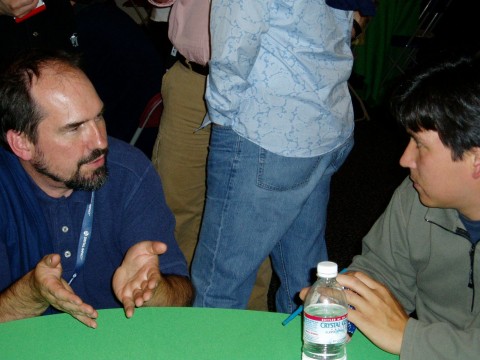
One of the highlights last year was a chance to talk to several of the Google Search Engineers. Here I am pestering Kekoa – I think about 302 vs 301 redirection and ranking items:

Kekoa at Google Party

Matt Cutts is generally in *high demand* at conferences as well as here at the 2005 Google Party webmaster talks, which are held away from the really big crowd outside. In fact in Boston at Webmasterworld he told me he hardly got anything to eat at this 2005 Google bash because he was constantly mobbed.  Thanks to my good friend John for shooting these pix.   He’ll be joining me again this year at the Party.

Matt Cutts at Google Dance 2005

Ringtone Scams and PPC Fraud – why so little outrage?


One of my most read and commented blog posts relates to Ringtone Scams, a scandalous scourge of the internet, with collusion of most of the major phone companies. I’m confident these ringtone scams will soon be making more mainstream headlines.

Along with Pay Per Click fraud, ringtone scams, unlike some other online frauds and deceptions like phishing, have not quite made the big radar screens because they are harder to understand than traditional deceptive business practices such as bait and switch at a store or salespeople lying. In those “storefront” cases you can often confront the scamming salesperson or store directly, a powerful tool lacking in the online world.

What frustrates me is the level of tolerance for these practices, especially in the online community. Very questionable in scope and scale was the recent slap on the wrist of Google for failing to catch what appears to be massive PPC fraud – perhaps as much as a billion dollars per year. Contrary to the claims of all the PPC players much of the fraud could be eliminated with more careful screening and identification of contracted parties in the online transaction. This would eat into profits and therefore has been a low priority, but when as much as 25% of online advertising revenue may be obtained through fraud it’s time to stop expecting advertisers, often unwitting ones, to paying the price. This means the PPC outlets, especially Google who reaps the lions share of PPC profit (and therefore PPC ill gotten gains), should be paying a LOT more attention.

Xbox 360 Table Tennis Review


Part of the deal when we bought my son an XBox 360 was that he get the Rockstar Games Table Tennis Video Game, widely reviewed as a masterpiece of realism.   I’m a regular competitive Table Tennis player and fan and I’m really impressed by how realistic the game is in terms of *watching* the play.  However, since you use controllers rather than paddles much of the play is counterintuitive (e.g. you don’t do anything to hit the ball, rather the controller adjusts for your location, ball placement, and spin.)

I’m glad people will gain more respect for quality Table Tennis, though I doubt much of the viewed skill will transfer to the real game.

My son simply crushes me at the video game.

Ironically this game is made by the same folks who brought the controversial Grand Theft Auto (“GTA”) series of games so wrought with violence and cruelty that they were banned in Australia and have become a poster boy game company for the anti-video game lobby.

No, you can’t shoot or rob your virtual table tennis opponent, though maybe that’ll come in the next version…

Yahoo! Corporate Blog. Believe it or not, it’s cool.


I’m not usually a fan of corporate blogs because they usually suck in that sucky self-serving way, but based on a quick take the Yahoo blog, Yodel Anecdotal (I like it!) is going to be a light hearted view from and of a company filled with very clever people.   I’ll still turn to Jeremy for the unvarnished insider view, but this looks like the place to get a feel for a company that’s breaking a lot of new Web 2.0 ground even though they are not getting nearly enough credit for it. 

Now, if only the Panama team could get their act in gear maybe I’d be right about Yahoo stock potential.

Google Books = Good Google. Adding UC Books = Great!


What I really like about Tim O’Reilly is that he’s almost always …. right.   More importantly he does a fine job of seeing where things are going in our increasingly frantic and complex digital maelstrom.

As a publisher Tim’s insights into the Google scanning controversies are very relevant and over at his blog he’s making a lot of great points about why Google should be cut loose to spread the digital word.

O’Reilly suggests that “Google’s initiative is innovative, useful, and a real boost to an industry that has yet to make significant headway with electronic books….”

Right on O’Reilly.

You call US military spending a bargain? I want my money back.


At a Pentagon news conference I’m watching on TV Don Rumsfeld is explaining to me that with only 3.8% of US Gross Domestic Product going towards military spending nobody should complain since this is lower than back in the good old days of  Mutually Assured Destruction nuclear buildups.

I’m complaining.

Neoconservative hypocrisy regarding Government spending has become far more outrageous than the naivete that continues to characterize liberal notions that Governments are a good environment for the allocation of other people’s money.   They are not, and they have never been.

Political spending, whether in the social or military sectors, is rarely rational spending, and tends to evolve quickly into territorial “feathering of nests”, inefficient allocations, and choices based on conflicting sets of Government priorities. This was well understood by the founders who wanted Government small and taxes low.

Although “fighting terrorism” is a legitimate Government objective, the current approaches are so recklessly expensive it is unlikely they can continue much longer.  Also, military spending does not build infrastructure (often it destroys it), so unless you are truly saving the nation from disaster – a weak argument given the current state of the world  – wasteful military spending has far less favorable impact than, for example, wasteful spending on infrastructure.    However I’m not advocating wasteful liberal spending either.

Alternatives?    Recognize that risk is a part of life, allocate resources rationally, and trust that people will spend their money far more effectively than the neoconservatives have been spending it, or the liberals will spend it when they take control of the bloating corpse of Government spending.

Global Challenges vs Global Warming. An Inconvenient Truth * * *


I finally got to see “An Inconvenient Truth” On the upside I think Al Gore comes off like the fine, sincere, bright fellow he is.    A movie like this around election 2000 would have given Florida, and the Presidency, to Al Gore.   The film’s creative use of graphics and video is also very impressive.  This is educational media used in compelling fashion and all presenters should take note of this approach which cleverly blends animation, video, and lecture.

Unfortunately the fundamental premise of this film – that global catastrophe is looming just around the corner – is misguided and not supported by the science Gore claims he holds so dear.   As the film suggests, global warming is well established and it has become clear that much of that warming is a result of human processes (anthropogenic warming).   However, the film strongly implies that castastrophic sea level rises and weather conditions are “likely” when science says only that they are “possible”.   Many things are possible and it’s very foolish to allocate resources without addressing “how likely is this to happen?”.

The science Gore abuses to support the wild claims comes mostly from IPCC reports which actually suggest that sea levels will probably rise at most a few feet *over the next century*.  The best estimates suggest that global climate change is not creating catastrophic sea level rises and killer storms.

What is certain is that we have many current global catastrophes.  They are the hunger, disease, and bad water supplies that plague hundreds of millions of people on earth right now, killing tens of thousands of people *daily*.

First let’s solve those problems, which are much cheaper and easier to solve than global warming and have much clearer and immediate positive benefits.

Clear thinking people should work towards prioritizing issues of global concern and then solving as many of those significant global concerns as possible given the constraints of money, politics, and human ignorance.  Drive less?  Sure.   Support wise resource use?  Of course.   We should apply common sense principles to all problems and wiser use of resources is important.   It’s just not the world’s most pressing problem.  Not by a long shot.

Rather than simply jump on another alarmist bandwagon of the many that litter the historical landscape I’d hope folks will ask themselves “If I could allocate a billion dollars to solving some global problems, what would be the best use of that money?”

Need a hint? It’s been done here:  Copenhagen Consensus 

Must be Good to be Google


Just in from my “biting the hand that is going to feed me at next week’s Google Party” department:

It must be great to go unchallenged in your sector, especially in the hyper-competitive big money internet extravanza.

Over at WebMasterworld people are doing their usual fawning over the greatness of Google search, this despite the fact that Yahoo and MSN are close in quality according to most objective analyses, that history suggests dominance is often short lived, and that search dominance really does not bode well for anybody except Google.  I posted the following comment over there:

———–
I still use mostly Google out of habit but I predict that Yahoo’s recent move to bring social network and tagging information into the results will be successful and may even land them on top until Google relaxes it’s “no human ranking” approaches.

This thread surprises me as most objective measures indicate that Google  is the best, but not by much and certainly not always best if compared to good vertical search tools.  Habit is driving SE choice, not careful analysis of result sets.

Also, I think there will be legal battles when Vista launches over default search in future versions of IE browsers, MS will win most of them, and Google market share will go down with new users.

Search dominance is not healthy for users or webmasters – this community should recognize that more than most.
——————-